
Deck Railing Ideas: 30 Stylish, Safe and Cheap Options
30 deck railing ideas, from timber and black metal to cable, glass and cheap DIY options, plus US and UK safety rules, a material comparison and maintenance tips.
By Magda Callery, interior designer

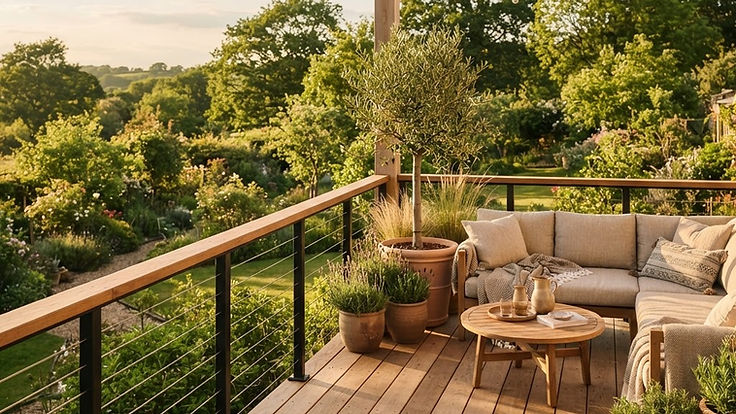
Your deck railing does two jobs at once. It keeps people safe, and it frames the view from your favourite outdoor space. Get it right and your deck feels open, stylish and finished. Get it wrong and you're left with a railing that blocks the view, rots in a few years or, worst of all, fails a safety inspection.
In this guide I'll share 30 deck railing ideas, from classic timber and sleek black metal to glass, cable and clever cheap DIY options. You'll also find a side-by-side comparison of materials, the key safety rules in the US and the UK, a guide to cable railing, budget ideas, maintenance tips and the mistakes to avoid.
Deck Railing Ideas at a Glance
| Railing type | Look | Cost | DIY friendly | Maintenance | Views |
|---|---|---|---|---|---|
| Timber balusters | Classic, warm | Low | Yes | Medium to high | Partial |
| Horizontal timber slats | Modern, natural | Low to medium | Yes | Medium to high | Partial |
| Metal balusters (aluminium or steel) | Clean, crisp | Medium | Yes, with kits | Low | Good |
| Cable railing | Modern, minimal | High | With care | Low to medium | Excellent |
| Glass panels | Sleek, contemporary | Very high | Usually professional | Medium (cleaning) | Best |
| Composite or vinyl | Tidy, uniform | Medium to high | Yes, with kits | Very low | Partial |
| Welded wire or stock panels | Rustic, farmhouse | Low | Yes | Low to medium | Good |
| Decorative metal panels | Statement, design-led | Medium to high | Yes, with kits | Low | Varies |
Safety First: Deck Railing Rules
Before you choose a style, check the rules. Building codes vary by country, state and council, so always check with your local building department or building control before you start. These are the key points.
In the US
According to the International Residential Code (IRC), as summarised by Decks.com:
| Rule | Requirement |
|---|---|
| When a guard is needed | Decks more than 30 inches above the ground |
| Minimum guard height | 36 inches from the deck surface to the top of the rail |
| Gaps | No opening should let a 4 inch sphere pass through, including the gap at the bottom |
| Stairs | The triangle formed by the tread, riser and bottom rail can allow a 6 inch sphere |
| Strength | The top rail must withstand a concentrated 200 lb load |
Some states and towns, including California, require 42 inch guards, so check locally.
In the UK
Approved Document K of the Building Regulations covers protection from falling. Guarding is needed where there's a drop of more than 600mm. For homes, the minimum heights are 900mm for stairs and 1100mm for landings and balconies, and openings shouldn't let a 100mm sphere pass through. Many designers treat a raised deck like a balcony and use 1100mm. Separately, the Planning Portal advises that decking more than 30cm above the ground usually needs planning permission, so check before you build a raised deck.
30 Deck Railing Ideas
Timber deck railings
- Classic square balusters. Simple timber balusters between a top and bottom rail are timeless, affordable and easy to build. Paint them white for a coastal look, or stain them to match the deck.
- Horizontal timber slats. Horizontal boards look modern and suit contemporary homes. Keep the gaps within the rules, and remember that horizontal designs can be easier for young children to climb.
- Mixed timber and metal balusters. Timber posts and rails with slim black metal balusters combine warmth with a crisp, modern look. It's one of the most popular upgrades for older decks.
- A wide top rail. A deep timber top rail, sometimes called a drink rail, gives you somewhere to rest a glass or a plant pot. It's the simplest way to make a basic railing feel bespoke.
- Painted railings. A fresh colour changes everything. Black and charcoal look smart, white feels coastal, and a soft green blends into the garden. My guide to the best green paint colours has shades to inspire you.
Metal deck railings
- Black aluminium balusters. Aluminium is light, strong and won't rust, which makes it a great low maintenance choice. Black balusters almost disappear against the garden.
- Round metal balusters. Round balusters feel softer than square ones and suit both traditional and modern decks.
- Horizontal metal bars. Flat bars or rods running horizontally give a sleek, modern look with excellent views.
- Decorative metal panels. Laser-cut steel panels with botanical, geometric or Moroccan-style patterns turn your railing into a feature, and add some privacy too.
- Wrought iron style. Scrolls, finials and curved balusters suit period homes and traditional gardens.
- Corrugated metal panels. Galvanised corrugated sheets framed in timber give an industrial, farmhouse feel and plenty of privacy.
Cable and wire railings
- Horizontal cable railing. Stainless steel cables strung between sturdy posts give almost unbroken views. It's the most popular choice for decks with a view (see the full guide below).
- Vertical cable railing. Running the cables vertically gives the same airy look while being harder to climb.
- Welded wire mesh panels. Galvanised welded wire panels framed in timber are a budget-friendly way to keep the view open.
- Stock panels. Also known as hog or cattle panels, these heavy wire grids are a popular cheap DIY option with a relaxed, farmhouse look. Frame them well and check the opening sizes against your local rules.
Glass deck railings
- Frameless glass. Toughened glass panels held in a channel or with discreet clamps give the clearest views and a very high-end look.
- Framed glass panels. Glass set in a timber or aluminium frame is a little more affordable and easier to fit. Both need regular cleaning to look their best.
Composite and vinyl railings
- Composite railings. Made to match composite decking, they won't rot, splinter or need painting.
- Vinyl (PVC) railings. A tidy, low maintenance option in white, black and wood-effect finishes, usually sold as easy-to-assemble kits.
Cheap and DIY deck railing ideas
- Metal conduit pipe. Galvanised conduit pipe threaded through or strapped to timber posts is one of the cheapest DIY looks. Add enough runs to keep every gap within the rules; three widely spaced runs won't be safe for children.
- Galvanised pipe and fittings. Plumbing pipe and fittings create a sturdy, industrial railing with a little more character.
- Simple 2x2 balusters. Plain timber balusters are often the cheapest code-compliant railing of all, especially if you build them yourself.
- Refresh your existing railing. Sanding, repairing and repainting an old railing costs a fraction of replacing it.
- Rope accents. Rope looks lovely on a coastal deck, but it isn't a safe barrier on its own. Use it as a decorative detail on a deck that's close to the ground, or alongside a proper guard.
Finishing touches
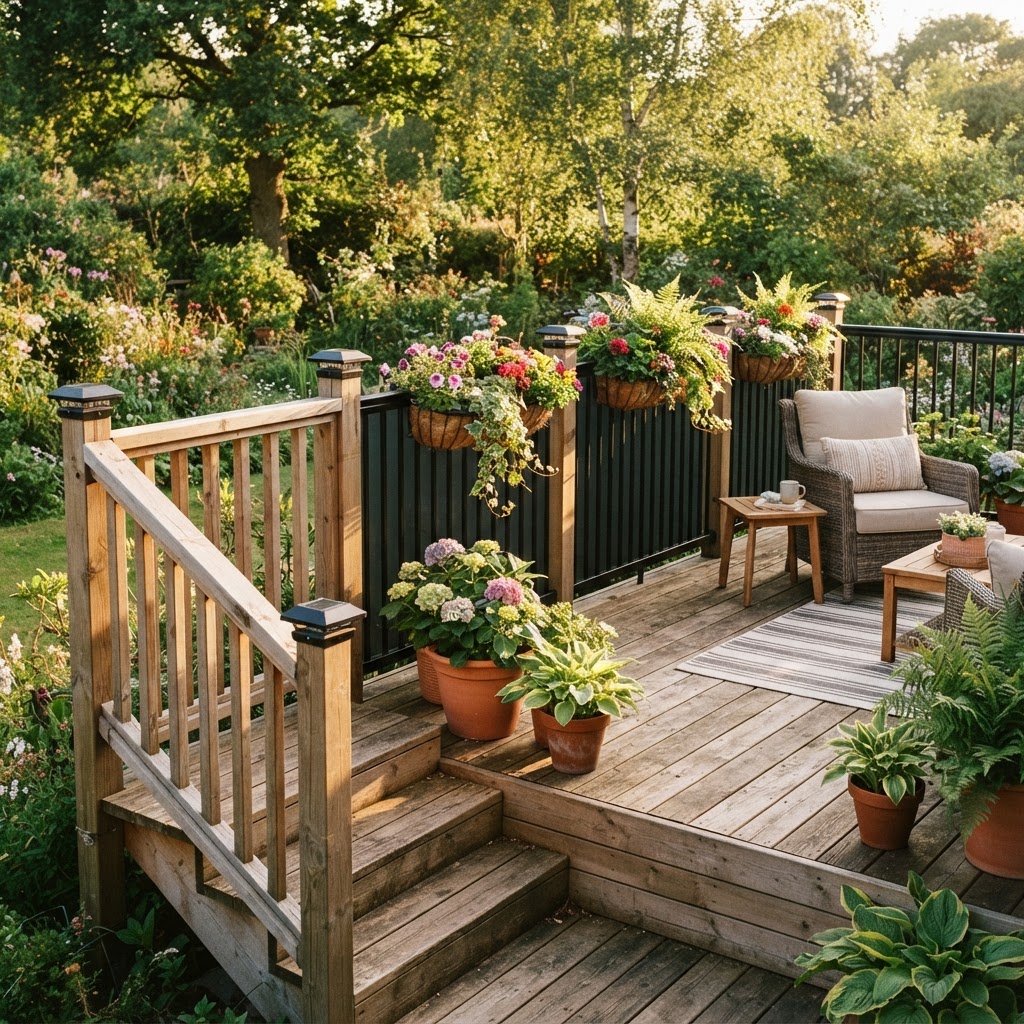
- Built-in planters. Planter boxes along the top rail or between posts soften a railing with greenery. Terracotta pots and trailing plants look wonderful; see my terracotta colour guide for ideas.
- Post cap lights. Solar or low voltage lights on top of the posts make a deck safer and more magical at night.
- Under-rail lighting. LED strips under the top rail cast a soft glow on the deck.
- Privacy screens. Use solid slats, panels or a trellis with climbing plants on one side to block an overlooked view, and keep the open railing where the view is best.
- Built-in benches. A bench along the edge saves space, but a bench next to a railing can help children climb over it. Many designers keep benches away from the guard or raise the guard behind them.
- Seasonal styling. Garlands, lanterns and planters change the mood through the year. My autumn decoration ideas include ideas for outdoor spaces.
A Closer Look at Cable Railing
Cable railing is one of the most searched-for deck railing ideas, and for good reason: it gives you almost uninterrupted views. But it's also one of the most technical to get right.
- Spacing. Cables are typically spaced about 3 inches apart, so that a 4 inch sphere can't pass between them even when the cable flexes.
- Tension. Cables need serious tension, often around 160 pounds each, so check them with a tension gauge and re-tension them periodically.
- Sturdy posts. The tension puts a lot of force on the end posts, so they must be strong, well fixed and often closer together than on a standard railing.
- Materials. Use stainless steel cables and fittings. Near the coast, marine-grade stainless steel resists corrosion best.
- Climbing. Horizontal cables can be climbable for young children. If that worries you, vertical cables or a different infill may be better.
How to Choose the Right Deck Railing
| If you want | Choose |
|---|---|
| The best views | Glass or cable |
| The lowest cost | Timber balusters or DIY conduit or wire panels |
| The least maintenance | Aluminium, composite or vinyl |
| A traditional look | Timber balusters or wrought iron style |
| A modern look | Horizontal slats, cable or black metal |
| Privacy | Solid slats, decorative panels or a screen |
| Safety for young children | Vertical balusters or glass, without climbable horizontal rails |
| A coastal location | Aluminium, composite, glass or marine-grade stainless steel |
Think about your house too. A railing should feel like part of the architecture rather than an afterthought, so echo the colours and materials of your windows, doors and fences. My guide to cheap garden fence ideas shows how to tie the whole garden together.
Cheap Deck Railing Ideas Compared
| Idea | Why it's cheap | Watch out for |
|---|---|---|
| Timber 2x2 balusters | Inexpensive timber, simple to build | Needs regular painting or staining |
| Conduit pipe runs | Low-cost galvanised pipe and straps | Enough runs to meet spacing rules |
| Stock or welded wire panels | One panel covers a long run | Sharp edges, framing and opening sizes |
| Galvanised pipe and fittings | Off-the-shelf parts | Fittings can add up on long runs |
| Repainting an old railing | No new materials | Check for rot and loose posts first |
Deck Railing Maintenance
| Material | Maintenance |
|---|---|
| Timber | Clean, then re-stain or repaint every few years, and check for rot and loose fixings |
| Aluminium | Wash occasionally with soapy water |
| Steel | Check for rust and touch up the coating |
| Stainless steel cable | Re-tension periodically and clean to prevent tea staining near the coast |
| Glass | Clean regularly to remove water marks |
| Composite and vinyl | Wash with soapy water |
Check every railing once a year: push firmly on the posts and top rail, tighten loose fixings and replace anything damaged.
Common Deck Railing Mistakes
- Not checking the rules for height, gaps and strength before building.
- Weak posts. A beautiful infill is no use if the posts wobble. Posts must be fixed securely into the deck structure.
- Gaps that are too big, especially at the bottom of the railing and on the stairs.
- Rope or decorative panels as the only barrier on a raised deck.
- Benches or planters against the railing that let children climb over.
- Choosing a material that doesn't suit your climate, such as untreated steel near the sea.
- Blocking the best view with a heavy, solid railing.
Upcycling and Styling Your Deck
Once your railing is up, the fun part is furnishing the space. Secondhand outdoor furniture, painted planters and reclaimed timber all make a deck feel personal; see my guide to upcycled furniture for ideas. And around Halloween, a deck or porch railing is the perfect place for lanterns and garlands, as I show in my guide to Halloween decorations.
Frequently Asked Questions
What is the cheapest deck railing?
Simple timber balusters are usually the cheapest code-compliant railing, especially if you build them yourself. DIY options such as galvanised conduit pipe or welded wire panels can also be very affordable, as long as the gaps and strength meet your local rules.
How high should a deck railing be?
In the US, the IRC requires guards at least 36 inches high on decks more than 30 inches above the ground, and some areas require 42 inches. In the UK, Approved Document K sets 1100mm for balconies and landings, which many designers use for raised decks.
How far apart should deck balusters be?
In the US, no opening should let a 4 inch sphere pass through. In the UK, the limit is a 100mm sphere. In practice, this means gaps of a little under 4 inches or 100mm between balusters.
Is cable railing up to code?
Cable railing can meet code when it's properly designed and installed. Cables are typically spaced about 3 inches apart and must be tensioned so a 4 inch sphere can't pass through, with strong posts to handle the tension. Check with your local building department, as some areas have extra rules.
Do I need a railing on a low deck?
In the US, guards are required on decks more than 30 inches above the ground. In the UK, guarding is needed where there's a drop of more than 600mm. Even on a low deck, a railing or planters can make it safer and feel more enclosed.
What deck railing gives the best view?
Frameless glass gives the clearest view, followed by cable railing and slim horizontal metal bars.
What is the most low maintenance deck railing?
Aluminium, composite and vinyl railings need the least maintenance, usually just an occasional wash.
Frame Your Outdoor Space
The best deck railing keeps everyone safe, suits your home and frames the view you love. Start with the rules, choose a material that fits your budget, climate and maintenance time, and then add the details that make it yours: planters, lighting and a wide top rail for your morning coffee.
If you'd like help designing your garden, deck or outdoor living space so it flows beautifully from your home, you can book a one-hour online interior design consultation with me. For more ideas, browse my decorating articles.
About the author
Magda Callery is a UK interior designer with more than 15 years' experience designing homes, pubs, restaurants and bars, and her expert commentary has featured in Homes & Gardens, The Mirror and The Spruce. Explore more of the decorating articles.
Continue reading

Colour Psychology of Grey: What It Does to a Room
The colour psychology of grey explained by an interior designer: what the research really says, warm vs cool and light vs dark greys, and how to make grey feel calm, not cold.


Wimborne White Farrow and Ball: A Designer's Guide
Farrow & Ball Wimborne White No. 239 explained by an interior designer: undertone, how it looks in every light, how it compares with Pointing and All White, and what to pair it with.

Can You Reuse Peel and Stick Wallpaper? An Honest Guide
Can you reuse peel and stick wallpaper? Sometimes, but don't count on it. How to remove, store and rehang panels, and clever ways to reuse them.