
Mould on a Leather Sofa: How to Remove It Safely
How to remove mould from a leather sofa without damaging it: telling mould from fatty spew, identifying your leather type, a safe step by step method, what to avoid and how to stop mould coming back.
By Magda Callery, interior designer and florist

Finding white or green fuzzy spots on a leather sofa is unpleasant, especially on a piece you've paid good money for. The good news is that surface mould on leather can usually be removed at home if you catch it early and use the right method. The bad news is that the wrong method, such as bleach, heat or soaking, can damage leather permanently.
I've dealt with mould on leather furniture in everything from damp holiday cottages to pub and restaurant refits, where leather banquettes sit against cold walls all winter. In this guide I'll explain how to tell mould from the harmless white bloom that also appears on leather, how to identify your leather type, a safe step by step method for removing mould, when to call a professional, and how to stop mould from coming back.
Why Does Mould Grow on a Leather Sofa?
Leather is an organic material made from animal hide, and it contains fats, oils and proteins that mould can feed on. Mould spores are always in the air; they only grow when conditions suit them. The main triggers are:
- High humidity. The Canadian Conservation Institute notes that mould growth is promoted by relative humidity between 65 and 100%, warmth and poor air circulation. It says mould will generally grow after two days at 90 to 100% humidity, ten days at 80% and 100 days at 70%.
- Cold external walls. Sofas pushed tight against an outside wall sit in a pocket of cold, damp air where condensation forms.
- Poor ventilation, especially in rooms where washing is dried indoors.
- Storage. Sofas stored in garages, sheds, storage units or under plastic sheeting are classic candidates for mould.
- Spills and body oils. Food, drink and the natural oils from skin and hair give mould extra nutrients, which is why it often appears on headrests and arms first.
- Empty homes. Holiday homes and rooms that are closed up and unheated over winter.
Is It Mould or Something Else?
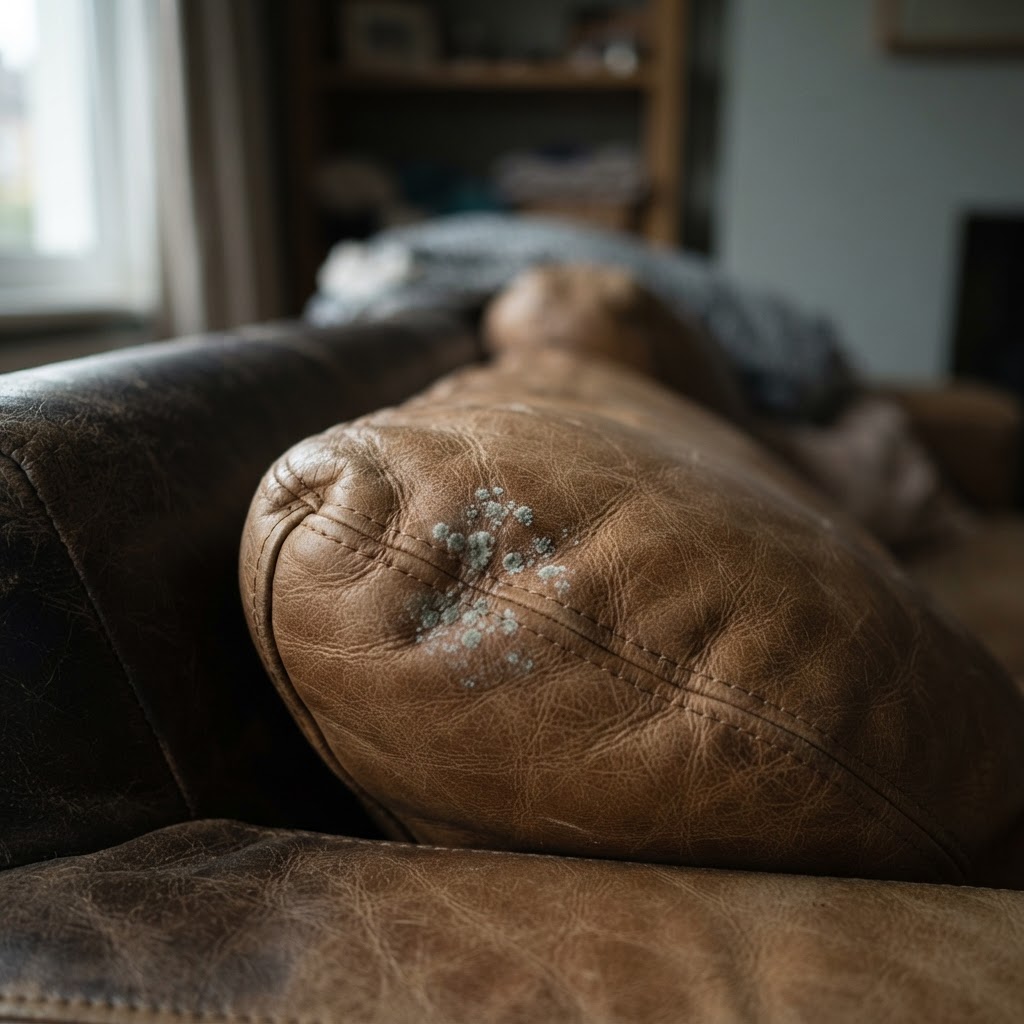
Before you start cleaning, make sure it really is mould. Leather can also develop a white, powdery or waxy bloom, often called fatty spew or spue, when fats from the tanning process migrate to the surface. It's harmless and is treated differently.
| What you see | Likely cause | How to tell |
|---|---|---|
| Fuzzy or powdery white, grey or green spots, often in patches or circles | Mould | Musty smell; spots may spread; often in damp areas or on seams |
| Even, waxy white haze, often across a whole panel | Fatty spew | No musty smell; feels waxy; may melt or disappear when warmed by your hand |
| Black dots that don't wipe away | Established mould staining | Usually in very damp conditions; may have penetrated the leather |
| White tide marks | Water or salt staining | Edges follow the shape of a spill |
The Canadian Conservation Institute suggests a simple test: swab a small, hidden area with a little white spirit and check after about 15 minutes. If the white deposit disappears, it may be wax or fat rather than mould. Its advice is clear, though: "If in doubt, treat as a mould covered object."
Know Your Leather Type First
The type of leather decides how gently you need to clean. Put a drop of water on a hidden area, such as under a seat cushion.
| Leather type | The water test | How to treat it |
|---|---|---|
| Pigmented or protected leather | The drop beads and sits on the surface | Most family sofas; the most forgiving to clean |
| Semi-aniline | The drop sits for a moment, then slowly darkens the leather | Clean gently and test everything first |
| Aniline or nubuck | The drop soaks in and darkens the leather straight away | Very absorbent; I'd call a leather specialist |
| Faux leather (PU or vinyl) | The drop beads | Plastic, not leather; mild soapy water is usually enough |
If you're not sure, check the manufacturer's care label or paperwork, which often states the leather type and approved cleaners.
Safety First
Mould spores can affect your health. The NHS says damp and mould make respiratory problems, infections, allergies and asthma more likely, and advises that babies and children, older people, people with skin conditions such as eczema, people with allergies or asthma, and anyone with a weakened immune system should stay away from damp and mould.
- Wear disposable gloves and a well fitted FFP2 or FFP3 mask, and ideally goggles.
- Work outside on a dry day if you can move the sofa, or open windows and close the door to the rest of the house.
- Keep vulnerable people and pets away while you work.
- Bag and bin cloths you've used, rather than washing them with other laundry.
- Wash your hands thoroughly afterwards.
How to Remove Mould From a Leather Sofa: Step by Step
This method is for surface mould on pigmented and semi-aniline leather. Always test every product on a hidden area first and leave it to dry before you carry on.
What you'll need
- Disposable gloves and an FFP2 or FFP3 mask
- A vacuum cleaner with a soft brush attachment, ideally with a HEPA filter
- Several soft white microfibre cloths
- Mild, pH neutral soap or a dedicated leather cleaner
- Either white vinegar or isopropyl (rubbing) alcohol
- A leather conditioner
- A dehumidifier, if the room is damp
Step 1: Dry the sofa and the room
Mould smears when it's damp. Open windows, run a dehumidifier and let the sofa dry thoroughly before you touch the mould. Don't use a hairdryer, heater or direct sunlight to speed things up, because heat can dry out and crack leather.
Step 2: Vacuum the loose mould
Use a soft brush attachment and let the suction lift the mould rather than scrubbing it in. Vacuum the whole sofa, not just the visible spots, including seams, under cushions and the back and base, as spores spread further than you can see. A vacuum with a HEPA filter traps spores rather than blowing them around the room. Empty the vacuum outdoors afterwards.
Step 3: Wipe with a mild mould treatment
For pigmented leather, mix a gentle solution in a bowl:
- White vinegar and water, in equal parts, or
- Isopropyl alcohol and water, in equal parts.
Dampen a cloth, wring it out until it's barely damp, and wipe the affected area in small sections. Never pour liquid onto leather or let it soak in. Wipe with a clean cloth dampened with plain water afterwards to remove any residue, then pat dry. Both vinegar and alcohol can strip oils and, on some finishes, colour, which is why the patch test matters so much.
Step 4: Clean the whole sofa
Mould treatment only deals with the spots. Clean the whole piece with a mild, pH neutral soap solution or a leather cleaner, following the manufacturer's instructions, so you remove spores and the body oils that feed them, and avoid patchy marks.
Step 5: Let it dry naturally
Leave the sofa to air dry completely in a well ventilated room, away from radiators and direct heat.
Step 6: Condition the leather
Cleaning removes natural oils, so finish with a good quality leather conditioner applied thinly with a soft cloth. Some conditioners contain a mould inhibitor, which is worth looking for if the room tends to be damp.
Step 7: Check again in a week
Look closely at seams, piping and the underside of cushions after a few days. If spots return, repeat the process and tackle the cause of the damp.
What Not to Use on a Leather Sofa
| Avoid | Why |
|---|---|
| Bleach and mould sprays for bathrooms | They can bleach, dry out and permanently damage leather |
| Heat from hairdryers, heaters or radiators | Dries the leather out and can make it crack |
| Soaking or steam cleaning | Water soaks into the hide and padding, which encourages more mould |
| Baby wipes and household wipes | Many contain chemicals that build up on or dry out leather |
| Undiluted vinegar or alcohol | Too harsh; can strip the finish and colour |
| Abrasive pads or stiff brushes | Scratch the finish and push mould into the grain |
When to Call a Professional
Home cleaning works well for small patches of surface mould on protected leather. Call a leather cleaning or restoration specialist if:
- The sofa is aniline, nubuck or suede, or an antique.
- The mould covers large areas or has left black staining that won't wipe away.
- The mould has got inside the cushions or frame, which is likely if the sofa smells musty even after cleaning.
- The sofa has been wet, flooded or stored somewhere damp for a long time.
- Anyone in the house has asthma, allergies or a weakened immune system.
A specialist can deep clean, recolour faded patches and, where needed, replace mouldy foam and padding. If the frame and filling are badly affected, replacing the sofa may honestly be the healthier option.
How to Stop Mould Coming Back
| Prevention tip | Why it works |
|---|---|
| Keep humidity between about 40 and 60% | Mould growth is promoted at 65% and above; a cheap hygrometer lets you check |
| Pull the sofa 5 to 10cm away from external walls | Lets air circulate and reduces condensation behind it |
| Ventilate daily and use extractor fans | Moves moist air out, especially after cooking, showers and drying laundry |
| Use a dehumidifier in damp rooms | Brings humidity down quickly in winter |
| Clean and condition leather every few months | Removes the oils, food and dust that feed mould |
| Never store leather in plastic | Plastic traps moisture; use breathable cotton covers instead |
| Avoid damp garages and sheds for storage | Cold, unheated spaces are classic mould traps |
| Fix the source of damp | Leaks, rising damp and condensation will keep causing mould |
Regular dusting helps more than people think, as dust holds moisture and organic matter, and the same habits that prevent dust in a room also make a sofa less inviting to mould. If you've had mould on the sofa, check other furniture in the room too: wooden pieces often hold on to the same musty smell, and removing a musty smell from wood furniture takes a slightly different approach.
If the damp is coming from the building itself, deal with that first. A damp basement or garage wall may need treating with a masonry waterproofer such as Behr Dry Plus or Drylok before any furniture goes back against it. And if you're planning to keep furniture in a garage, a properly sealed and insulated garage floor makes a real difference to damp.
Mould on Fabric or Faux Leather Sofas
Faux leather (polyurethane or vinyl) is plastic, so mould usually sits only on the surface. Vacuum it, then wipe with warm water and a little washing up liquid, rinse and dry. Fabric sofas are harder, because mould grows into the fibres and padding; removable covers can be washed at the highest temperature the care label allows, while fixed upholstery usually needs a professional clean.
Frequently Asked Questions
Can you get mould off a leather sofa?
Yes. Surface mould on most leather sofas can be removed by drying the sofa, vacuuming the spores, wiping with a mild vinegar or alcohol solution, cleaning the whole sofa and conditioning the leather.
What kills mould on leather?
A diluted solution of white vinegar or isopropyl alcohol, used sparingly on a well wrung cloth, is the most common home method. Always patch test first, as both can affect some leather finishes.
Can I use bleach on a leather sofa?
No. Bleach can discolour, dry out and permanently damage leather.
Why is my leather sofa going mouldy?
Usually because of high humidity, poor ventilation, a cold external wall behind the sofa, or storage in a damp space such as a garage or storage unit.
What is the white stuff on my leather sofa?
It may be mould, or it may be fatty spew, a harmless waxy bloom of natural fats. Mould smells musty and grows in patches; fatty spew is waxy, odourless and often disappears when warmed.
Is mould on a leather sofa dangerous?
Mould can trigger allergies, asthma and respiratory problems, especially in children, older people and anyone with a weakened immune system, so remove it promptly and wear gloves and a mask.
Should I throw away a mouldy leather sofa?
Not necessarily. Small patches of surface mould can be cleaned at home. If mould has spread into the cushions or frame, or the sofa keeps smelling musty after cleaning, it may need professional restoration or replacing.
How do I stop mould growing on my leather sofa?
Keep humidity between about 40 and 60%, ventilate the room, pull the sofa away from cold external walls, clean and condition the leather regularly and fix any source of damp.
A Healthier, Longer Lasting Sofa
Mould on a leather sofa is a warning sign about the room as much as the furniture. Clean it gently, without bleach or heat, condition the leather, and then deal with the humidity and airflow so it doesn't come back.
For more ways to care for your home and furniture, explore the decorating section, and if you're rethinking a damp or awkward room, you can book a one-hour online interior design consultation with me.
About the author
Magda Callery is a UK interior designer and florist with more than 15 years' experience designing homes, pubs, restaurants and bars, and her expert commentary has featured in Homes & Gardens, The Mirror and The Spruce. Explore more of the decorating articles.
Continue reading


What Colour Is Mustard? Mustard Yellow Explained
What colour is mustard? A designer explains mustard yellow: where the name comes from, the shades and hex codes, how to mix it, the colours that go with mustard and how to use it at home.


How to Remove Musty Smell From Wood Furniture
A step-by-step guide to getting rid of a musty smell in old wood furniture and drawers, with the methods that work, what doesn't, mould safety and how to stop it coming back.

Cost of Replacing a Garage Floor: 2026 Price Guide
What it really costs to replace a garage floor in the UK and US, with prices per square metre and square foot, cheaper alternatives, hidden costs and how long it takes.