Boleslawiec Polish Pottery: History, Care and Styling
Everything you need to know about Boleslawiec pottery, from its 600-year history and hand-stamped patterns to quality grades, oven and dishwasher care, and how a Polish designer styles it at home.
By Magda Callery, interior designer and florist
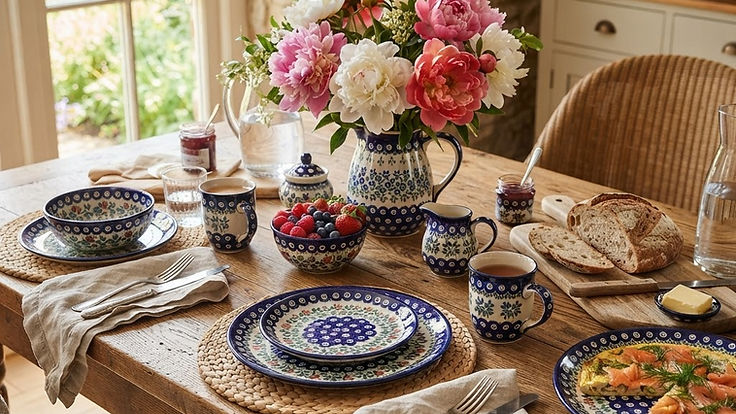
If you've ever seen a mug or a pie dish covered in cobalt blue "peacock eyes", tiny dots and stamped flowers, you've met Boleslawiec pottery. It's one of Poland's best loved exports and a familiar sight in Polish kitchens. Every piece is hand decorated, it's tough enough for everyday cooking, and it brings instant warmth and character to a kitchen.
In this guide I'll explain what Boleslawiec pottery is, where it comes from, how it's made, the most popular patterns, how to tell genuine pieces from imitations, what the quality grades and marks mean, whether it's oven and dishwasher safe, where to buy it, and how I like to style it as an interior designer.
What Is Boleslawiec Pottery?
Boleslawiec pottery is hand-decorated stoneware made in and around the town of Bolesławiec in Lower Silesia, south west Poland. It's often simply called Polish pottery. The pieces are made from local white clay, decorated by hand with small sponge stamps and brushes, glazed and fired at a high temperature, which makes them strong, chip resistant and suitable for the oven.
The town's name is pronounced roughly boh-leh-SWAH-vyets. You'll also see the pottery sold as Bunzlau or Bunzlauer pottery, from the town's German name, especially older and vintage pieces.
| At a glance | Boleslawiec pottery |
|---|---|
| Made in | Bolesławiec and nearby villages, Lower Silesia, Poland |
| Material | Stoneware from local clay |
| Decoration | Hand sponge stamping and brushwork |
| Classic colours | Cobalt blue on a cream white body, often with green, red, yellow or brown accents |
| Most famous pattern | Peacock eye (pawie oczko) |
| Everyday use | Oven, microwave, dishwasher and freezer use is generally fine for first quality pieces |
A Short History of Boleslawiec Pottery
Pottery has been made in Bolesławiec for more than 600 years. The area sits on rich deposits of fine clay, and potters there are recorded as early as 1380. By the 17th century the town was known for bulbous brown-glazed jugs and bottles, and a guild of potters had been formed.
In 1753 the master potter Johann Gottlieb Joppe made the town's most famous piece, the Great Pot, a two-handled vessel about 2.5 metres tall that became a symbol of Bunzlau. The 19th century was a turning point: the potter Johann Gottlieb Altmann developed thinner, finer stoneware and a feldspar glaze that replaced harmful lead-based glazes, and the sponge stamping technique that defines the pottery today took hold. According to the Polish history portal Dzieje.pl, the town then had 15 large potteries exporting their wares across Europe.
The town was German (Bunzlau) until 1945, when it became part of Poland. Polish potters revived the craft after the Second World War, with help from artists at the art academy in Wrocław, and the familiar blue and white folk patterns developed from there. Today several large manufacturers, including Zakłady Ceramiczne Bolesławiec, Ceramika Artystyczna and Manufaktura, and many smaller studios carry on the tradition.
How Boleslawiec Pottery Is Made
- Shaping. Pieces are cast in plaster moulds or thrown, then dried and smoothed by hand.
- First firing. The dried pieces are fired once to make them strong enough to decorate.
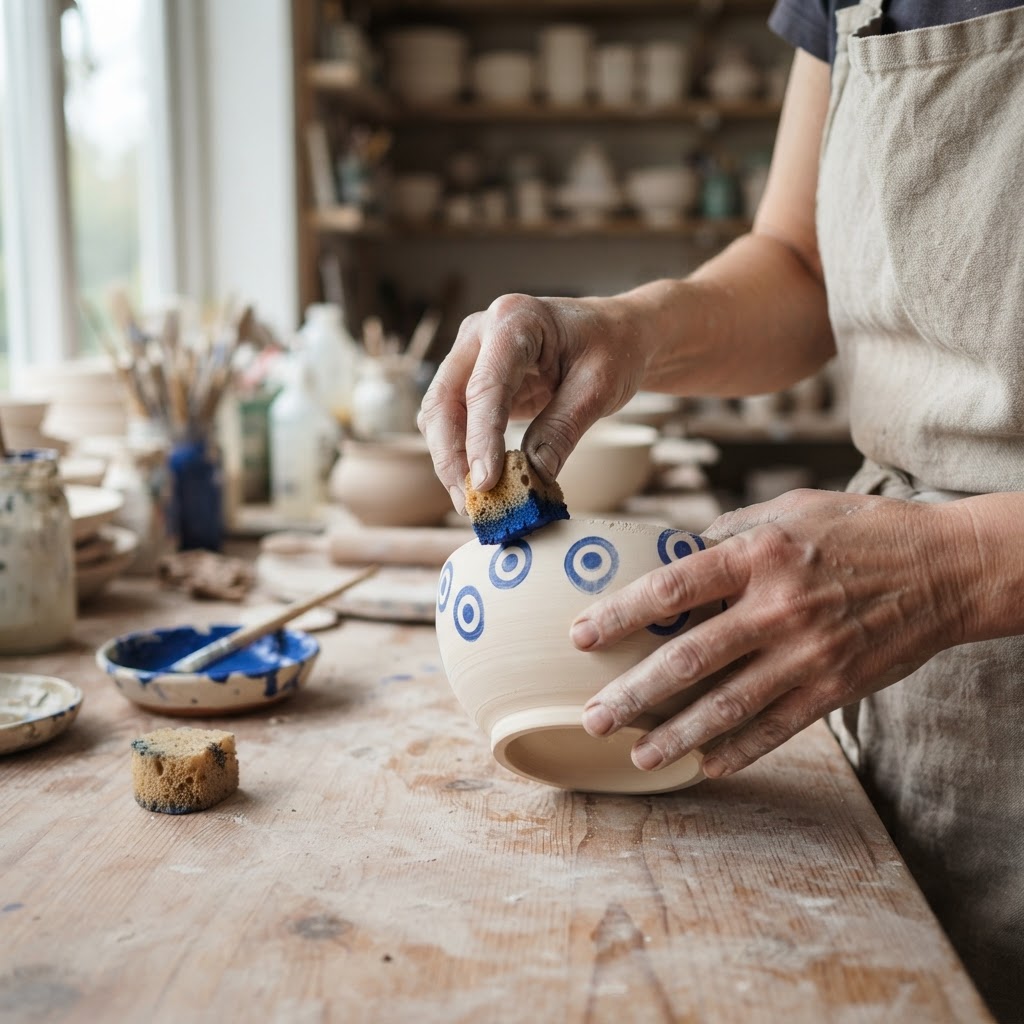
- Hand stamping. Artists dip small hand-cut sponge stamps into paint and press them onto the surface, building up dots, flowers, leaves and peacock eyes. A sponge holds paint well, so an artist can work steadily around a bowl or plate.
- Brushwork. Finer details, such as stems, petals and lines, are painted with a brush. On more elaborate pieces, a single artist may spend hours on one dish.
- Glazing and second firing. The piece is dipped in glaze and fired again at a very high temperature, which fuses clay and glaze into hard, durable stoneware.
Popular Boleslawiec Pottery Patterns
| Pattern | What it looks like | Good to know |
|---|---|---|
| Peacock eye (pawie oczko) | Blue circles with a darker centre, radiating lines and dots, like a peacock's feather | The classic, best loved design |
| Dots and polka dots | All-over small blue or white dots | Easy to mix with other patterns |
| Daisies and flowers | Stamped white or blue flowers, often with green leaves | Pretty and cottagey |
| Bluebells and leaves | Delicate blue flowers and trailing leaves | Soft, romantic look |
| Strawberries and fruit | Red fruit with green leaves | Popular for jam pots and bowls |
| Hearts and folk motifs | Stylised hearts, stars and folk flowers | Lovely for gifts and seasonal pieces |
| Unikat designs | Complex, multi-coloured patterns with fine brushwork | Signed by the artist, and more expensive |
Most manufacturers give each pattern a number, so you can build up a set or match pieces you already own. Many collectors happily mix patterns in the same colour family instead.
Traditional vs Unikat: What's the Difference?
| Traditional | Unikat | |
|---|---|---|
| Decoration | Simpler stamped patterns, often mostly blue | More intricate designs combining stamps and detailed brushwork |
| Colours | Cobalt blue on cream, sometimes with one accent colour | Several colours alongside blue |
| Made by | Often several artisans working on different stages | Usually designed and painted by one artist |
| Marks | "Hand made in Poland" and the factory mark | An extra UNIKAT stamp, the pattern number and the artist's initials or signature |
| Price | More affordable | Higher, reflecting the time and skill involved |
Unikat means "unique" in Polish, and these pieces are the most collectable.
How to Tell if Boleslawiec Pottery Is Genuine
Its popularity means there are plenty of "Polish style" imitations. Genuine pieces share a few tell-tale signs:
- The marks on the base. Look for "Hand made in Poland" and the maker's stamp or logo, usually with "Bolesławiec" in the mark. Unikat pieces also carry the UNIKAT stamp and the artist's initials or signature.
- Hand stamping. Look closely and you'll see slight variations in each stamped motif, tiny overlaps and the soft texture of a sponge print. Printed decals look flat and perfectly identical.
- Weight. Real Boleslawiec stoneware feels solid and fairly heavy for its size.
- The body. Where the clay shows, usually on the base, it's a pale cream or white, not grey or red.
- The quality sticker. New pieces often have a sticker showing the grade, or gatunek.
Quality Grades and Marks Explained
Boleslawiec pottery is sorted into grades after firing, shown on a sticker as "Gat" followed by a number. Stars and Stripes Europe's guide to visiting Bolesławiec's pottery hub sums them up:
| Grade | What it means | Use |
|---|---|---|
| Gat 1 | "the highest quality with no imperfections" | Oven, microwave and dishwasher |
| Gat 2 | "may have a slight painting error" | Oven, microwave and dishwasher |
| Gat 3 and 4 | "may have cracks or glaze problems" | Serving food, hand washed, not heated |
| Gat 5 | "not food safe and should only be used decoratively" | Display only |
Gat 2 pieces are often a bargain, because the flaw is usually a tiny painting slip that you'll barely notice.
Is Boleslawiec Pottery Oven Safe?
Yes. First and second quality Boleslawiec stoneware is generally safe in the oven, microwave, dishwasher and freezer. It's one of the reasons it's so popular for baking dishes, pie plates and casseroles. The main thing to avoid is thermal shock, a sudden change of temperature, which can crack any stoneware.
- Don't move a dish straight from the freezer or fridge into a hot oven. Let it come up to room temperature first.
- Never use it on a hob, under a grill, on a barbecue or over an open flame.
- Don't put a hot dish on a cold or wet surface. Use a wooden board or trivet.
- Add a little liquid to the base of an empty dish when roasting.
- Check the maker's own instructions, as advice on oven temperatures varies.
Is Boleslawiec Pottery Dishwasher Safe?
Yes, Gat 1 and Gat 2 pieces can go in the dishwasher. That said, many collectors hand wash their favourite and Unikat pieces to keep the glaze looking its best for decades. If you do use a dishwasher, avoid harsh, abrasive tablets and don't pack pieces so tightly that they knock together. Grey marks from cutlery can usually be removed with a gentle, non-scratch cleaner or a paste of bicarbonate of soda.
Where to Buy Boleslawiec Pottery
- In Bolesławiec. The town is packed with factory shops and outlets, and buying there is usually the cheapest way to get it. The town also hosts a lively ceramics festival every August.
- From the makers. Several manufacturers sell online and ship abroad.
- Specialist Polish pottery shops. There are dedicated importers in the US, the UK and across Europe.
- Second hand. Charity shops, flea markets and online auctions often turn up pieces, and vintage Bunzlau pottery is collectable in its own right.
If you're planning a trip, Bolesławiec is in Lower Silesia, close to several of the best castles in Poland, such as Czocha and Książ, so it's easy to combine pottery shopping with castle visits.
How Much Is Boleslawiec Pottery Worth?
Prices depend on the size of the piece, the grade, the pattern and whether it's Unikat. Small pieces such as mugs and bowls are the most affordable, while large bakers, teapots and serving platters cost considerably more, and signed Unikat pieces sit at the top of the range. Pieces bought in Poland are usually far cheaper than the same items sold abroad.
Vintage Bunzlau pottery made before 1945, with its brown glazes or early stamped patterns, can be valuable to collectors. If you think you have an old piece, look for the maker's mark and ask a specialist dealer or auction house for a valuation.
13 Ways to Style Boleslawiec Pottery at Home
As a Polish designer, I love using Boleslawiec pottery in modern homes as well as country kitchens. The trick is to let the blue and white pattern work with the rest of the room rather than compete with it.
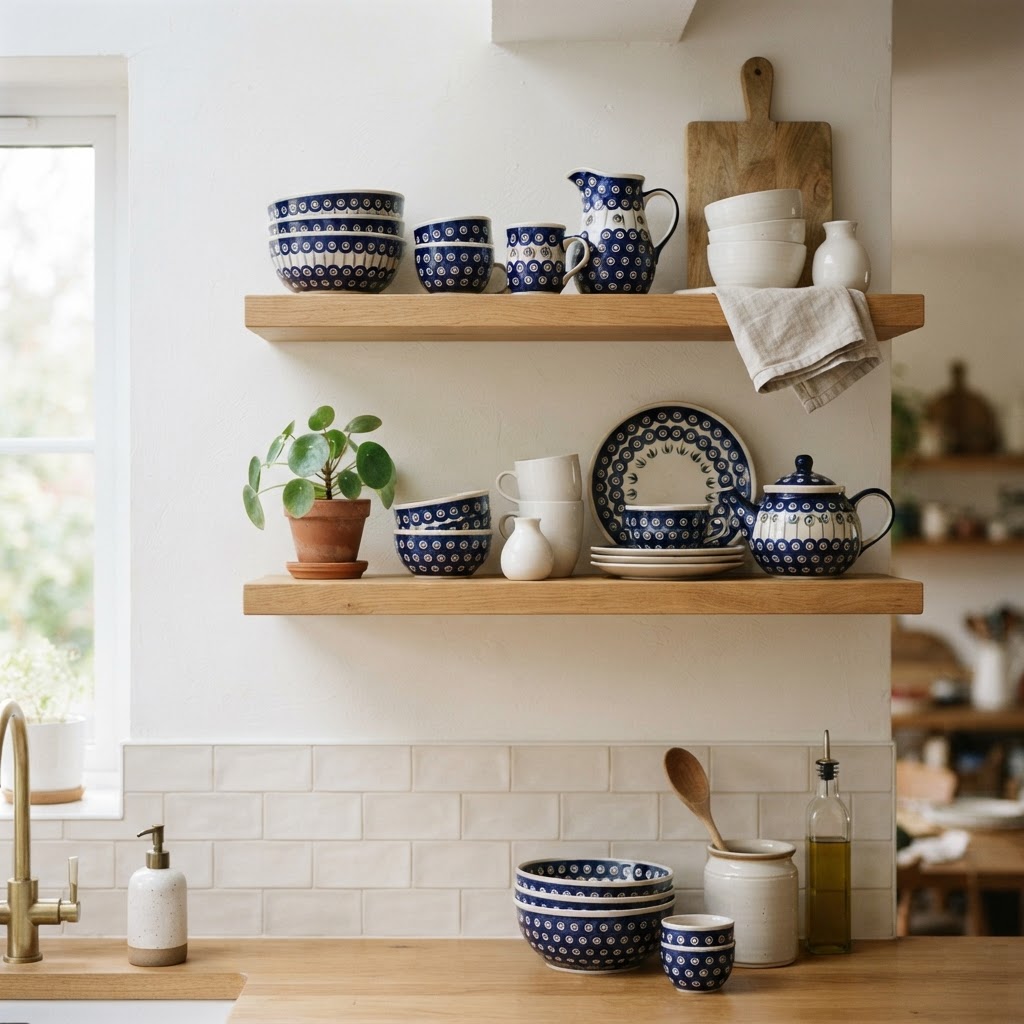
1. Display it on open shelves. A few stacks of bowls and a pitcher on oak shelves look fresh and collected. Mix in plain white pieces so the patterns have room to breathe.
2. Fill a dresser. A painted dresser full of blue and white pottery is a classic for a reason, and it's lovely in a country or farmhouse kitchen.
3. Mix patterns in one colour family. Keep to cobalt blue and white and you can combine peacock eyes, dots and flowers without the look feeling chaotic.
4. Pair it with warm wood. Oak, walnut and pine bring out the warmth of the cream glaze.
5. Contrast it with soft greens. Blue and white pottery looks beautiful against sage green kitchen cabinets or olive walls.
6. Use warm white walls. A soft, warm white makes the blue look crisp without feeling cold. Any of these white paint colours with a creamy base will work.
7. Add terracotta. A touch of terracotta in tiles, pots or textiles gives blue and white a warm, Mediterranean feel.
8. Hang a platter on the wall. A large decorative platter makes simple, inexpensive wall art in a kitchen or dining room.
9. Use pitchers and jugs as vases. A Boleslawiec pitcher filled with garden flowers is pure Polish charm. Peonies are a favourite, and they're at their best in late spring and early summer.
10. Lay a relaxed table. Combine patterned plates with linen napkins, woven placemats and plain glassware for a brunch table that feels special but unfussy.
11. Bring in other Polish crafts. Framed wycinanki paper cuts, linen and carved wood sit beautifully with Boleslawiec pottery, and they're all part of the folk tradition in Polish architecture and design.
12. Keep everyday pieces handy. Store the mugs and bowls you use every day at the front of a drawer or cupboard. It's one of the easiest ways to organise kitchen drawers so they work for you.
13. Edit your collection. A few well-chosen pieces look more considered than every surface covered. Rotate pieces seasonally to keep the display fresh.
Common Mistakes to Avoid
| Mistake | Why it's a problem | What to do instead |
|---|---|---|
| Moving a dish from freezer to hot oven | Thermal shock can crack stoneware | Let it come to room temperature first |
| Using it on the hob or under a grill | Direct heat can crack it | Use it only in the oven or microwave |
| Heating Gat 3, 4 or 5 pieces | They may have cracks or glaze faults | Keep them for serving or display |
| Buying without checking the base | Imitations are common | Look for the "Hand made in Poland" mark |
| Covering every surface with pattern | The room feels busy | Mix in plain white pieces and edit |
Frequently Asked Questions
Is Boleslawiec pottery oven safe?
Yes. First and second quality (Gat 1 and Gat 2) Boleslawiec stoneware is generally oven safe. Avoid sudden temperature changes, such as moving a dish straight from the freezer to a hot oven, and never use it on a hob or under a grill.
Is Boleslawiec pottery dishwasher safe?
Yes, Gat 1 and Gat 2 pieces are dishwasher safe, though many collectors hand wash their favourite and Unikat pieces to protect the glaze.
Is vintage Boleslawiec pottery dishwasher safe?
It's best to hand wash vintage and antique pieces. Older glazes may be more fragile, and very old pieces may have been made before modern safety standards, so use them for display if you're unsure.
Where can I buy Boleslawiec pottery?
The cheapest place is Bolesławiec itself, which has many factory shops. Outside Poland, you can buy from the manufacturers online, specialist Polish pottery shops and second hand sellers.
How much is Boleslawiec pottery worth?
It depends on the size, grade, pattern and whether it's a signed Unikat piece. Mugs and small bowls are the most affordable, while large bakers, teapots and Unikat pieces cost much more. Vintage Bunzlau pieces made before 1945 can be valuable to collectors.
How can you tell if Polish pottery is real?
Check the base for "Hand made in Poland" and a Bolesławiec maker's mark, look for the slight irregularities of hand stamping, and feel the weight: genuine stoneware is solid and heavy.
What does Unikat mean on Polish pottery?
Unikat means "unique". These pieces have more complex, multi-coloured designs, are usually painted by a single artist, and carry an extra UNIKAT stamp with the artist's initials or signature.
A Little Piece of Poland
Boleslawiec pottery is practical, joyful and made to last, and every piece carries the mark of the person who decorated it. Start with a mug or a baking dish, look for the "Hand made in Poland" stamp, and build your collection slowly. It will brighten your kitchen for years.
For more ideas for a warm, characterful home, explore the decorating section, and if you'd like help bringing a little Polish style into your own kitchen, you can book a one-hour online interior design consultation with me.
About the author
Magda Callery is a UK interior designer and florist with more than 15 years' experience designing homes, pubs, restaurants and bars, and her expert commentary has featured in Homes & Gardens, The Mirror and The Spruce. Explore more of the decorating articles.
Continue reading


Edgecomb Gray Review: Benjamin Moore HC-173 Explained
An honest Edgecomb Gray review: what colour Benjamin Moore HC-173 really is, its LRV and undertones, how it looks in different light, how it compares with Revere Pewter, Agreeable Gray and Pale Oak, the best trim whites and coordinating colours.

Is Self Adhesive Wallpaper Any Good? Honest Guide
An honest guide to self adhesive wallpaper: whether peel and stick wallpaper is any good, the pros and cons, where it works and where to avoid it, how it compares with traditional wallpaper, how to apply it and whether it can go over existing wallpaper.

How to Remove Black Mould From Wallpaper Safely
How to remove black mould from wallpaper safely, the right method for vinyl, paper and peel and stick wallpaper, when to strip the paper instead, why wallpaper keeps going black and how to stop mould coming back.