
Polish Architecture: Poland's Most Famous Buildings
From red brick Gothic castles to Zakopane carving, a Polish designer's tour of Polish architecture, its styles, its most famous buildings and how to bring a little of it home.
By Magda Callery, interior designer and florist
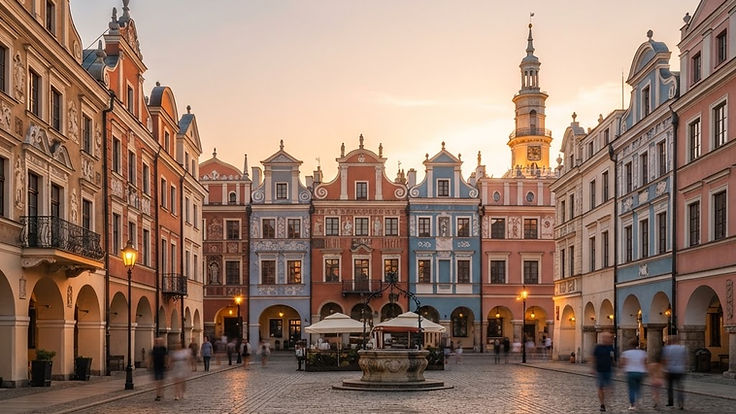
Polish architecture is one of Europe's most underrated stories. In a single country you can walk through red brick Gothic castles built by crusading knights, Italian Renaissance market squares painted in sherbet colours, wooden churches held together without a single nail, whitewashed country manors with columned porches and a carved mountain style invented in Zakopane to give Poland a look of its own. Then there's Warsaw, a capital flattened in the Second World War and rebuilt brick by brick from paintings.
As a Polish designer, this is the architecture I grew up with, and it still shapes the way I think about colour, timber and craft in interiors. In this guide I'll explain the main styles of Polish architecture through the centuries, the features that make it distinctive, 17 famous Polish buildings worth seeing, a few Polish architectural words worth knowing, and how to bring a little Polish style into your own home.
What Is Polish Architecture?
Polish architecture is the architecture of Poland across more than a thousand years, from 10th century Romanesque churches to 21st century glass and steel. It follows the great European movements, Romanesque, Gothic, Renaissance, Baroque, Neoclassical and Modernist, but gives each a local accent: deep red brick in the north, Italian craftsmen in the royal courts, larch and spruce in the mountains, and a strong tradition of folk carving and painting.
Poland's history explains much of it. The country sat at a crossroads of trade between east and west, borrowed builders from Italy, the Netherlands and Germany, disappeared from the map for 123 years after the partitions, and suffered enormous destruction in the Second World War. Its architecture is a mix of grand borrowings, proud national revivals and painstaking reconstruction. If you'd like the wider European picture first, these types of architecture give the background to every style below.
Polish Architecture at a Glance
| Period | Approximate dates | Key features | Famous example |
|---|---|---|---|
| Romanesque | 10th to 13th century | Thick stone walls, round arches, small windows | Collegiate church at Tum, near Łęczyca |
| Brick Gothic | 13th to 16th century | Red brick, pointed arches, tall towers, stepped gables | Malbork Castle |
| Renaissance | 16th to early 17th century | Arcaded courtyards, decorative parapets, colourful townhouses | Wawel Castle courtyard, Zamość |
| Baroque | 17th to 18th century | Curves, domes, rich stucco and gilding | Wilanów Palace |
| Neoclassical | Late 18th to early 19th century | Columns, porticoes, calm symmetry | Palace on the Isle, Łazienki |
| Wooden and vernacular | Medieval to 19th century | Larch and spruce, shingle roofs, carved details | Wooden churches of southern Lesser Poland |
| Zakopane style | 1890s to 1910s | Carved pine, steep roofs, Highland folk motifs | Villa Koliba, Zakopane |
| Art Nouveau and Young Poland | c. 1890 to 1914 | Flowing lines, stained glass, floral motifs | Palace of Art, Kraków |
| Modernism | 1910s to 1930s | Concrete, clean lines, ocean liner curves | Centennial Hall, Wrocław; interwar Gdynia |
| Socialist realism | 1949 to mid 1950s | Monumental scale, stone facades, classical details | Palace of Culture and Science, Warsaw |
| Contemporary | 1990s to today | Glass, steel, bold sculptural forms | Szczecin Philharmonic |
Polish Architecture Through the Centuries
Romanesque: where it begins
Poland's first stone buildings arrived with Christianity in 966. Very little survives intact, but the twin-towered collegiate church at Tum near Łęczyca, with its massive stone walls, and the carved Romanesque columns of the Holy Trinity Church in Strzelno give a vivid sense of how solid and fortress-like these early churches were. Under Wawel Hill in Kraków you can still see the foundations of early rotundas and the crypt of St Leonard, part of the Romanesque cathedral that came before today's.
Brick Gothic: red castles and soaring churches
Gothic is where Polish architecture really finds its voice, especially in the north, where there was plenty of clay and little building stone. The result is Brick Gothic: deep red walls, pointed arches, stepped gables and towers that dominate the skyline.
The greatest example is the castle of the Teutonic Knights at Malbork, the largest castle in the world by land area. UNESCO describes the Castle of the Teutonic Order in Malbork as "A particularly fine example of a medieval brick castle", a 13th century fortified monastery that was "substantially enlarged and embellished after 1309, when the seat of the Grand Master moved here from Venice."
Other highlights include the medieval town of Toruń, birthplace of Copernicus, where Gothic churches, granaries and merchants' houses line the streets; St Mary's Church in Gdańsk, one of the largest brick churches in the world; and St Mary's Basilica in Kraków, whose two unequal towers rise over the main square. Every hour a trumpeter plays the hejnał from the taller tower, breaking off mid-note, and inside is Veit Stoss's carved wooden altarpiece, completed in 1489 and one of the finest Gothic altarpieces in Europe.
Renaissance: Italian craftsmen and painted squares
In the 16th century the Jagiellonian kings brought Italian architects to Kraków, and the Renaissance arrived in style. The arcaded courtyard of Wawel Castle, three storeys of elegant galleries, and Sigismund's Chapel in Wawel Cathedral, built by the Florentine Bartolomeo Berrecci with a gilded dome, are often described as the purest Renaissance architecture north of the Alps.
Poland then developed its own twist: the Polish parapet, or attyka. This tall decorative wall along the top of a building hides the roof behind a crown of pinnacles, arches and carved masks. You can see it on the Cloth Hall (Sukiennice) in Kraków's main square, rebuilt after a fire in 1555, and on the merchant houses of Kazimierz Dolny on the Vistula.
The most complete Renaissance vision is Zamość, founded in 1580 by the chancellor Jan Zamoyski and laid out by the Italian architect Bernardo Morando as an "ideal town". Its arcaded market square, colourful townhouses and town hall with a sweeping fan-shaped staircase make it one of the loveliest squares in Europe, and it was added to UNESCO's World Heritage List in 1992.
In Gdańsk, the influence came from the Netherlands rather than Italy. The tall, narrow gabled houses, the Golden House and the Neptune Fountain on the Long Market give the city a Dutch Mannerist elegance quite unlike the south.
Baroque: palaces and domes
Baroque arrived with the Counter-Reformation and the royal court. Wilanów Palace in Warsaw, the summer residence of King Jan III Sobieski, the victor of the Battle of Vienna in 1683, is often called the Polish Versailles. It's one of the few royal residences to survive the partitions and the Second World War largely intact, and its painted facades, gardens and interiors are a joy.
Across the country you'll also see bulbous Baroque helmets crowning church towers, and churches such as Saints Peter and Paul in Kraków, with its row of apostle statues along the front.
Neoclassical: the last king's Warsaw
Stanisław August Poniatowski, the last king of Poland, was a great patron of the arts, and the calm, columned Neoclassical style is his legacy. His Palace on the Isle in Łazienki Park, Warsaw, a former bathhouse remodelled by Domenico Merlini in the late 18th century, sits on the water surrounded by gardens, an amphitheatre and peacocks. Warsaw's Grand Theatre and many columned country manors followed in the same spirit.
Wooden architecture: churches without nails
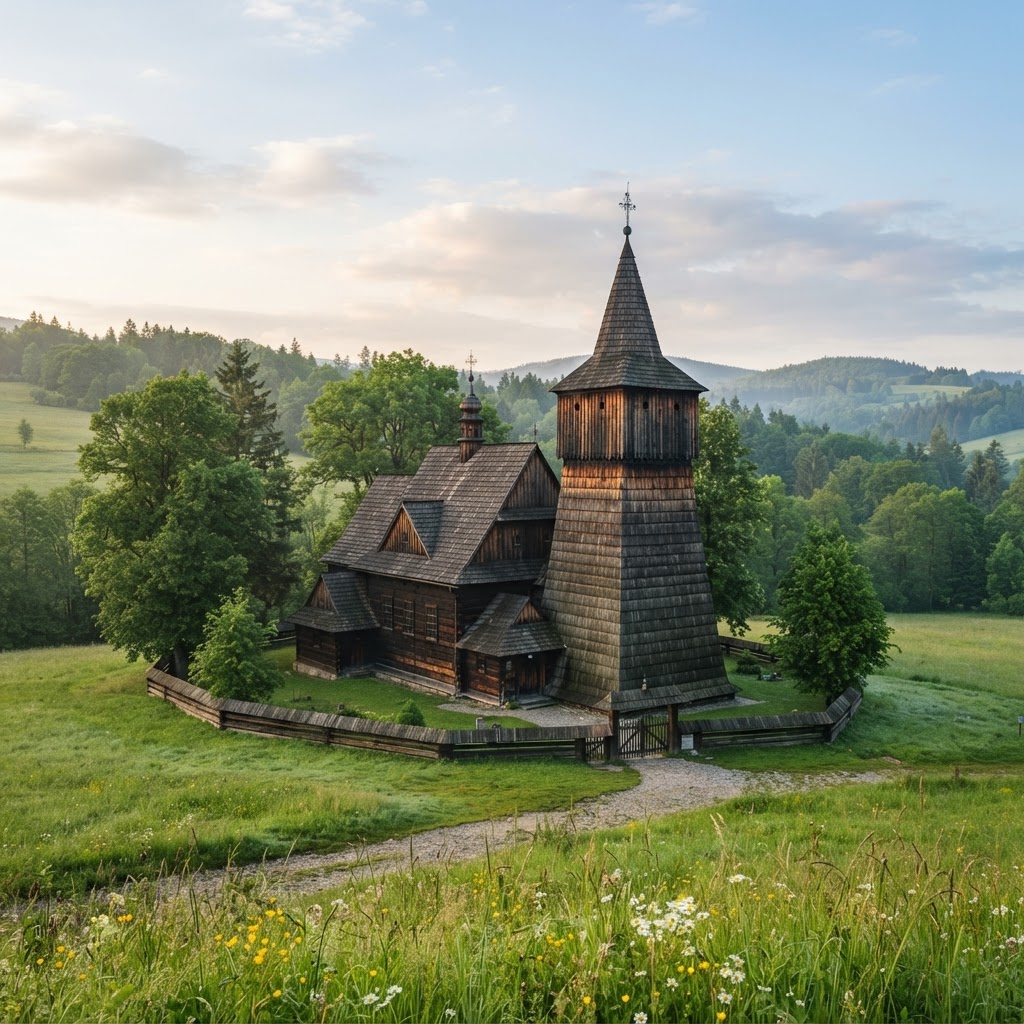
For me, this is the heart of Polish architecture. In the villages of the south, generations of carpenters built churches, bell towers, cottages and granaries from larch, fir and spruce, joined with wooden pegs and covered in hand-split shingles.
The wooden churches of southern Lesser Poland are on UNESCO's list, including St Michael the Archangel in Dębno, with its painted stencilled interior, and the church in Haczów, one of the largest and oldest Gothic wooden churches in Europe. The wooden tserkvas of the Carpathians, Orthodox and Greek Catholic churches with tiered domes, are inscribed jointly with Ukraine.
Then there are the remarkable Churches of Peace in Jawor and Świdnica, built for Lutherans in Silesia in the mid-17th century. They were only allowed to use wood, clay and straw, and to build outside the city walls, yet UNESCO calls the Churches of Peace "the largest timber-framed religious buildings in Europe." Inside, galleries rise in tiers, and the Baroque decoration is breathtaking.
The dwór: the Polish manor house
The dwór is the home of the Polish gentry and a national symbol in its own right. A classic dwór is single storey, whitewashed, with a columned porch at the front, a tall shingled or broken roof, and lime trees and an orchard around it. Its role was much like the English manor house: the centre of a rural estate rather than a fortress. The manor annexe at Żelazowa Wola, where Chopin was born in 1810, captures the spirit beautifully.
Zakopane style: a national style from the mountains
At the end of the 19th century, when Poland didn't exist as a state, the painter and critic Stanisław Witkiewicz set out to create a truly Polish architecture. He found it in the wooden cottages of the Podhale Highlanders around Zakopane, at the foot of the Tatra Mountains.
His first Zakopane style building, Villa Koliba, was built in 1892 and 1893 by local carpenters. The Tatra Museum, which now runs it as the Museum of Zakopane Style at Villa Koliba, calls the style "the first theoretically wrought and successfully effected concept of a Polish national style", created as an answer to the Swiss and Tyrolean chalets then fashionable in the resort. It was also short lived: "The Koliba villa opens the brief history of the Zakopane Style, which lasted barely twenty years."
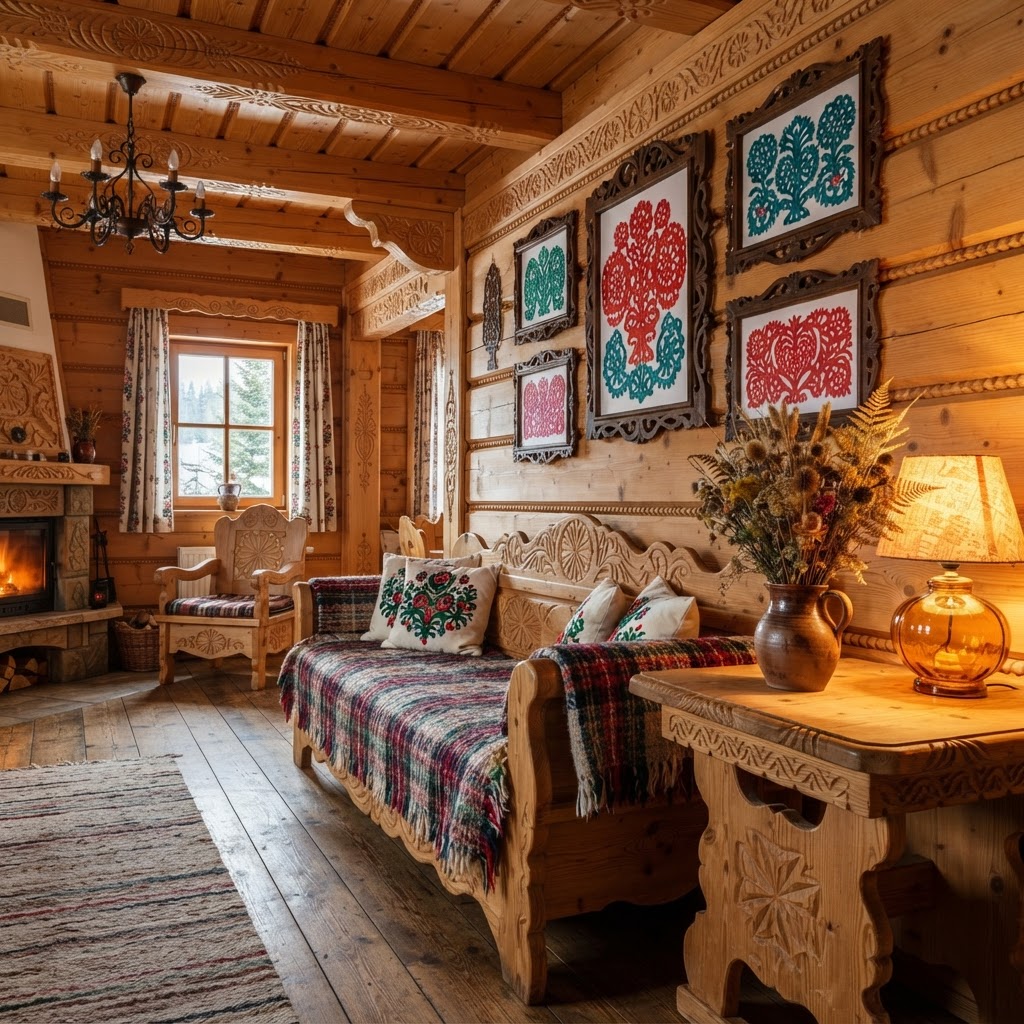
Look for steep, shingled roofs, log walls, deep carved eaves, sun motifs (słoneczka), stylised thistles and lilies, and furniture carved to match the house. Witkiewicz's later chapel at Jaszczurówka, near Zakopane, is a small masterpiece of the style.
Art Nouveau and Young Poland
Around 1900, Kraków became the centre of Young Poland (Młoda Polska), the Polish answer to Art Nouveau. The artist Stanisław Wyspiański designed extraordinary stained glass windows for the Franciscan Church in Kraków, and the Palace of Art on Szczepański Square was built for the Society of Friends of Fine Arts. Flowing lines, flowers and folk motifs ran through architecture, furniture and decoration, in much the same spirit as the Art Nouveau details found in Edwardian interiors in Britain.
In industrial Łódź, wealthy textile families built red brick factories and lavish Art Nouveau and eclectic villas. Izrael Poznański's vast factory complex is now Manufaktura, a shopping, arts and leisure quarter.
Modernism: concrete and ocean liners
Centennial Hall in Wrocław (then the German city of Breslau), designed by Max Berg and built between 1911 and 1913, was a pioneering reinforced concrete building with one of the largest domes of its time, and it is now a UNESCO World Heritage Site.
After independence in 1918, Poland embraced modernism with energy. The port city of Gdynia, built almost from scratch in the 1920s and 1930s, is full of white modernist buildings with rounded corners and porthole windows inspired by ocean liners. Warsaw's interwar districts, such as Saska Kępa and Żoliborz, have elegant modernist villas too.
Socialist realism: the Palace of Culture
After the Second World War, Poland came under Soviet influence and the official style became socialist realism: monumental, symmetrical and decorated with "national" details. The most famous example is Warsaw's Palace of Culture and Science, a gift from the Soviet Union built between 1952 and 1955. At about 237 metres including its spire, it was the tallest building in Poland for decades, and its Polish parapets were copied from Renaissance towns such as Kraków and Zamość. Kraków's Nowa Huta, a planned socialist town begun in 1949, and the MDM district in Warsaw are other striking examples.
Rebuilding Warsaw
During the Warsaw Uprising of 1944 and the destruction that followed, the city's historic centre was almost completely destroyed. After the war, it was rebuilt with extraordinary care, using surviving fragments, pre-war drawings and the detailed 18th century views of Warsaw painted by Bernardo Bellotto. The Historic Centre of Warsaw was added to the UNESCO World Heritage List in 1980 as an outstanding example of near total reconstruction, and walking through its Old Town Market Square today, it's hard to believe it isn't original.
Contemporary Polish architecture
Since 1989, Polish architecture has become bold and confident again. Some of the most admired buildings include:
- The Szczecin Philharmonic by Barozzi Veiga, opened in 2014, a glowing white glass building whose pointed roofs echo the city's old gables. It won the EU Prize for Contemporary Architecture, the Mies van der Rohe Award, in 2015.
- POLIN Museum of the History of Polish Jews in Warsaw, by the Finnish architects Lahdelma and Mahlamäki, opened in 2013, with a glass facade split by a dramatic curving hall.
- The European Solidarity Centre in Gdańsk, opened in 2014, clad in rusted steel that recalls the hulls of ships built in the neighbouring shipyard.
- The Silesian Museum in Katowice, built on the site of a former coal mine, with most of its galleries underground beneath glass pavilions.
- Krzywy Domek, the Crooked House in Sopot, completed in 2004, a playful building that looks as though it's melting.
- Varso Tower in Warsaw, by Foster and Partners, completed in 2022. At 310 metres including its spire, it's the tallest building in the European Union.
What Makes Polish Architecture Distinctive?
- The Polish parapet. The decorative attyka crowning Renaissance buildings is a uniquely Polish feature.
- Arcaded market squares. Every historic town has a rynek, often with arcades, a town hall and colourful townhouses around it.
- Red brick Gothic. Northern Poland's castles and churches are some of the finest brick buildings anywhere.
- Master carpentry. Wooden churches, bell towers and Zakopane villas show centuries of skill in timber.
- Colour. Painted facades, sgraffito decoration and folk painting bring warmth, even in grey winters.
- Reconstruction. Warsaw, Gdańsk and Wrocław were rebuilt after the war, and their old towns are as much about memory as about architecture.
17 Famous Polish Buildings
| Building | City | Style | Built | Why it's famous |
|---|---|---|---|---|
| Wawel Royal Castle | Kraków | Gothic and Renaissance | 14th to 16th century | Royal seat with a Renaissance arcaded courtyard |
| St Mary's Basilica | Kraków | Brick Gothic | 14th to 15th century | Two unequal towers, the hourly hejnał and Veit Stoss's altarpiece |
| Cloth Hall (Sukiennice) | Kraków | Gothic and Renaissance | Rebuilt after 1555 | Polish parapet in the heart of the main square |
| Malbork Castle | Malbork | Brick Gothic | 13th to 15th century | The largest castle in the world by land area |
| Old Town Hall | Toruń | Brick Gothic | Late 14th century | Centre of a perfectly preserved medieval town |
| St Mary's Church | Gdańsk | Brick Gothic | 1343 to 1502 | One of the largest brick churches in the world |
| The Crane (Żuraw) | Gdańsk | Gothic | 15th century | A medieval port crane and city gate |
| Town Hall | Zamość | Renaissance and Baroque | Late 16th century | The fan-shaped staircase of an "ideal town" |
| Wilanów Palace | Warsaw | Baroque | From 1677 | Summer residence of King Jan III Sobieski |
| Palace on the Isle | Warsaw | Neoclassical | Late 18th century | The last king's palace on the water |
| Church of Peace | Świdnica | Timber-framed Baroque | 1656 to 1657 | Among the largest timber-framed churches in Europe |
| St Michael the Archangel | Dębno | Wooden Gothic | Late 15th century | Painted interior in a larch shingled church |
| Villa Koliba | Zakopane | Zakopane style | 1892 to 1893 | The first building in Poland's national style |
| Centennial Hall | Wrocław | Early modernism | 1911 to 1913 | A pioneering reinforced concrete dome |
| Palace of Culture and Science | Warsaw | Socialist realism | 1952 to 1955 | Warsaw's most recognisable, and most debated, landmark |
| Krzywy Domek | Sopot | Contemporary | 2004 | The Crooked House on Monte Cassino Street |
| Szczecin Philharmonic | Szczecin | Contemporary | 2014 | Winner of the 2015 Mies van der Rohe Award |
Polish Architecture Words Worth Knowing
| Polish word | Meaning |
|---|---|
| Rynek | Market square, the heart of every historic town |
| Ratusz | Town hall |
| Kamienica | Townhouse, usually a tall, narrow building with shops below and flats above |
| Attyka | The decorative parapet crowning a Renaissance building |
| Dwór | Manor house of the gentry |
| Zamek | Castle |
| Cerkiew | Orthodox or Greek Catholic church |
| Sukiennice | Cloth hall, a covered market for cloth merchants |
| Chata | Cottage or hut, especially a wooden one |
How to Bring Polish Style Into Your Home
You don't need a wooden villa in the Tatras to enjoy Polish design. These are the details I love using in interiors, and they sit beautifully alongside both cottage and modern schemes.
- Carved and natural timber. Pine, larch and oak with visible grain bring the warmth of a Zakopane interior, in the same way that Japanese house design celebrates natural wood. A pale, limed finish keeps it fresh, and it's easy to whiten wood on old pine furniture.
- Wycinanki. These traditional paper cutouts are wonderful framed as art. The Łowicz style is layered and colourful, while the Kurpie style is a single colour with a symmetrical tree or bird.
- Bolesławiec pottery. Hand-stamped blue and white stoneware from Lower Silesia looks lovely on open shelves or a dresser.
- Painted flowers. In the village of Zalipie, women paint their cottages, inside and out, with bright flowers. A hand-painted cupboard, headboard or border is a joyful nod to it.
- Linen and wool. Polish linen, woven kilims and Highland wool blankets add texture and comfort.
- Folk colours. Red, green, cream and deep blue are classic. For a softer look, choose earthy shades such as terracotta and olive green.
- Garden flowers indoors. Peonies are a favourite in Polish gardens, and a jug of them, at their best in late spring and early summer, on a carved table feels instantly Polish.
Where to See Polish Architecture
- Kraków: Wawel, the main square, St Mary's Basilica, the Cloth Hall and the Young Poland churches.
- Warsaw: the rebuilt Old Town, Wilanów, Łazienki, the Palace of Culture and the new skyline.
- Gdańsk: Dutch-style gabled houses, St Mary's Church, the Crane and the European Solidarity Centre.
- Toruń and Malbork: the best of Brick Gothic, easily combined in one trip.
- Zamość: the Renaissance "ideal town".
- Zakopane and Podhale: Villa Koliba, Jaszczurówka and the wooden churches.
- Wrocław: the market square, Centennial Hall and the Church of Peace at nearby Świdnica.
Frequently Asked Questions
What is Polish architecture known for?
Polish architecture is known for red Brick Gothic castles and churches, Renaissance market squares with decorative parapets, wooden churches, the Zakopane style and the remarkable post-war reconstruction of Warsaw's Old Town.
What is the most famous building in Poland?
Wawel Royal Castle in Kraków, Malbork Castle and Warsaw's Palace of Culture and Science are probably the best known. St Mary's Basilica in Kraków is also one of the most visited.
What is Zakopane style?
Zakopane style is a national architectural style created by Stanisław Witkiewicz in the 1890s, based on the wooden cottages of the Podhale Highlanders. It features steep shingled roofs, log walls and rich carving, and Villa Koliba was the first building in the style.
What is a Polish parapet?
A Polish parapet, or attyka, is a tall decorative wall along the top of a Renaissance building that hides the roof behind arches, pinnacles and carved details. The Cloth Hall in Kraków is a famous example.
Why was Warsaw's Old Town rebuilt?
It was almost completely destroyed in 1944. After the war, Poles rebuilt it using surviving fragments, drawings and Bernardo Bellotto's 18th century paintings, and it was added to the UNESCO World Heritage List in 1980.
What is the tallest building in Poland?
Varso Tower in Warsaw, completed in 2022, is the tallest at 310 metres including its spire, and it's also the tallest building in the European Union.
A Country Built by Craftsmen
Polish architecture is a story of craftsmanship and resilience: Italian masons and Highland carpenters, kings and merchants, and a nation that rebuilt its capital from paintings. Whether you visit Kraków's main square or simply hang a framed wycinanka in your hallway, there's something in it for everyone who loves beautiful buildings.
For more on architecture and interiors, explore the interior design section, and if you'd like help bringing a touch of Polish character into your own home, you can book a one-hour online interior design consultation with me.
About the author
Magda Callery is a UK interior designer and florist with more than 15 years' experience designing homes, pubs, restaurants and bars, and her expert commentary has featured in Homes & Gardens, The Mirror and The Spruce. Explore more of the interior design articles.
Continue reading

Pink and Green Room Ideas: 21 Fresh Ways to Style It
21 pink and green room ideas for living rooms, bedrooms, nurseries, kitchens and bathrooms, plus which pinks go with which greens, paint colours to try and how to keep a pink and green room looking grown up.

How to Organize Kitchen Drawers: 19 Clever Ideas
How to organize kitchen drawers in 7 simple steps, which drawer should hold what, the best drawer organizers, and 19 clever ideas for shallow, deep and IKEA kitchen drawers, plus how to keep them tidy for good.

Contemporary Wallpaper for Living Room: 19 Modern Ideas
19 contemporary wallpaper ideas for a living room, from grasscloth, plaster and fabric-effect textures to painterly abstract murals, modern geometrics and muted botanicals, plus modern colour palettes and how to style the room.