
Edwardian Interior Design: Colours, Features and Ideas
A designer's guide to Edwardian interior design: what makes it different from Victorian style, the key features to keep, the Edwardian colour palette, furniture, lighting and room by room ideas for modern living.
By Magda Callery, interior designer and florist

Edwardian homes are some of the most loved houses in Britain, and for good reason. They're wider, lighter and more generous than their Victorian neighbours, with deep bay windows, wide hallways, high ceilings, tiled paths and porches, and some of the prettiest fireplaces and stained glass ever made. I've worked on a number of them over the years, and the best Edwardian interiors are the ones that work with that light and those details rather than against them.
In this guide I'll explain what Edwardian interior design is, how it differs from Victorian style, the key features to look for and keep, the Edwardian colour palette, furniture, lighting and textiles, room by room ideas, and how to give an Edwardian house a modern update without losing its character.
What Is Edwardian Interior Design?
Edwardian interior design is the style of decorating that flourished during the reign of King Edward VII, from 1901 to 1910. Many historians and estate agents stretch the period to 1914 and the outbreak of the First World War, because houses kept being built in the same way until then.
It sits between two very different worlds. On one side are the dark, crowded rooms of the late Victorians; on the other, the clean lines of the interwar years. Edwardian rooms took the best of what came before, simplified it and let the daylight in. Three big influences shaped the look:
- The Arts and Crafts movement, with its love of honest materials, handmade furniture and nature-inspired patterns.
- Art Nouveau, with its flowing lines, tulips, lilies and whiplash curves, seen in fireplace tiles, stained glass and light fittings.
- A revival of 18th century elegance, which brought back lighter Georgian and Sheraton-style furniture, delicate mouldings and paler colours.
New technology mattered too. Electric lighting was spreading through wealthier homes, ready-mixed paints became affordable, and indoor bathrooms became far more common in new middle class houses. Edwardian houses were often built in the new suburbs and "garden suburbs" such as Letchworth Garden City, founded in 1903, and Hampstead Garden Suburb, founded in 1907, with front gardens, wider plots and more space between houses.
Edwardian vs Victorian Interiors
The two are often confused, especially in terraced streets where building styles overlap. These are the differences I look for.
| Victorian (1837 to 1901) | Edwardian (1901 to about 1914) | |
|---|---|---|
| Light | Darker rooms, smaller windows, heavy curtains | Bigger windows, wider bays, lighter rooms |
| Colours | Deep reds, rich greens, browns and plums | Creams, soft greens, pale blues, pinks and lilac |
| Woodwork | Often dark stained or grained | Increasingly painted white or cream |
| Pattern | Dense, heavy, everywhere | Lighter, with botanical Arts and Crafts and Art Nouveau motifs |
| Furniture | Heavy, ornate, dark mahogany | Lighter oak, inlaid Sheraton-style pieces, rattan and wicker |
| Layout | Narrow hallways, smaller rooms | Wider hallways, squarer rooms, higher ceilings |
| Overall feel | Formal and crowded | Brighter, airier and more relaxed |
A designer's tip: if your hallway is wide enough for a hall chair and a radiator without feeling cramped, your windows are generous and your ceilings feel higher than a typical Victorian terrace, there's a good chance your house is Edwardian. If you're unsure, the date on the deeds or your local council's records will settle it, and it helps to see how both periods fit into the wider story of British architectural styles.
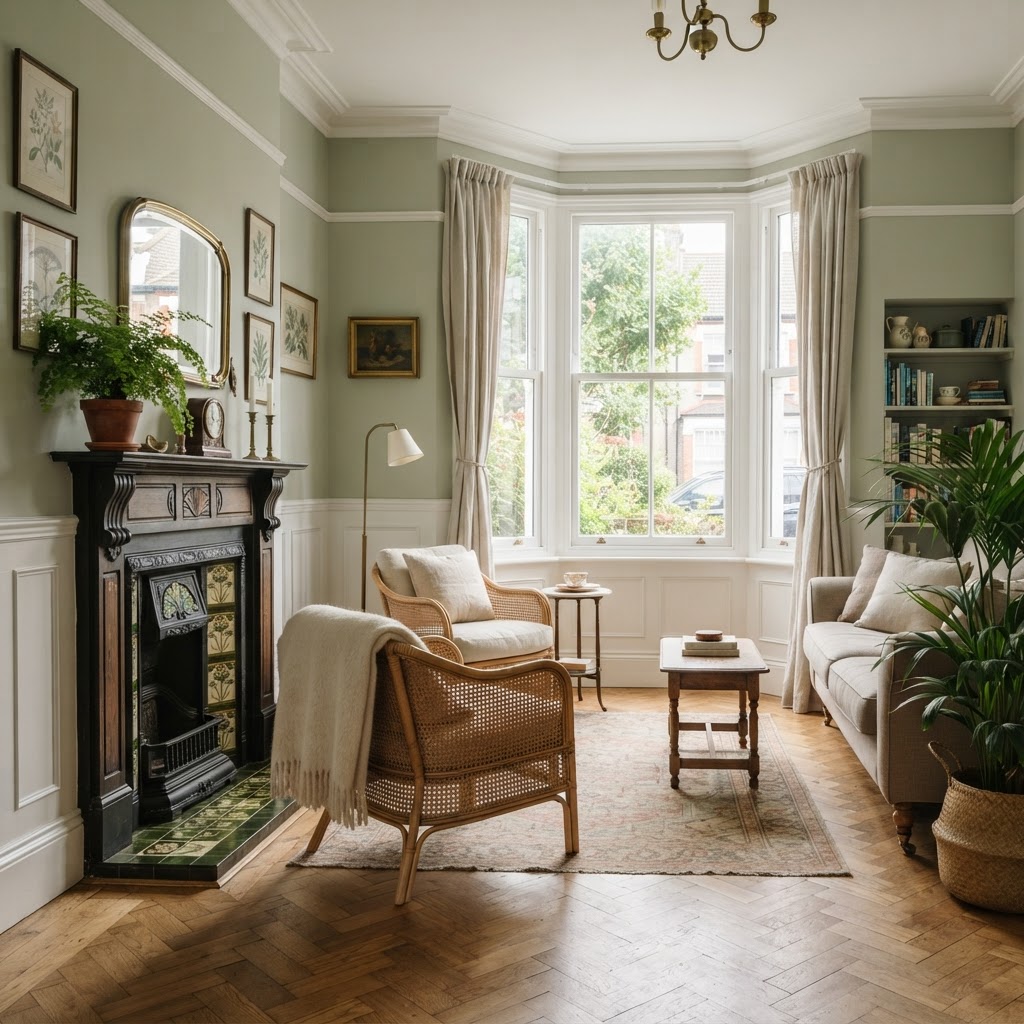
Key Features of Edwardian Interiors
These are the details that make an Edwardian house special. If you have them, keep them, restore them and design around them.
Wide hallways and tiled floors
Edwardian hallways are generous, and many still have their original geometric or encaustic tiled floors in terracotta, cream, black and blue. Clean them gently with a pH neutral cleaner rather than anything acidic, and plan the rest of the hall around their colours. The warm reds of those tiles look wonderful with the terracotta shades that are so popular again.
Stained glass
Coloured glass panels in front doors, fanlights, porch windows and internal doors are one of the joys of the period, often with Art Nouveau tulips, birds or simple geometric leading. They throw beautiful coloured light across a hallway in the morning.
Picture rails, dado rails and panelling
Edwardian walls were usually divided. A picture rail sat around 30 to 50cm below the ceiling, with a frieze above it, and many halls and dining rooms had a dado rail around a metre from the floor, sometimes with panelling or embossed paper below. Painting the frieze and ceiling the same pale colour makes a room feel taller, while a stronger colour below the dado grounds a hallway and hides scuffs.
Fireplaces
Edwardian fireplaces are smaller and lighter than Victorian ones. Look for slim cast iron inserts with tiled side panels, often decorated with tube-lined Art Nouveau flowers, set in a painted or oak surround, sometimes with an overmantel mirror above.
Parquet and timber floors
Wood block parquet became fashionable in better rooms, while ordinary floorboards were often stained around the edges with a large rug in the middle. Restored parquet or sanded boards with a generous rug are the most authentic choices today, and the right living room rug does a lot to soften high-ceilinged rooms.
Bay windows and high ceilings
Big bays with sash windows bring in far more light than Victorian windows did. Keep window treatments light so you don't lose it: unlined linen curtains, simple Roman blinds or café shutters across the lower half for privacy.
Plaster details
Ceiling roses and cornicing are usually simpler and more delicate than in Victorian houses, often with garlands, ribbons or gentle Art Nouveau curves. Don't paint them in thick layers of modern emulsion; soft distemper or a breathable matt paint keeps the detail crisp.
The Edwardian Colour Palette
Edwardian colours were lighter and fresher than anything the Victorians used. Think of the colours of an English garden in early summer, softened with white.
| Colour family | Typical Edwardian shades | Where to use them today |
|---|---|---|
| Creams and off whites | Warm creams, stone and soft ivory | Ceilings, friezes, woodwork and whole rooms |
| Greens | Sage, eau de nil, pale olive and moss | Living rooms, halls and below the dado |
| Pinks | Dusty rose, soft plaster pink and blush | Bedrooms and drawing rooms |
| Blues | Duck egg, powder blue and soft grey blue | Bedrooms, bathrooms and accents |
| Lilac and mauve | Soft lavender and heather | Bedrooms and Art Nouveau details |
| Yellows | Primrose, straw and soft buttercup | Sunny morning rooms and kitchens |
White and cream painted woodwork was one of the big changes of the period, and it's still the simplest way to give a room an Edwardian feel. A soft, warm white such as Farrow & Ball's Wimborne White works beautifully on skirting boards, picture rails and ceilings in a north facing Edwardian room. For walls, the muted sage and olive greens that have been so popular in recent years are almost exactly the shades Edwardian decorators loved.
If you'd like something with more depth for a dining room or study, deeper Arts and Crafts tones such as a rich mustard yellow, deep green or soft terracotta feel right for the period without slipping into heavy Victorian gloom.
Wallpaper and Pattern
Pattern didn't disappear in Edwardian homes; it simply became lighter. Popular choices included:
- Arts and Crafts botanicals, with willow boughs, birds, fruit and climbing flowers in the spirit of William Morris and C.F.A. Voysey.
- Art Nouveau designs, with stylised tulips, lilies, irises and flowing stems.
- Delicate stripes and small florals, inspired by the Georgian revival.
- Embossed papers such as Lincrusta and Anaglypta below the dado in hallways and dining rooms, because they're hard wearing and easy to paint.
A good modern approach is to choose one patterned element per room: a wallpapered frieze above the picture rail, a papered wall behind the bed, or patterned curtains with plain walls.
Edwardian Furniture
Edwardian furniture is lighter, more delicate and more comfortable than Victorian pieces.
| Style | What it looks like | Where it works |
|---|---|---|
| Sheraton revival | Slender legs, satinwood or mahogany with fine inlaid lines and marquetry | Dining rooms, bedrooms and halls |
| Arts and Crafts | Solid oak, simple lines, visible joints, hammered copper handles | Living rooms, studies and kitchens |
| Rattan, cane and wicker | Light, airy chairs and tables | Conservatories, bay windows and bedrooms |
| Bentwood | Curved steam-bent chairs | Kitchens and dining rooms |
| Upholstered club and wing chairs | Deep, comfortable seating with turned legs | Living rooms and studies |
You don't need a house full of antiques. One good period piece, such as an inlaid display cabinet, a bureau or a small Edwardian writing desk in a bay window, sits happily alongside modern sofas and beds.
Lighting, Textiles and Plants
Lighting. Electric lighting was new and exciting, and Edwardian fittings show it off: pendant lights with frilled or tulip-shaped glass shades, brass picture lights and Art Nouveau wall lights. Reproduction fittings are easy to find, and a mix of pendants, wall lights and table lamps suits the high ceilings far better than a single overhead light.
Textiles. Chintz, linen, lace panels, velvet cushions and Persian or Arts and Crafts rugs all feel right. Keep curtains lighter than Victorian drapes; the point of those big windows is the light.
Plants and flowers. Ferns, palms and aspidistras in jardinières were part of every Edwardian parlour, and sweet peas, roses and lilies were the fashionable flowers of the day. As a florist, I love a simple jug of garden roses or sweet peas on a mantelpiece in an Edwardian room, and decorating with fresh flowers is one of the easiest ways to bring a period room to life.
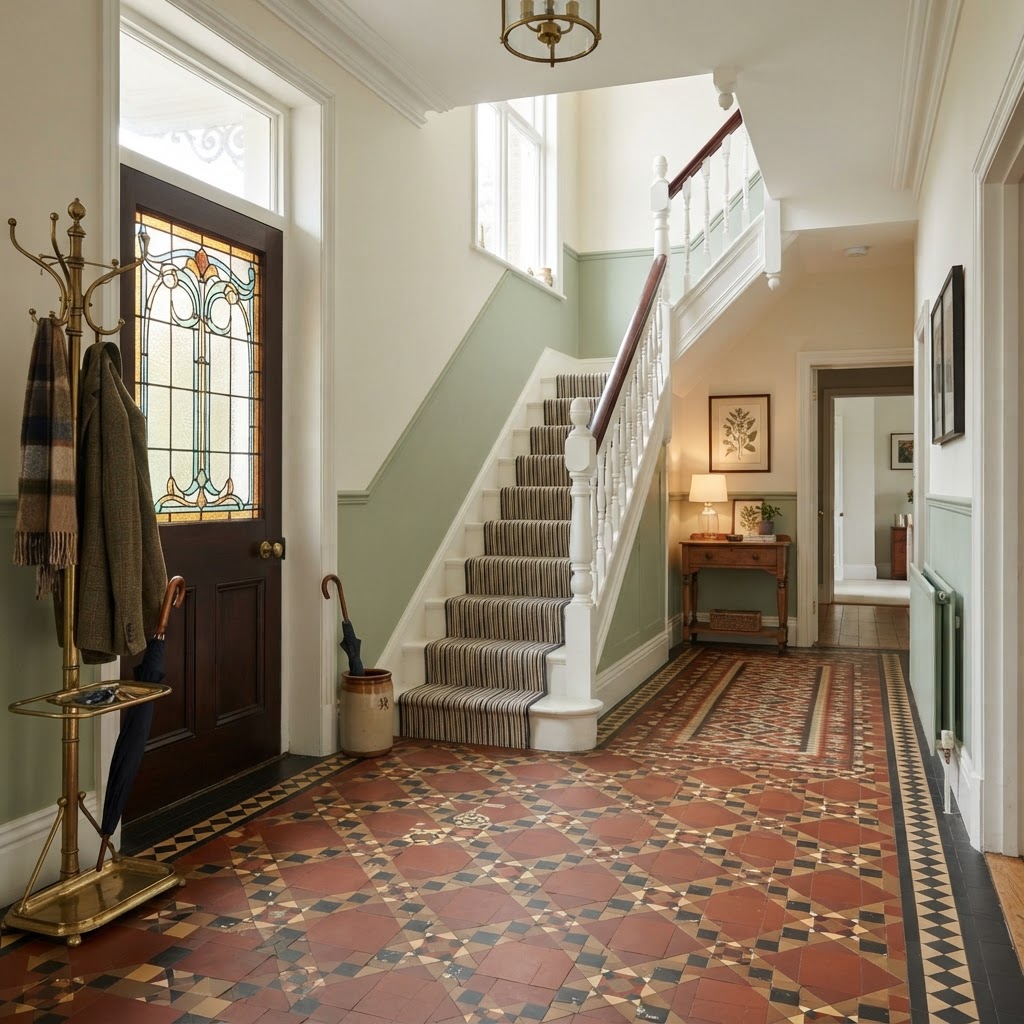
Edwardian Interior Design Ideas Room by Room
Hallway
Make the tiled floor the star. Paint the walls below the dado in a soft green, grey green or warm stone that picks up a colour from the tiles, and keep the walls above and the staircase light. Add a runner on the stairs, a hall stand or slim console table for keys and post, and a mirror to bounce light from the stained glass. Many Georgian hallway ideas translate well here too, as both periods prize symmetry and good proportions.
Living room
Arrange seating around the fireplace and the bay. Paint walls in a soft green, pink or cream with white woodwork, restore the fireplace tiles, and use the picture rail for its original purpose: hanging paintings on brass hooks and chains is practical and instantly authentic. A pair of armchairs in the bay is the classic Edwardian layout.
Dining room
Edwardian dining rooms were often the most decorated room in the house, so this is the place for a deeper colour, a patterned paper or panelling below the dado. A round or oval table, a sideboard and a pendant light hung low over the table complete the look.
Kitchen
Original Edwardian kitchens were service spaces, so there's no need for a period copy. In-frame painted cabinets, a butler's sink, wooden worktops, a dresser and white glazed tiles laid in a brick pattern all sit comfortably in an Edwardian house, while still giving you a modern kitchen.
Bedroom
Soft blues, pinks and lilacs, a cast iron or brass bed or an upholstered headboard, a small fireplace, floral or striped wallpaper and a wicker chair give a light, restful Edwardian bedroom.
Bathroom
Edwardian bathrooms brought us the roll top bath, the high level cistern and the pedestal basin. Black and white mosaic floors, white wall tiles, a chrome or nickel shower and a washstand all feel authentic.
How to Modernise an Edwardian House Without Losing Its Character
- Keep the original features that give the house its character: fireplaces, stained glass, tiles, doors, cornicing and picture rails. They're expensive to replace and add value.
- Open up carefully. Knocking the front and back reception rooms together is common, but keep a nib of wall and a beam, so you can still read the two original rooms.
- Put the drama at the back. Many people keep the front of the house traditional and make the kitchen extension at the back clean and contemporary.
- Use period colours in a modern way. Colour drenching a room in one soft Edwardian green, including the woodwork, looks fresh and current.
- Mix old and new furniture. A modern sofa beside an Arts and Crafts oak cabinet looks considered; a room full of reproduction pieces can look like a film set.
- Choose good lighting. Swap a single central light for layered lighting to show off high ceilings and plasterwork.
Common Mistakes to Avoid
| Mistake | Why it's a problem | What to do instead |
|---|---|---|
| Ripping out picture rails and cornicing | You lose proportion and character | Restore and paint them |
| Painting everything brilliant white | It looks cold and flat in older houses | Use warm whites and soft creams |
| Covering original tiles or floorboards | Hides some of the house's best features | Clean, repair and seal them |
| Heavy, dark Victorian style decoration | Fights the light the house was designed for | Keep colours softer and lighter |
| Using non-breathable paints on old plaster | Can trap moisture and cause damp | Use breathable paints where needed |
Frequently Asked Questions
What years are Edwardian houses?
Strictly, Edwardian houses were built during the reign of Edward VII, from 1901 to 1910, but the term is usually used for houses built from 1901 until around 1914.
What is the difference between Victorian and Edwardian interiors?
Edwardian interiors are lighter, brighter and less cluttered than Victorian ones, with paler colours, white painted woodwork, bigger windows, wider hallways and lighter furniture influenced by Arts and Crafts, Art Nouveau and the Georgian revival.
What colours are Edwardian?
Creams, soft greens, sage, eau de nil, pale blues, dusty pinks, lilac and primrose yellow, usually with white or cream woodwork.
What furniture is Edwardian?
Edwardian furniture includes Sheraton revival pieces with inlaid decoration, solid Arts and Crafts oak, rattan and wicker chairs, bentwood chairs and comfortable upholstered armchairs.
Can you mix modern furniture in an Edwardian house?
Yes. Edwardian houses have generous proportions and plenty of light, so they suit a mix of period features, a few antique pieces and modern sofas, lighting and kitchens.
Should I keep the picture rail in an Edwardian house?
Usually, yes. Picture rails are part of the room's original proportions, and they're still useful for hanging art without drilling into old plaster.
Bringing Out the Best in an Edwardian Home
The secret to Edwardian interior design is light: soft colours, painted woodwork, lighter furniture and room for those big windows to do their work, with the tiles, glass and fireplaces as the stars of the show.
For more period home inspiration, explore the interior design section, and if you'd like a fresh pair of eyes on your own Edwardian house, you can book a one-hour online interior design consultation with me.
About the author
Magda Callery is a UK interior designer and florist with more than 15 years' experience designing homes, pubs, restaurants and bars, and her expert commentary has featured in Homes & Gardens, The Mirror and The Spruce. Explore more of the interior design articles.
Continue reading

Scandi Console Table: Styling Ideas, Sizes and Tips
How to choose and style a Scandi console table, with standard sizes, where to use one, a simple styling formula, 20 ideas for hallways and living rooms, and what to check before you buy.


Writing Desks: Types, Sizes and How to Choose One
An interior designer's guide to writing desks: every type and what it's called, standard sizes, how to choose one for your space, buying vintage and styling ideas.

What Is Industrial Furniture Design? A Designer's Guide
What industrial furniture design is, where it came from, its key materials and design classics, the colours that suit it and how to use it at home without it feeling cold.