
Best White Paint Colours for Walls: A Designer's Picks
How to choose the best white paint colour for your walls: undertones and LRV explained, how light changes white, a designer's favourite UK and US whites with LRVs, the best whites by room, white on white trims, ceilings and exteriors, and how to test whites properly.
By Magda Callery, interior designer and florist
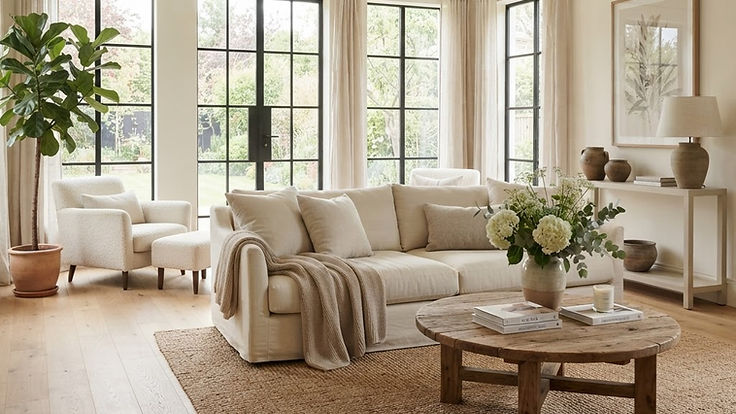
Choosing a white paint should be the easiest decision in decorating, yet it's the one my clients agonise over most. Stand in front of a paint chart and there are dozens of whites that look almost identical, but on the wall one turns yellow, another looks grey and a third feels cold and clinical. The difference is all in the undertone, the light reflectance and the light in your room.
In this guide I'll explain how to choose the right white for your walls, what undertones and LRV mean, how room direction and lighting change a white, my favourite UK and US white paint colours with their LRVs, the best whites room by room, how to do white on white with trims, ceilings and exteriors, and how to test whites properly before you commit.
Why Choosing a White Is So Hard
Almost no wall white is truly pure white. Most contain a small amount of another pigment, such as yellow, red, black, green or blue, which gives them an undertone. On a small chip it's barely visible, but on four walls, bouncing light off each other, that undertone is magnified. That's why a white that looked perfect in the shop can look creamy, grey or even slightly green at home.
| Undertone | What it looks like | Best for |
|---|---|---|
| Warm (yellow or red) | Creamy, soft and cosy | North facing rooms, period homes, bedrooms |
| Cool (blue or green) | Crisp, fresh and bright | South facing rooms, modern spaces, bathrooms |
| Neutral | Clean, with no obvious lean | Most rooms, trims, ceilings, galleries |
| Greige or grey | Soft, muted and sophisticated | Contemporary schemes, sunny rooms |
What Is LRV?
LRV stands for light reflectance value: a measure of how much light a colour reflects. Homebuilding & Renovating explains that the scale runs from 0, which is black, to 100, which is pure white. Most wall whites sit somewhere between about 70 and 92: the higher the number, the brighter and lighter the white will look.
- LRV 85 to 92: bright, clean whites; great for ceilings, trims and rooms that need maximum light.
- LRV 80 to 85: soft, versatile whites that work on most walls.
- LRV 70 to 80: off-whites with more depth, warmth or grey; cosy and forgiving.
LRV is a useful guide, but not a rule. As Annie Sloan, founder of Annie Sloan Chalk Paint, told Homebuilding & Renovating, "I wouldn't use LRV as a set of rules." Undertone and light matter just as much.
How Light Changes White
Room direction
| Room faces | The light | Which white to choose |
|---|---|---|
| North | Cool, grey, consistent | Warm whites with yellow or red undertones; avoid cool, blue whites |
| South | Warm, bright, strong | Almost any white; cool and neutral whites look fresh |
| East | Bright and warm in the morning, cooler later | Soft neutral or slightly warm whites |
| West | Cooler in the morning, golden in the evening | Neutral or slightly cool whites balance the warm evening glow |
Artificial light
Bulbs change whites too. Warm white bulbs, around 2700K, make whites look creamier and cosier; cooler bulbs, around 4000K, make them look crisper and sometimes grey or blue. Choose your white under the bulbs you'll actually use in the evening.
Reflected colour
White picks up colour from everything around it: a green garden outside the window, an oak floor, a terracotta tile or a navy sofa. A white next to a warm wood floor will look warmer than the same white in a grey-carpeted room.
The Best White Paint Colours (UK)
These are the British whites I use most. Farrow & Ball doesn't print LRVs on its colour pages, so I've focused on undertone and character for UK brands.
| Paint | Character | Best for |
|---|---|---|
| Farrow & Ball All White No. 2005 | A clean, gentle white with no cold undertones | Ceilings, woodwork and modern rooms |
| Farrow & Ball Wimborne White No. 239 | A soft, warm off-white with a gentle creamy undertone | North facing rooms, period homes and kitchens |
| Farrow & Ball Wevet No. 273 | Light and cool, with a hint of grey | Bright, sunny rooms and Scandi schemes |
| Farrow & Ball Strong White No. 2001 | Cooler, with soft grey undertones | Contemporary, crisp interiors |
| Farrow & Ball Pointing No. 2003 | Slightly warmer and deeper, a traditional cream | Cottages, bedrooms and period woodwork |
| Farrow & Ball School House White No. 291 | A gentle, understated off-white with more depth | Older houses and cosy living rooms |
| Little Greene Slaked Lime | A soft, warm, chalky white | Living rooms and bedrooms |
| Dulux Pure Brilliant White | A bright, clean white | Ceilings and new builds on a budget |
My go-to warm white is Wimborne White, which looks soft and welcoming in almost any British room, especially north facing ones.
The Best White Paint Colours (US)
For readers in the US, these are some of the most popular whites, with LRVs from PaintDB.
| Paint | LRV | Undertone | Best for |
|---|---|---|---|
| Benjamin Moore Chantilly Lace OC-65 | 90 | Nearly neutral; Benjamin Moore's brightest, most neutral white | Trims, ceilings, modern walls |
| Benjamin Moore Simply White OC-117 | About 89.5 | A very faint warm, yellow-cream | Walls, cabinets and exteriors |
| Benjamin Moore White Dove OC-17 | 83 | Soft, warm cream | Walls, kitchens and cosy rooms |
| Sherwin-Williams Extra White SW 7006 | 86 | Neutral, crisp | Trims, ceilings and exteriors |
| Sherwin-Williams Pure White SW 7005 | 84 | Neutral, with no strong warm or cool bias | Walls, trims and cabinets |
| Sherwin-Williams Snowbound SW 7004 | 83 | Neutral with a faint grey-blue undertone | Modern and sunny rooms |
| Sherwin-Williams Alabaster SW 7008 | 82 | Warm, with a gentle cream undertone | Living rooms, bedrooms and kitchens |
The Sherwin-Williams LRVs and undertones come from PaintDB's Sherwin-Williams whites guide.
The Best White Paint Colours by Room
| Room | What you need | Whites to try |
|---|---|---|
| North facing living room | Warmth without yellowness | Wimborne White, School House White, White Dove, Alabaster |
| South facing living room | Freshness that doesn't glare | Wevet, All White, Chantilly Lace, Pure White |
| Kitchen | Clean but not clinical, wipeable | Wimborne White, Simply White, Pure White |
| Bedroom | Soft, restful warmth | Pointing, Slaked Lime, White Dove, Alabaster |
| Bathroom | Bright and fresh, moisture-resistant finish | All White, Strong White, Chantilly Lace, Extra White |
| Hallway | Light-reflecting and durable | Wimborne White, Pure White, Simply White |
| Ceilings | Bright, flat and light-reflecting | All White, Chantilly Lace, Extra White, Pure Brilliant White |
| Woodwork and trims | Durable and slightly brighter than walls | All White, Pure White, Extra White |
Kitchens: white walls are the classic partner for coloured cabinets. A soft warm white suits sage green kitchen cabinets and wood, while a crisper white suits navy or black.
Small rooms: a bright white isn't always the answer in a small, dark room. A warmer, slightly deeper off-white can feel cosier and more intentional than a white that turns grey in low light. There are more ideas for brightening tight spaces among these small living room ideas.
White on White: Walls, Woodwork and Ceilings
A white on white scheme is one of the most elegant looks in decorating, but the whites need to work together.
- Same white, different finish. The simplest option: matt on walls, eggshell on woodwork, and matt on the ceiling. The change in sheen alone gives definition.
- A slightly brighter trim. Use a cleaner, brighter white on woodwork and ceilings, such as All White, with a softer white on the walls.
- Tonal whites. Choose whites with the same undertone at different depths, for example a warm white on walls and a warmer, deeper off-white on panelling.
- Avoid mixing undertones. A cool, blue white trim next to a warm, creamy wall can make the wall look dirty and the trim look stark.
- Colour drench in white. Painting walls, woodwork and ceiling in the same soft white creates a calm, gallery-like space.
For ceilings, white painted timber is lovely too. A white tongue and groove ceiling adds texture without colour, and white ceilings are the classic backdrop for timber faux ceiling beams.
White on White Exterior Paint
White exteriors look fresh and timeless, from Georgian townhouses to modern farmhouses, but outdoor light is much stronger than indoor light.
- Avoid the very brightest whites on large areas in strong sun, as they can glare. Many designers choose a slightly softer white for the walls or cladding.
- Use a crisper white for trims, windows and doors, so they stand out against a softer body colour.
- Consider your roof, brick and stone. A warm white suits red brick, honey stone and terracotta roofs; a cooler white suits slate and grey stone.
- Look at samples outside on several sides of the house, at different times of day.
- Use the right paint. Masonry paint for render and brick, exterior wood paint for timber, and products designed for your climate.
US favourites for exteriors include Sherwin-Williams Pure White and Extra White and Benjamin Moore White Dove and Chantilly Lace.
How to Test White Paint Properly
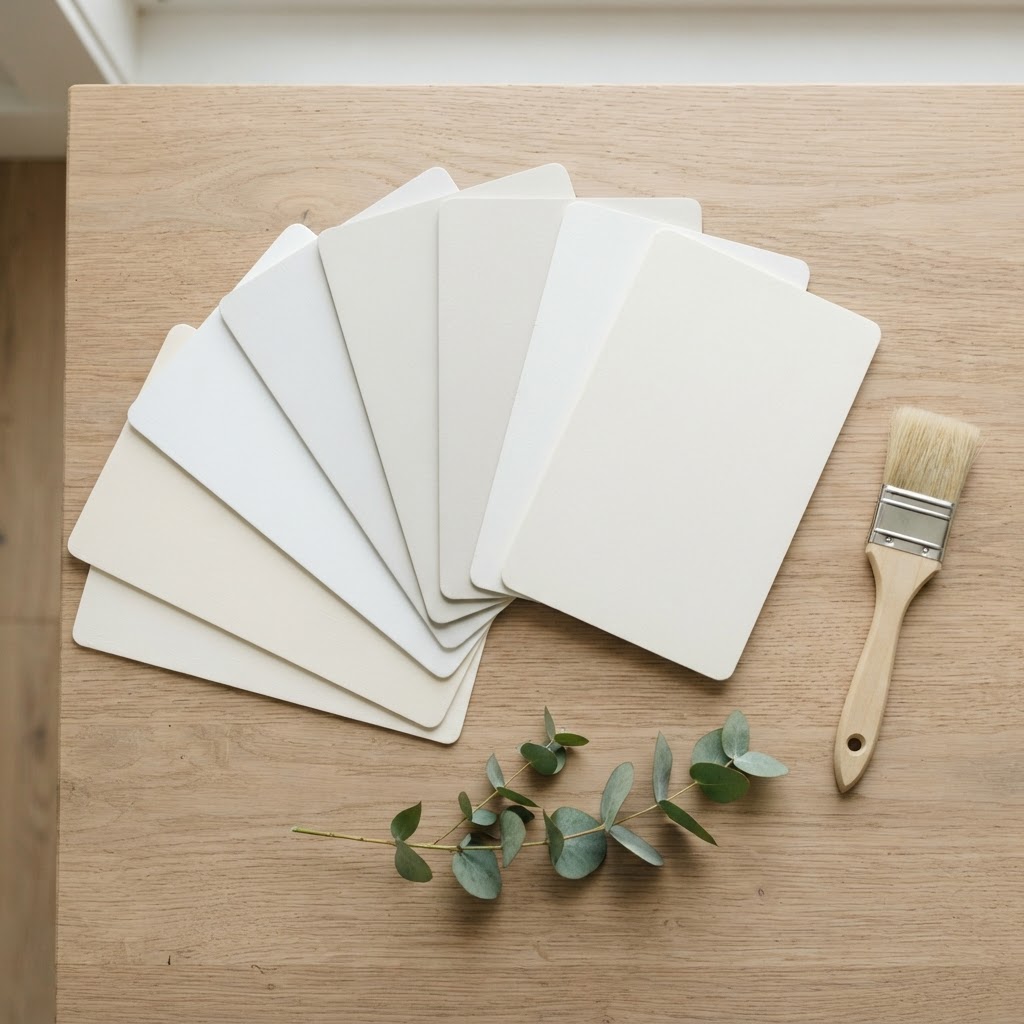
- Compare against plain white paper. Hold your samples against a sheet of printer paper to see their true undertone: creamy, pink, grey, green or blue.
- Paint large samples. Use A3 sample boards or paint large patches, rather than relying on tiny chips.
- Test on every wall. Light changes dramatically between walls, especially near and away from windows.
- Look at different times of day, and again in the evening under your own bulbs.
- Check against fixed elements: floors, worktops, tiles, sofas and curtains.
- Live with it for a few days before deciding.
White in Interiors Right Now
Whites are firmly in fashion. Pantone named Cloud Dancer (PANTONE 11-4201), a soft, airy white, as its Colour of the Year for 2026, the first time it has chosen a white since the programme began in 1999. In interiors, that translates into soft, warm, layered whites rather than stark brilliant white, paired with natural textures such as limewash, linen, oak and stone. A limewashed white has the same soft, chalky feel as the walls of a Spanish style bedroom.
Colours That Go With White
White is the perfect backdrop for almost any colour, but some pairings are especially beautiful:
- Greens: warm whites with sage, olive and deep green. The muted olive green shades are lovely against a creamy white.
- Earthy tones: whites with terracotta, rust and clay.
- Deep blues: a soft white with navy, such as Dulux Ink Well, for crisp contrast.
- Greys: warm whites lift and soften grey, which helps a grey scheme keep the calming effect grey is known for.
- Black: crisp whites with black frames, hardware and lighting for a graphic look.
Common Mistakes When Choosing White
| Mistake | Why it's a problem | What to do instead |
|---|---|---|
| Choosing from a tiny chip | Undertones only show on large areas | Test large samples on several walls |
| Using a cool white in a north facing room | Looks grey and cold | Choose a warmer white |
| Mixing warm and cool whites | One looks dirty, the other stark | Keep undertones consistent |
| Brilliant white everywhere in an old house | Looks flat and harsh | Use softer, warmer whites |
| Ignoring the floor and furniture | White picks up surrounding colour | Test next to fixed elements |
| Testing in daylight only | Bulbs change the colour | Check in the evening too |
Frequently Asked Questions
What is the best white paint colour for walls?
There isn't one best white for every room. Warm whites such as Farrow & Ball Wimborne White or Benjamin Moore White Dove suit most homes, especially north facing rooms, while neutral whites such as Chantilly Lace or Pure White suit bright, modern spaces.
What white paint doesn't look yellow?
Choose a neutral white with little or no yellow, such as Benjamin Moore Chantilly Lace, Sherwin-Williams Pure White or Farrow & Ball All White, and check it under your own lighting.
What white paint doesn't look grey?
Avoid whites with grey, green or blue undertones in north facing rooms. A white with a soft warm undertone stays fresh rather than grey in cool light.
What is a good LRV for white walls?
Most wall whites sit between about 80 and 90. Higher LRVs look brighter; lower LRVs look softer and warmer. Use LRV as a guide alongside undertone and light.
Should walls and ceilings be the same white?
They can be. Using the same white in a different finish is the simplest approach. Alternatively, use a slightly brighter white on the ceiling with the same undertone as the walls.
What white goes with grey?
Warm whites soften grey and make it feel cosier, while crisp, neutral whites give a cleaner, more modern contrast.
Is brilliant white out of fashion?
Brilliant white is still useful on ceilings and in modern spaces, but softer, warmer whites are more popular on walls because they feel calmer and suit natural materials.
Find Your Perfect White
The best white is the one that suits your light, your floors and the feeling you want in the room. Understand the undertone, use LRV as a guide, test large samples on every wall and look at them morning and night, and you'll find a white that feels right all year round.
For more colour inspiration, explore the decorating section, and if you'd like help choosing the perfect white for your home, you can book a one-hour online interior design consultation with me.
About the author
Magda Callery is a UK interior designer and florist with more than 15 years' experience designing homes, pubs, restaurants and bars, and her expert commentary has featured in Homes & Gardens, The Mirror and The Spruce. Explore more of the decorating articles.
Continue reading


Christmas Tree Trends 2026: 15 Ideas From a Florist
The Christmas tree trends for 2026 from a designer and florist: the return of the classic green tree, jewel tones, XL bows, heritage tartan, handmade and natural trees, colour palettes, how to decorate like a florist, which real tree to buy and real vs artificial.

Olive Green Colour: Shades, Paints and Pairings
What colour is olive green? A designer explains the shades and hex codes, what colour green olives really are, how to mix olive, what it symbolises, the best olive paint colours and the colours that go with olive at home.


Mould on a Leather Sofa: How to Remove It Safely
How to remove mould from a leather sofa without damaging it: telling mould from fatty spew, identifying your leather type, a safe step by step method, what to avoid and how to stop mould coming back.