
Writing Desks: Types, Sizes and How to Choose One
An interior designer's guide to writing desks: every type and what it's called, standard sizes, how to choose one for your space, buying vintage and styling ideas.
By Magda Callery, interior designer

A writing desk is one of the most useful pieces of furniture you can own. It's smaller and lighter than a full office desk, often prettier, and it fits into places a big desk never could: a bedroom corner, a living room alcove, a landing or the end of a hallway. It's perfect for laptop work, letters, journaling, homework and running the household admin.
In this guide I'll explain what a writing desk is, the different types and their names, from bureaus and secretaires to davenports and Carlton House desks, the sizes to look for, how to choose the right one for your space, materials and styles, ergonomics, buying vintage and how to style a writing desk so it looks beautiful in any room.
What Is a Writing Desk?
A writing desk is a compact desk designed mainly for writing and light work, usually with a flat or sloping surface, slim legs and one or two shallow drawers, rather than the deep drawers and filing storage of a full office desk.
Writing desks have been made for centuries, from portable writing boxes to grand pieces for royalty. Wikipedia notes a portable writing desk made in about 1525 to 1526 for Henry VIII, for example. Today, the term covers everything from a simple writing table to an antique bureau with pigeonholes and secret drawers.
Types of Writing Desks and What They're Called
| Type | What it is | Best for |
|---|---|---|
| Writing table | A simple table-style desk with a flat top and one or two shallow drawers | Most rooms, laptops, a clean look |
| Bureau | A desk with a hinged, sloping fall front that opens into a writing surface, with drawers below | Hiding clutter in a living room or bedroom |
| Secretaire or secretary desk | A writing desk with a hinged writing surface, drawers below and often a bookcase above | Storage and display in one piece |
| Escritoire | A term used for some secretary desks, often with glazed bookcase doors, and sometimes for a portable writing slope | Period and traditional interiors |
| Davenport | A small English desk with a sloping lift-up top and drawers down one side | Small spaces and collectors |
| Carlton House desk | A D-shaped desk with small drawers rising around the writing surface | Statement studies |
| Bonheur du jour | A small, elegant lady's writing desk with a raised back of small drawers or shelves | Bedrooms and dressing rooms |
| Pedestal desk | A larger desk with a bank of drawers on one or both sides | Full-time home offices |
| Ladder or wall desk | A modern slim desk built into a leaning shelf unit or fixed to the wall | Very small rooms and studios |
| Console desk | A narrow console table that doubles as a desk | Hallways, living rooms and landings |
A few of these have interesting histories. According to Wikipedia, the davenport takes its name from a Captain Davenport, who commissioned the design from Gillows of Lancaster near the end of the 18th century. The Carlton House desk was reportedly designed in the 18th century for the Prince of Wales and named after Carlton House, his London home at the time; its design is traditionally credited to George Hepplewhite.
Writing Desk Sizes
| Measurement | Typical writing desk | Typical office desk |
|---|---|---|
| Width | About 80 to 120cm | About 120 to 160cm |
| Depth | About 45 to 60cm | About 60 to 80cm |
| Height | About 72 to 76cm | About 72 to 76cm |
These are general guides, as sizes vary a lot between makers, and antiques can be smaller or lower than modern desks.
How much space do you need?
- Behind the desk: allow around 90cm to 100cm so your chair can move in and out comfortably.
- For a laptop only: a depth of around 45cm is usually enough.
- For a laptop and a monitor: look for 60cm or more, so the screen isn't too close.
- For a bureau or secretaire: check the depth with the writing flap open, not just closed.
My home office design ideas go into more detail on planning a workspace.
How to Choose the Right Writing Desk
| Question | If yes, choose |
|---|---|
| Is it in a living room or bedroom? | A bureau or secretaire, so you can close the clutter away |
| Do you work on a laptop only? | A slim writing table or wall desk |
| Do you use a monitor or printer? | A deeper writing table or a pedestal desk |
| Is space very tight? | A wall-mounted, ladder or console desk |
| Do you need storage? | A secretaire with a bookcase, or a desk with drawers |
| Will children use it? | A sturdy writing table that can grow with them, secured if it's tall |
| Do you love antiques? | A davenport, bureau or vintage writing table |
Writing Desk Materials and Styles
| Style | What to look for | Suits |
|---|---|---|
| Traditional | Mahogany, walnut or oak, a leather writing surface, brass handles | Period homes and studies |
| Scandinavian | Pale oak or ash, slim tapered legs, simple drawers | Light, calm rooms |
| Japandi | Solid wood, clean lines, closed storage, no fuss | Minimal, natural interiors |
| Industrial | A wood top on a black steel frame | Lofts and modern flats |
| Rattan and cane | Woven drawer fronts or a cane chair to match | Relaxed, vintage-inspired rooms |
| Painted | A painted wood desk in a soft colour | Bedrooms, children's rooms, cottages |
| Modern | Lacquer, glass or slim metal with a minimal profile | Contemporary homes |
For a calm, natural look, see my Japandi office guide. If you love black steel and reclaimed wood, my guide to industrial furniture design explains the style.
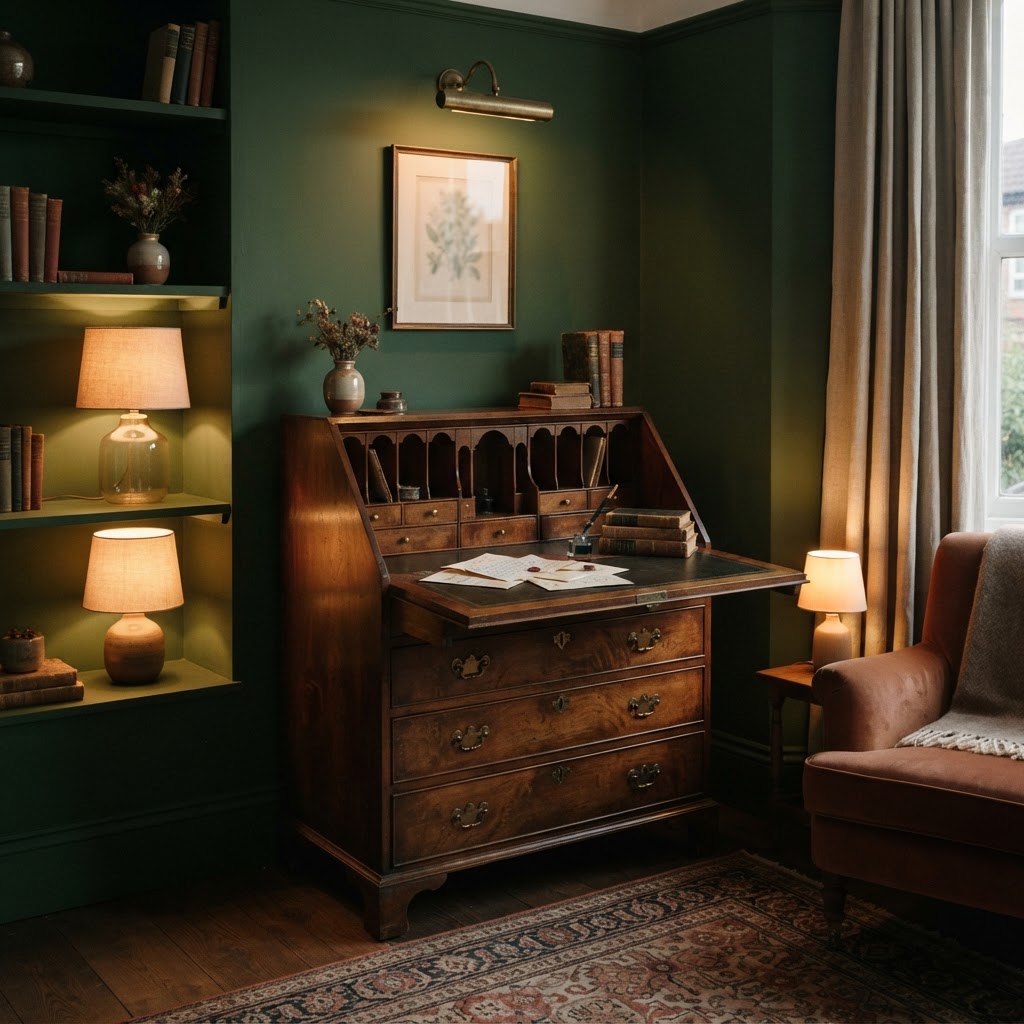
Where to Put a Writing Desk
- In a bedroom. A slim writing desk can double as a dressing table. Place it near the window for daylight.
- In a living room. A bureau or secretaire looks like a handsome piece of furniture when it's closed. My small living room ideas show how to fit one in without crowding the room.
- In a studio flat. A writing desk or wall desk can double as a dining table. My small studio apartment ideas explain how to zone a single room.
- On a landing or in a hallway. A console-style writing desk turns a wide landing into a quiet work spot.
- In an alcove. A writing table fits neatly beside a chimney breast, with shelves above.
- In a child's room. A sturdy writing table is perfect for homework and drawing, and will last for years.
Make It Comfortable
A writing desk is often used for long stretches, so set it up properly.
- Chair height. Your feet should rest flat on the floor and your elbows should be roughly level with the desk.
- Screen position. If you use a laptop for more than short periods, a laptop stand with a separate keyboard and mouse brings the screen closer to eye level.
- Light. Place the desk side-on to a window to avoid glare, and add a desk lamp for evenings.
- Legroom. Check there's enough clearance under the desk, especially with antiques, which can be lower or have a central drawer that sits close to your knees.
In the UK, the Health and Safety Executive publishes a free workstation checklist for people who use computers, which is a useful guide at home too.
Buying a Vintage or Antique Writing Desk
Vintage writing desks are full of character, and often better made and cheaper than new ones. Check these before you buy:
- Drawers. Do they open and close smoothly? Are the runners worn?
- The fall front. On a bureau, check the hinges and the slides (called lopers) that pull out to support the writing flap.
- Woodworm. Look for small round holes and fresh dust, which can mean an active infestation.
- Veneer and leather. Lifting veneer and worn leather can be restored, but factor in the cost.
- Locks and keys. Many bureaus have locks; a missing key can usually be replaced by a locksmith.
- Smell. Old desks can smell musty inside. My guide on how to remove a musty smell from wood furniture explains how to freshen one safely.
- Stability. Tall secretaires and bookcases should be secured to the wall.
If you'd like to give a tired desk a new look, my guide to upcycled furniture has lots of ideas.
How to Style a Writing Desk
- Keep the surface clear. A lamp, a notebook, a pen pot and one decorative object is enough.
- Add a beautiful chair. A cane, rattan or upholstered chair turns a desk into a feature.
- Hang art above it. A single print or a small gallery wall gives the desk a focal point.
- Use a pretty lamp. A brass, ceramic or pleated lamp is practical and decorative.
- Add fresh flowers or a plant. A small vase of flowers makes it a lovely place to sit.
- Paint the wall behind it. A soft green or warm white wall frames the desk beautifully. See my guides to the best green paint colours and Farrow & Ball Wimborne White.
- Ground it with a rug. A small rug under the desk and chair softens the corner; my rugs for living room ideas include a size guide.
Frequently Asked Questions
What is a writing desk called?
Depending on its design, a writing desk can be called a writing table, bureau, secretaire or secretary desk, escritoire, davenport, Carlton House desk or bonheur du jour.
What is the difference between a desk and a writing desk?
A writing desk is usually smaller and lighter than a standard office desk, with a shallower depth and one or two shallow drawers, while an office desk is larger and often has deep drawers or filing storage.
What size is a writing desk?
Most writing desks are around 80 to 120cm wide, 45 to 60cm deep and 72 to 76cm high, although sizes vary between makers and antiques can be smaller.
Can you use a writing desk as a computer desk?
Yes. A writing desk works well for a laptop. If you use a monitor, choose one at least 60cm deep so the screen isn't too close, and consider a laptop stand with a separate keyboard and mouse.
What is a bureau desk?
A bureau is a desk with a hinged, sloping fall front that opens to form a writing surface, usually with drawers below and small compartments inside. It lets you close your work away when you're finished.
What is a davenport desk?
A davenport is a small English desk with a sloping lift-up top and a stack of drawers down one side. Its name comes from a Captain Davenport, who commissioned the design from Gillows of Lancaster near the end of the 18th century.
Where should I put a writing desk?
Side-on to a window is ideal for daylight without glare. Writing desks also fit well in bedroom corners, living room alcoves, landings and studio flats.
A Desk to Love
The best writing desk is one that fits your space, suits the way you work and makes you want to sit down. Whether it's a slim oak writing table, a characterful vintage bureau or a clever wall desk, choose the right size first, then the style you love.
If you'd like help finding the right desk and creating a beautiful workspace, you can book a one-hour online interior design consultation with me. For more ideas, browse my interior design articles.
About the author
Magda Callery is a UK interior designer with more than 15 years' experience designing homes, pubs, restaurants and bars, and her expert commentary has featured in Homes & Gardens, The Mirror and The Spruce. Explore more of the interior design articles.
Continue reading

What Is Industrial Furniture Design? A Designer's Guide
What industrial furniture design is, where it came from, its key materials and design classics, the colours that suit it and how to use it at home without it feeling cold.

Baby Girl Nursery Ideas: 30 Rooms She'll Grow Into
30 baby girl nursery ideas from an interior designer: soft colour palettes beyond pink, wallpaper, furniture, lighting and storage, plus nursery safety and a room she'll grow into.


French Cafe Interior Design: Get the Parisian Look
How to bring French café interior design home, with the key elements, colours, a little history, 25 ideas for kitchens, nooks and gardens, and how to avoid a themed look.