
Home Office Design Ideas: A Designer's Guide for UK Homes
Home office design ideas for real British homes, from box rooms and alcoves to cupboard offices and garden rooms, with layout, lighting, colour, storage and video call tips from an interior designer.
By Magda Callery, interior designer
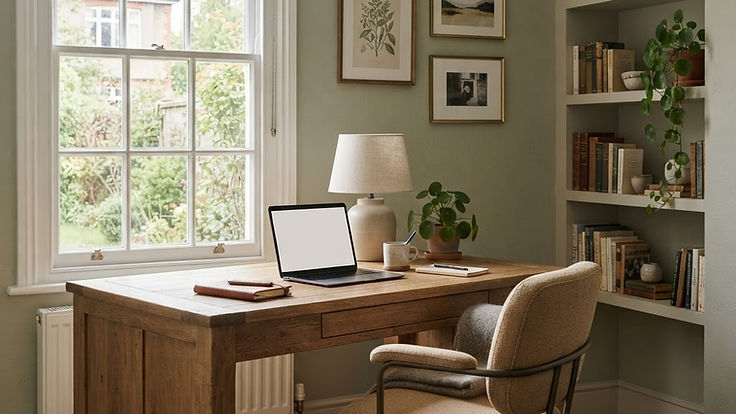
Working from home has changed what we need from our houses. A laptop on the kitchen table might get you through a week, but for regular home working you need a space that helps you focus, looks good on camera, and lets you switch off at the end of the day.
As an interior designer, home offices are now one of the rooms I'm asked to design most often, and in British homes they rarely come with a spare room attached. They're squeezed into box rooms, alcoves, landings, cupboards and corners of the living room. In this guide I'll share the home office design ideas I use with clients: how to find the right spot, plan the layout, get the ergonomics right, and style a workspace that feels like part of your home rather than a corporate cubicle.
Start With How You Work
Before choosing a desk or a paint colour, answer four questions. They shape every design decision that follows.
- How many hours a week will you work here? Two days a week at the dining table is a very different brief from full-time remote work.
- Do you take a lot of calls? If so, you'll need a door, soft furnishings to absorb sound, and a background you're happy to show.
- What do you need to store? Paperwork, samples, a printer, a second monitor and cables all need a home.
- Does the space need to disappear after work? In a living room or bedroom, being able to close the office away is the key to switching off.
Where to Put a Home Office: Ideas for Every Space
You don't need a spare room. These are the spaces I most often turn into workspaces in UK homes.
| Space | Best for | Designer tip |
|---|---|---|
| Box room or spare bedroom | Full-time home working, lots of calls | Put the desk facing or beside the window, never with your back to it on video calls |
| Alcove beside a chimney breast | Part-time working, small homes | Fit a floating desk with shelves above and a cupboard below to hide the printer |
| Under the stairs | Compact, tidy setups | Add a wall light and a pull-out keyboard shelf to make the most of a shallow depth |
| Built-in cupboard ("cloffice") | Bedrooms and living rooms | Remove the rail, fit a desk shelf and lighting, and close the doors at the end of the day |
| Landing or wide hallway | Occasional working | Keep it shallow (about 45cm deep) so the walkway stays clear |
| Corner of the living room | Shared and open-plan homes | Use a bookcase, screen or rug to zone it, and match the desk to your living room furniture |
| Garden room or shed office | Full separation from home life | Plan insulation, heating, power and Wi-Fi from the start, and check planning rules with your council |
| Dining table | Very occasional working | Use a lidded box or trolley so everything packs away before dinner |
If you're carving out space in a small home, my smart interior design tips for small spaces and small living room ideas cover zoning and multifunctional furniture in more detail.
Plan the Layout
Position the desk
- Side-on to the window is ideal. You get daylight without glare on the screen and without being a silhouette on video calls.
- Facing the window gives you a view to rest your eyes on, but use a blind to control glare.
- Avoid sitting with your back to the window. Your screen will reflect the glare and you'll appear as a dark shape on camera.
- Face into the room if you can. Having your back to the door can feel unsettling, which is why many designers favour a "command position" where you can see the entrance.
Give yourself enough room
Allow around 90cm to 100cm behind the desk for your chair to move freely. A desk around 120cm wide and 60cm to 80cm deep fits a laptop, a monitor and a notebook comfortably. If space is tight, a 45cm deep wall-mounted desk works for laptop users.
Get the Ergonomics Right
A beautiful office that gives you backache isn't a good design. These measurements are a helpful starting point for most adults:
- Desk height: about 72cm to 76cm, or a height-adjustable desk if more than one person uses it.
- Chair: adjustable height and lumbar support, with your feet flat on the floor (or on a footrest) and knees roughly level with your hips.
- Screen: about an arm's length away, with the top of the screen at or just below eye level.
- Keyboard and mouse: close enough that your elbows rest by your sides at roughly 90 degrees.
- Laptop users: raise the laptop on a stand and use a separate keyboard and mouse.
If you're employed, it's worth knowing that UK employers have health and safety responsibilities for home workers too, including display screen equipment assessments. Ask your employer what support is available before buying expensive equipment yourself.
Light Your Home Office Properly
Lighting makes the biggest difference to how comfortable a workspace feels by late afternoon.
- Maximise daylight. Keep the window clear and use light-filtering blinds or sheer linen to soften glare rather than block light.
- Add a good task lamp. An adjustable desk lamp placed on the opposite side to your writing hand avoids shadows. Neutral white bulbs (around 4000K) help concentration during the day.
- Layer warm light for the evening. A table lamp or wall light with a warm bulb makes the room feel welcoming and helps the office blend into the rest of the home.
- Light your face for calls. A soft light placed behind your screen, facing you, is far more flattering than a ceiling light directly overhead.
Choose Colours That Help You Work
Colour affects both mood and focus, so choose it deliberately.
- Greens feel calm and balanced, and are a natural choice for a room you'll spend long hours in.
- Soft blues are associated with focus and clear thinking, but choose a warm blue in north facing rooms so the space doesn't feel cold.
- Warm neutrals such as stone, oatmeal and putty create a calm backdrop that suits video calls.
- Earthy tones such as terracotta and ochre bring warmth and energy in small doses, perhaps on a desk wall or in accessories.
- Colour blocking a painted panel behind the desk is a clever way to define an office zone in a shared room.
If you're unsure where to start, my step-by-step guide to choosing a colour palette explains how to build a scheme around the way you want a room to feel. Wallpaper behind the desk adds personality too, and our wallpaper calculator works out how many rolls you need.
Storage That Keeps You Focused
Visual clutter competes for your attention, so the best home offices give everything a closed home.
- Floor to ceiling shelving stores far more than a low unit and draws the eye upwards in a small room.
- Closed cupboards or a sideboard for the printer, paperwork and chargers.
- A slim filing drawer or rolling pedestal that tucks under the desk.
- Cable management: a cable tray under the desk, a single extension lead and cable clips make a surprising difference to how calm the space feels.
- A "launch pad" tray for headphones, notebook and pens, so the desk can be cleared in seconds.
The ideas in small details that make a space feel more organised apply perfectly to a home office: alignment, empty surfaces and a home for every object. Fewer open surfaces also mean less dusting, which I cover in how to prevent dust in a room.
Make It Look Good on Video Calls
Your background is now part of your professional image. A few simple changes make a big difference:
- Choose a calm backdrop. A styled shelf, a painted wall or a single large artwork is ideal. Avoid an unmade bed, a busy doorway or a cluttered bookcase.
- Style shelves in layers. Mix books (some stacked, some upright), one or two ceramics, a plant and a small frame. Leave gaps so it doesn't look crowded.
- Raise the camera to eye level. Stack books under a laptop if needed.
- Soften the sound. Rugs, curtains, upholstered chairs, cushions and full bookcases absorb echo, so you sound clearer on calls.
Style Ideas to Make It Feel Like Home
The best home offices feel personal rather than corporate. These are the finishing touches I suggest most often.
- Hang art you love. Artwork can lift your mood and shape how a workspace feels. My article on why office artwork matters explains how to choose and place it.
- Add plants. Greenery brings life into the room and gives your eyes somewhere restful to land between tasks. Fresh flowers on the desk are a lovely weekly ritual, and you'll find ideas in the art of decorating with fresh flowers.
- Bring in natural materials. A solid wood desk, a wool rug, linen curtains and ceramic pots feel warmer than glossy office furniture.
- Choose a chair that suits the room. Ergonomic chairs now come in fabrics and finishes that look at home in a living space.
- Give an old piece new life. A vintage writing desk or an upcycled chest of drawers adds character. See my guide to upcycled furniture for inspiration.
- Keep it calm. A restrained palette, closed storage and one or two meaningful objects create the focused, peaceful feeling I describe in Japanese house design.
Home Office Ideas for Small Spaces
If space is limited, these ideas help a small home office work hard:
- Wall-mounted or fold-down desks that close up when you're not working.
- A ladder desk that combines a work surface with shelving in a small footprint.
- Shelves above the desk rather than units beside it.
- A slim chair that tucks fully under the desk.
- A mirror on an adjacent wall to bounce light around a box room.
- Doors you can close. A cupboard office in a bedroom keeps work out of sight, which matters for good sleep.
How to Separate Work and Home Life
When your office is in your home, the design needs to help you switch off.
- Create a clear boundary, whether it's a door, a curtain, a bookcase or a rug that marks the work zone.
- Pack away at the end of the day. A desk that closes, a cupboard door or a lidded box tells your brain that work has finished.
- Change the lighting. Switch off the task lamp and turn on warm lamps in the evening.
- Keep work out of the bedroom if you can. If you can't, choose a setup you can fully hide.
Common Home Office Design Mistakes
- Sitting with your back to the window.
- Choosing a desk that's too deep for the space, or too small for your equipment.
- Relying on a single ceiling light.
- Buying a chair for its looks alone.
- Leaving cables and paperwork on show.
- Forgetting about acoustics until the first video call.
- Making the room so corporate it no longer feels like home.
Frequently Asked Questions
How can I make my home office look professional?
Keep the background calm and uncluttered, style a shelf or hang one large artwork behind you, use soft lighting in front of you and raise your camera to eye level. Closed storage for paperwork and tidy cables make the biggest difference.
Where is the best place to put a desk in a home office?
Side-on to a window is usually best, giving you daylight without screen glare or a backlit silhouette on video calls. Where possible, position the desk so you can see the door.
What colour is best for a home office?
Greens and soft blues are popular because they feel calm and support focus, while warm neutrals create a flexible backdrop for video calls. Choose warmer shades for north facing rooms so the space doesn't feel cold.
How do I create a home office in a small space?
Look for underused spaces such as an alcove, a cupboard, under the stairs or a wide landing. Use a wall-mounted or fold-down desk, store things vertically and choose a setup you can close away at the end of the day.
How big should a home office desk be?
Around 120cm wide and 60cm to 80cm deep suits most people using a laptop and one monitor. A narrower wall-mounted desk around 45cm deep can work for laptop-only setups.
How do I make my home office feel cosy?
Add a rug, linen curtains, a comfortable chair, plants, artwork and warm lamps for the evening. Natural materials and a few personal objects make a workspace feel like part of your home.
Design a Home Office You Love Working In
A great home office is about more than a desk and a chair. It's the right spot, good light, comfortable ergonomics, hidden storage and a few things you love to look at, all designed around the way you work.
If you'd like help designing your own workspace, you can book a one-hour online interior design consultation with me, and we'll plan the layout, colours and storage together. For more inspiration, browse my interior design articles.
About the author
Magda Callery is a UK interior designer with more than 15 years' experience designing homes, pubs, restaurants and bars, and her expert commentary has featured in Homes & Gardens, The Mirror and The Spruce. Explore more of the interior design articles.
Continue reading

Small Living Room Ideas: How to Make It Feel Bigger
An interior designer's small living room ideas: how to plan the layout, arrange furniture, choose colours and lighting, add storage and decorate so a small room feels bigger and cosier.

Japanese Soaking Tub: A Complete Guide to Ofuro Baths for UK Homes
Deep, compact and made for slow evenings: everything you need to know about Japanese soaking tubs, from sizes and materials to fitting one in a British bathroom and styling the room around it.


Japanese House Design: 12 Key Elements and How to Bring Them Home
Calm, light and deeply connected to nature: the principles behind Japanese house design, from the genkan and shoji screens to the idea of ma, and how to borrow them for a British home.