
Types of Architecture: 32 Architectural Styles Explained
A complete guide to the different types of architecture: 32 architectural styles from Classical to contemporary, with dates, key features, famous examples, a timeline and how to identify the style of any building.
By Magda Callery, interior designer

Walk down almost any street in Britain or America and you'll pass centuries of design history: a Georgian townhouse beside a Victorian terrace, an Art Deco cinema opposite a glass office block. Each of these buildings belongs to an architectural style, a set of shapes, materials and details that tells you when it was built and what its designers valued.
As an interior designer, understanding architecture is the starting point of almost every project, because the style of a building shapes the rooms inside it. In this guide I'll explain the main types of architecture, from the ancient world to today, with the key features to look for, a famous example of each, and a quick timeline you can use to identify the buildings around you. At the end I'll show you how to bring architectural style into your own interiors.
What Are the Main Types of Architecture?
The most widely recognised architectural styles, in roughly chronological order, are:
- Classical (Greek and Roman)
- Byzantine
- Islamic
- Romanesque
- Gothic
- Renaissance
- Baroque
- Rococo
- Tudor
- Georgian
- Colonial
- Neoclassical and Greek Revival
- Federal
- Regency
- Gothic Revival
- Victorian
- Beaux-Arts
- Arts and Crafts
- Art Nouveau
- Edwardian
- Craftsman
- Prairie School
- Art Deco
- Bauhaus
- Modernism and the International Style
- Mid-Century Modern
- Brutalism
- Postmodernism
- High-Tech
- Deconstructivism
- Neo-Futurism
- Contemporary and sustainable architecture
Alongside these, regional and traditional styles such as Japanese, Scandinavian and Mediterranean architecture have shaped homes around the world, and I cover them later in the guide.
Types of Architecture as a Profession
When people search for "types of architecture", they sometimes mean the different fields architects work in rather than historical styles. The main ones are:
- Residential architecture: houses, flats and housing developments.
- Commercial architecture: offices, shops, hotels and restaurants.
- Industrial architecture: factories, warehouses and infrastructure.
- Institutional and civic architecture: schools, hospitals, museums, libraries and government buildings.
- Landscape architecture: parks, gardens, public spaces and the land around buildings.
- Interior architecture: the structural design of interior spaces, often working closely with interior designers.
- Urban design and planning: the layout of streets, neighbourhoods and towns.
- Sustainable or green architecture: buildings designed to minimise energy use and environmental impact.
The rest of this guide focuses on architectural styles, which is what most people want to know.
Architectural Styles Timeline at a Glance
| Style | Period | Where it began | Signature features | Famous example |
|---|---|---|---|---|
| Classical | c. 7th century BC to 5th century AD | Greece and Rome | Columns, symmetry, pediments | Parthenon, Athens |
| Byzantine | 4th to 15th century | Eastern Roman Empire | Domes, mosaics, centralised plans | Hagia Sophia, Istanbul |
| Islamic | 7th century onwards | Middle East | Pointed arches, geometric tilework, courtyards | Alhambra, Granada |
| Romanesque | c. 1000 to 1150 | Western Europe | Round arches, thick walls, small windows | Durham Cathedral |
| Gothic | c. 1140 to 1500s | France | Pointed arches, flying buttresses, stained glass | Notre-Dame de Paris |
| Renaissance | 15th to 16th century | Italy | Symmetry, domes, classical proportions | Florence Cathedral dome |
| Baroque | c. 1600 to 1750 | Italy | Drama, curves, rich ornament | St Paul's Cathedral, London |
| Rococo | c. 1730 to 1770 | France | Light, playful, asymmetrical ornament | Wieskirche, Bavaria |
| Tudor | 1485 to 1603 | England | Timber framing, steep roofs, tall chimneys | Hampton Court Palace |
| Georgian | 1714 to 1830 | Britain | Symmetry, sash windows, brick or stone | Royal Crescent, Bath |
| Colonial (American) | 17th to 18th century | North America | Simple, symmetrical, central door | Colonial Williamsburg |
| Neoclassical | c. 1750 to 1850 | Europe | Greek and Roman temple fronts | British Museum, London |
| Federal | c. 1780 to 1830 | United States | Refined, delicate classical details | Many New England townhouses |
| Regency | c. 1811 to 1837 | Britain | Stucco, ironwork balconies, bow windows | Regent's Park terraces, London |
| Gothic Revival | c. 1830 to 1900 | Britain | Pointed arches, spires, tracery | Palace of Westminster |
| Victorian | 1837 to 1901 | Britain | Bay windows, decorative brick, ornate details | Countless terraced streets |
| Beaux-Arts | c. 1880 to 1920 | France | Grand, symmetrical, sculptural | Palais Garnier, Paris |
| Arts and Crafts | c. 1860 to 1910 | Britain | Handcraft, natural materials, honesty | Red House, Bexleyheath |
| Art Nouveau | c. 1890 to 1910 | Europe | Flowing organic lines, nature motifs | Casa Batlló, Barcelona |
| Edwardian | 1901 to 1910 | Britain | Lighter, airier, wider houses | Suburban villas across Britain |
| Craftsman | c. 1905 to 1930 | United States | Low roofs, deep porches, exposed rafters | Gamble House, Pasadena |
| Prairie School | c. 1900 to 1920 | United States | Strong horizontals, low roofs | Robie House, Chicago |
| Art Deco | 1920s to 1930s | France | Geometric patterns, glamour, streamlining | Chrysler Building, New York |
| Bauhaus | 1919 to 1933 | Germany | Function, flat roofs, no ornament | Bauhaus building, Dessau |
| International Style | 1920s to 1970s | Europe | Glass, steel, open plans, flat roofs | Seagram Building, New York |
| Mid-Century Modern | c. 1945 to 1970 | United States | Clean lines, big windows, indoor-outdoor living | Eames House, Los Angeles |
| Brutalism | 1950s to 1970s | Europe | Raw concrete, bold blocks | Barbican Estate, London |
| Postmodernism | 1970s to 1990s | United States and Europe | Playful colour, historical references | Portland Building, Oregon |
| High-Tech | 1970s to 1990s | Britain and France | Exposed structure and services | Lloyd's Building, London |
| Deconstructivism | 1980s onwards | International | Fragmented, angular forms | Guggenheim Museum Bilbao |
| Neo-Futurism | 1990s onwards | International | Sweeping curves, digital design | Heydar Aliyev Center, Baku |
| Contemporary | Today | International | Sustainability, glass, natural materials | New homes and public buildings worldwide |
Dates are approximate, because styles overlap and arrive in different countries at different times.
Ancient and Classical Architecture
1. Classical architecture
When: roughly the 7th century BC to the 5th century AD. Where: ancient Greece and Rome.
Classical architecture is the foundation of Western building design. The Greeks developed the three classical orders (Doric, Ionic and Corinthian), each with its own style of column, while the Romans added arches, vaults, domes and concrete. Look for columns, symmetry, triangular pediments and carefully calculated proportions.
Famous examples: the Parthenon in Athens and the Pantheon in Rome.
2. Byzantine architecture
When: from the 4th century to the fall of Constantinople in 1453. Where: the Eastern Roman (Byzantine) Empire.
Byzantine architecture combined Roman engineering with Eastern influences. Its churches are known for vast central domes resting on supports called pendentives, rich gold mosaics and centralised floor plans.
Famous example: Hagia Sophia in Istanbul, completed in 537.
3. Islamic architecture
When: from the 7th century onwards. Where: across the Middle East, North Africa, Spain, Central Asia and India.
Islamic architecture includes mosques, palaces, tombs and gardens. Typical features include pointed and horseshoe arches, domes, minarets, intricate geometric and calligraphic decoration, and courtyards with water. Mughal architecture in India, including the Taj Mahal, is one of its most celebrated branches.
Famous examples: the Alhambra in Granada and the Taj Mahal in Agra.
Medieval Architecture
4. Romanesque architecture
When: about 1000 to 1150. Where: Western Europe. In England, it's usually called Norman architecture.
Romanesque buildings are solid and fortress-like, with thick walls, round arches, sturdy columns and small windows. Churches and castles from this period feel heavy and grounded.
Famous example: Durham Cathedral, begun in 1093.
5. Gothic architecture
When: from about 1140 to the 16th century. Where: it began in France and spread across Europe.
Gothic architecture was a revolution in engineering. Pointed arches, ribbed vaults and flying buttresses allowed walls to be thinner and taller, filled with huge stained glass windows. The result was cathedrals that seem to reach towards the sky.
Famous examples: Notre-Dame de Paris, begun in 1163, and Salisbury Cathedral.
Renaissance to the 18th Century
6. Renaissance architecture
When: the 15th and 16th centuries. Where: it began in Florence, Italy.
Renaissance architects rediscovered the proportions of ancient Rome. Buildings are calm, balanced and symmetrical, with columns, round arches, domes and carefully ordered facades.
Famous examples: Brunelleschi's dome for Florence Cathedral, completed in 1436, and Palladio's villas near Vicenza, which later inspired English country houses.
7. Baroque architecture
When: about 1600 to 1750. Where: it began in Rome and spread across Catholic Europe.
Baroque takes Renaissance order and adds drama. Expect curving facades, grand staircases, rich decoration, gilding, painted ceilings and theatrical effects of light and shadow.
Famous examples: the Palace of Versailles in France and Sir Christopher Wren's St Paul's Cathedral in London.
8. Rococo architecture
When: about 1730 to 1770. Where: France, then Germany and Central Europe.
Rococo is Baroque's lighter, more playful cousin. Interiors are pastel coloured and covered in delicate, asymmetrical curls, shells and gilded plasterwork.
Famous example: the Wieskirche pilgrimage church in Bavaria.
9. Tudor architecture
When: 1485 to 1603. Where: England.
Tudor buildings are instantly recognisable by their black and white timber framing, steeply pitched roofs, tall decorative chimneys and small leaded windows. Grander Tudor buildings use red brick with stone details.
Famous examples: Hampton Court Palace and Little Moreton Hall in Cheshire. The 1930s "Mock Tudor" semi is a much later revival.
10. Georgian architecture
When: 1714 to 1830, during the reigns of the four King Georges. Where: Britain and Ireland.
Georgian architecture is all about elegant symmetry. Houses have a central front door, evenly spaced sash windows (often with small panes), brick or stone facades and classical proportions inspired by Palladio.
Famous example: the Royal Crescent in Bath, built between 1767 and 1774.
11. Colonial architecture (American)
When: the 17th and 18th centuries. Where: the American colonies.
American Colonial architecture adapted European styles to local materials. Common types include the simple, symmetrical New England Colonial, Dutch Colonial with its gambrel roof, and Spanish Colonial with stucco walls and tiled roofs in the South and West.
Famous example: the restored town of Colonial Williamsburg, Virginia.
12. Neoclassical and Greek Revival architecture
When: about 1750 to 1850. Where: Europe and the United States.
Inspired by archaeological discoveries in Greece and Italy, Neoclassical architecture returned to the purity of ancient temples. Expect grand columned porticoes, pediments, domes and restrained decoration. Greek Revival was especially popular for banks, museums and government buildings.
Famous examples: the British Museum in London and the United States Capitol in Washington, D.C.
13. Federal architecture
When: about 1780 to 1830. Where: the United States.
Federal architecture is a lighter, more refined American version of Georgian and Neoclassical design, with elliptical fanlights over doors, slender columns and delicate decoration.
Famous examples: many townhouses in Boston and other New England cities.
14. Regency architecture
When: roughly 1811 to 1837, often extended to cover the decades either side. Where: Britain.
Regency buildings are elegant and light, with cream stucco facades, wrought iron balconies, bow windows and graceful terraces.
Famous examples: John Nash's terraces around Regent's Park in London and the seafront squares of Brighton.
19th Century Architecture
15. Gothic Revival architecture
When: about 1830 to 1900. Where: Britain, then the wider world.
The Victorians fell in love with medieval Gothic and revived it for churches, universities, railway stations and government buildings. Look for pointed arches, spires, decorative tracery and asymmetrical outlines.
Famous example: the Palace of Westminster in London, designed by Charles Barry and Augustus Pugin.
16. Victorian architecture
When: 1837 to 1901, the reign of Queen Victoria. Where: Britain and its empire, and the United States.
Victorian architecture isn't one style but many, including Italianate, Gothic Revival and Queen Anne. Common features of Victorian houses include bay windows, decorative brickwork, ornate tiled paths, ceiling roses, cornicing, fireplaces in every room and, in the US, painted "gingerbread" trim and wraparound porches.
Famous examples: the terraced streets found in almost every British town and the "Painted Ladies" of San Francisco.
17. Beaux-Arts architecture
When: about 1880 to 1920. Where: France, then the United States.
Named after the École des Beaux-Arts in Paris, this style is grand, symmetrical and heavily sculptural, often used for opera houses, libraries, stations and museums.
Famous examples: the Palais Garnier in Paris and Grand Central Terminal in New York.
18. Arts and Crafts architecture
When: about 1860 to 1910. Where: Britain, then the United States.
A reaction against industrial mass production, the Arts and Crafts movement celebrated honest materials, local building traditions and skilled handcraft. Houses have steep roofs, tall chimneys, exposed timber and a cosy, rural feel.
Famous example: Red House in Bexleyheath, designed by Philip Webb for William Morris and completed in 1860.
19. Art Nouveau architecture
When: about 1890 to 1910. Where: across Europe, with local names such as Jugendstil in Germany and Modernisme in Catalonia.
Art Nouveau rejected rigid historical styles in favour of flowing, organic lines inspired by plants, flowers and the natural world. Ironwork, stained glass and curved windows are typical.
Famous examples: Antoni Gaudí's Casa Batlló in Barcelona and Charles Rennie Mackintosh's buildings in Glasgow.
Early 20th Century Architecture
20. Edwardian architecture
When: 1901 to 1910, often extended to 1914. Where: Britain.
Edwardian houses are lighter and airier than Victorian ones, with wider frontages, larger windows, simpler decoration, timber porches and mock timber gables.
Famous examples: the suburban villas and terraces built around British towns before the First World War.
21. Craftsman architecture
When: about 1905 to 1930. Where: the United States.
The American cousin of Arts and Crafts, the Craftsman bungalow has a low pitched roof, wide overhanging eaves, exposed rafters, a deep front porch with tapered columns and plenty of built-in woodwork inside.
Famous example: the Gamble House in Pasadena, California, by Greene and Greene.
22. Prairie School architecture
When: about 1900 to 1920. Where: the American Midwest.
Developed by Frank Lloyd Wright and his contemporaries, Prairie School houses emphasise the horizontal, echoing the flat landscape, with low hipped roofs, long bands of windows and open interiors.
Famous example: Frank Lloyd Wright's Robie House in Chicago.
23. Art Deco architecture
When: the 1920s and 1930s. Where: it took its name from a 1925 Paris exhibition and spread worldwide.
Art Deco is glamorous, geometric and modern. Look for stepped forms, zigzags, sunbursts, chevrons, rounded corners and luxurious materials such as chrome, marble and lacquer. The later Streamline Moderne style added curves inspired by ships and aircraft.
Famous examples: the Chrysler Building in New York and the Hoover Building in west London.
24. Bauhaus architecture
When: 1919 to 1933. Where: Germany.
The Bauhaus school, founded by Walter Gropius, aimed to unite art, craft and industry. Its buildings are functional and unornamented, with flat roofs, white walls, steel and glass, and asymmetrical, practical layouts.
Famous example: the Bauhaus building in Dessau, completed in 1926.
25. Modernism and the International Style
When: the 1920s to the 1970s. Where: Europe, then worldwide.
Modernist architects believed that form should follow function. Buildings have flat roofs, open plans, large windows, smooth white or glass walls and no decoration. The International Style was the name given to this approach when it spread around the world.
Famous examples: Le Corbusier's Villa Savoye near Paris and Ludwig Mies van der Rohe's Seagram Building in New York.
Mid and Late 20th Century Architecture
26. Mid-Century Modern architecture
When: about 1945 to 1970. Where: especially the United States.
Mid-Century Modern houses are warm, optimistic versions of Modernism, with clean lines, flat or gently sloping roofs, floor to ceiling windows, open plans and a strong connection between indoors and outdoors. The style is just as famous for its furniture.
Famous example: the Eames House in Los Angeles, completed in 1949.
27. Brutalism
When: the 1950s to the 1970s. Where: Britain and Europe, then worldwide.
Brutalism takes its name from the French "béton brut", meaning raw concrete. Buildings are bold, blocky and monumental, with exposed concrete surfaces and repeated forms. Once unfashionable, many Brutalist buildings are now celebrated and listed.
Famous examples: the Barbican Estate and the National Theatre in London.
28. Postmodernism
When: the 1970s to the 1990s. Where: the United States and Europe.
Postmodernism was a playful reaction against plain Modernism. Architects brought back colour, ornament, wit and exaggerated references to historical styles.
Famous examples: Michael Graves' Portland Building in Oregon and No 1 Poultry in the City of London.
29. High-Tech architecture
When: the 1970s to the 1990s. Where: Britain and France.
High-Tech architecture celebrates engineering, putting structure, pipes, lifts and services on the outside of the building.
Famous examples: the Centre Pompidou in Paris and Richard Rogers' Lloyd's Building in London.
30. Deconstructivism
When: the 1980s onwards. Where: international.
Deconstructivist buildings appear fragmented, twisted and unpredictable, with angular, colliding forms and unusual materials.
Famous example: Frank Gehry's Guggenheim Museum Bilbao, opened in 1997.
Contemporary Architecture
31. Neo-Futurism and parametric design
When: the 1990s onwards. Where: international.
Made possible by computer modelling, Neo-Futurist and parametric buildings have sweeping curves, fluid shapes and complex geometry that would have been impossible to design by hand.
Famous example: Zaha Hadid's Heydar Aliyev Center in Baku, completed in 2012.
32. Contemporary and sustainable architecture
When: today. Where: worldwide.
Contemporary architecture is simply the architecture of now, so it keeps evolving. Current priorities include sustainability, natural light, energy efficiency, natural and recycled materials, green roofs, mass timber construction and buildings designed for wellbeing. Standards such as Passivhaus, which originated in Germany, set strict targets for energy use.
Famous examples: award-winning new homes, schools and public buildings that combine timber, glass and greenery.
Regional and Traditional Styles
Some of the most influential architecture comes from regional traditions rather than historical movements:
- Japanese architecture: timber frames, sliding screens, tatami floors and a deep connection with nature. I explore it in my guide to Japanese house design.
- Scandinavian architecture: simple forms, timber cladding, pitched roofs and large windows to make the most of limited daylight.
- Mediterranean and Spanish Revival: whitewashed or stucco walls, terracotta roof tiles, arches and shaded courtyards. My guide to terracotta colour shows how to bring that warmth indoors.
- Vernacular architecture: buildings made by local builders with local materials and methods, such as Cotswold stone cottages, thatched cottages or adobe houses.
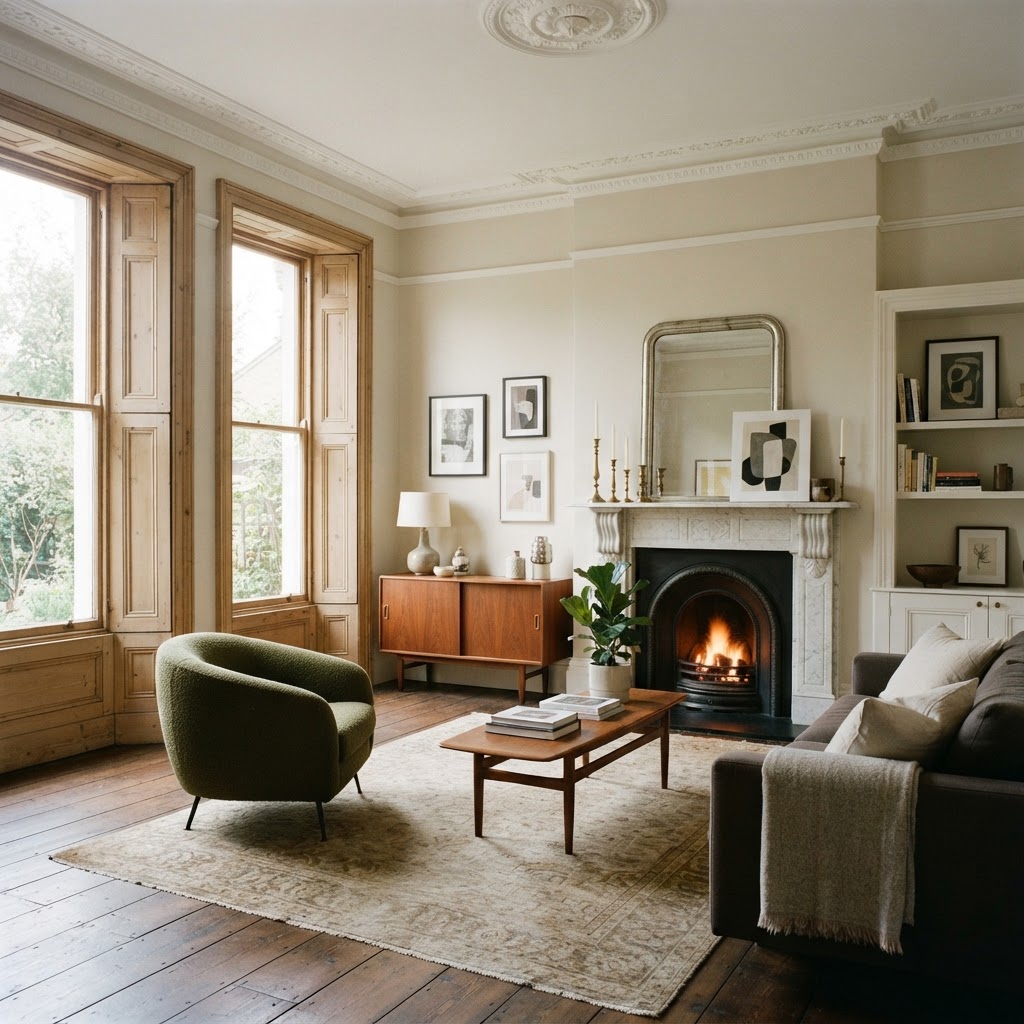
Common House Styles in the UK
| Style | Approximate period | How to spot it |
|---|---|---|
| Tudor and Tudor revival | 1485 to 1603, revived in the 1920s and 1930s | Black and white timber framing, steep gables |
| Georgian | 1714 to 1830 | Symmetrical facade, small-paned sash windows, central door |
| Regency | c. 1811 to 1837 | Cream stucco, ironwork balconies, bow windows |
| Victorian | 1837 to 1901 | Bay windows, decorative brick, tiled paths, high ceilings |
| Edwardian | 1901 to 1910 | Wider frontage, timber porch, larger windows |
| 1930s semi | 1920s to 1930s | Bay windows, hipped roof, mock Tudor gables, sometimes Art Deco details |
| Post-war | 1945 to 1970s | Simpler brick boxes, larger windows, open plan living |
| New build | 1990s onwards | Varied styles, efficient layouts, smaller rooms |
Common House Styles in the United States
| Style | Approximate period | How to spot it |
|---|---|---|
| Colonial | 17th century onwards, often revived | Symmetrical, two storeys, central door |
| Federal | c. 1780 to 1830 | Fanlight above the door, refined details |
| Victorian (including Queen Anne) | c. 1840 to 1900 | Towers, wraparound porches, decorative trim |
| Craftsman bungalow | c. 1905 to 1930 | Low roof, deep porch, tapered columns |
| Tudor Revival | 1920s to 1940s | Steep gables, half-timbering |
| Mid-Century Modern | c. 1945 to 1970 | Flat roofs, big windows, open plans |
| Ranch | 1940s to 1970s | Single storey, long and low, attached garage |
| Modern farmhouse | 2010s onwards | Gabled roof, board and batten siding, black windows |
How to Identify an Architectural Style
Next time you're looking at a building, check these clues:
- The roof: flat (Modernist), steep and gabled (Tudor, Gothic), low and wide (Prairie, Craftsman) or hipped (Georgian, 1930s).
- The windows: small-paned sash windows (Georgian), bay windows (Victorian, Edwardian), pointed arches (Gothic) or floor to ceiling glass (Modernist, Mid-Century).
- Symmetry: strict symmetry suggests Classical, Georgian, Colonial or Neoclassical. Deliberate asymmetry suggests Gothic Revival, Victorian or Arts and Crafts.
- Materials: stone and columns (Classical), timber framing (Tudor), stucco (Regency, Mediterranean), raw concrete (Brutalist), steel and glass (International Style).
- Decoration: none at all (Modernist), geometric (Art Deco), flowing and natural (Art Nouveau), playful and colourful (Postmodern), or rich and ornate (Baroque, Victorian).
- The date: local records, listed building entries and old maps can confirm when a building was built.
Bringing Architectural Style Into Your Interiors
The architecture of your home is the best guide to its interiors. As a designer, I always start by understanding the building:
- Respect the original features. Cornicing, fireplaces, panelling, sash windows and original floors are worth restoring, whatever style you decorate in.
- Choose colours that suit the era. Georgian rooms suit soft, chalky colours; Victorian rooms can take rich, deep shades such as deep navy (see my review of Dulux Ink Well) or heritage greens (see the best green paint colours); Mid-Century homes suit warm wood, olive and mustard.
- Mix old and new with confidence. Some of the most beautiful rooms combine a period building with modern or mid-century furniture. The contrast lets both shine.
- Match the scale. High Victorian ceilings can take large lights, tall art and generous curtains; low cottage ceilings suit smaller, cosier pieces.
- Work with the layout. A narrow Victorian terrace or a compact new build needs different solutions. My small living room ideas cover both.
- Reuse and restore. Salvaged doors, vintage furniture and reclaimed materials add authenticity, as I explain in my guide to upcycled furniture.
- Build a palette from the building. Brick, stone, timber and render all suggest colours. My step-by-step guide to choosing the perfect colour palette shows you how.
Frequently Asked Questions
What are the main types of architecture?
The main architectural styles include Classical, Byzantine, Islamic, Romanesque, Gothic, Renaissance, Baroque, Georgian, Neoclassical, Victorian, Arts and Crafts, Art Nouveau, Art Deco, Modernism, Mid-Century Modern, Brutalism, Postmodernism, Deconstructivism and Contemporary architecture.
What is the oldest architectural style?
Prehistoric structures such as Stonehenge and the architecture of ancient Egypt and Mesopotamia are the oldest. In Western architecture, Classical Greek and Roman architecture is the foundation for many later styles.
What is the difference between modern and contemporary architecture?
Modern architecture refers to a specific historical movement from roughly the 1920s to the 1970s, with flat roofs, open plans and no decoration. Contemporary architecture means the architecture of today, which is constantly changing and often focuses on sustainability.
What is the difference between Romanesque and Gothic architecture?
Romanesque buildings have round arches, thick walls and small windows. Gothic buildings have pointed arches, ribbed vaults and flying buttresses, which allowed thinner walls, greater height and large stained glass windows.
What is the most popular architectural style for homes?
In the UK, Victorian and Edwardian houses and 1930s semis are among the most common and sought after period homes. In the US, Colonial, Craftsman, Ranch and modern farmhouse styles are especially popular.
What style is my house?
Look at the roof shape, windows, materials, symmetry and decoration, then compare them with the tables above. Local planning records, listed building entries and old maps can help confirm the date.
What is the newest architectural style?
Contemporary architecture, including parametric and sustainable design, is the architecture of today. It continues to evolve as new materials, technologies and environmental priorities emerge.
Design Your Home Around Its Architecture
Understanding architectural styles helps you see the buildings around you, and your own home, with new eyes. Whether you live in a Georgian townhouse, a Victorian terrace, a Craftsman bungalow or a new build, the best interiors work with the architecture rather than against it.
If you'd like help designing an interior that suits the style and character of your home, you can book a one-hour online interior design consultation with me. For more inspiration, browse my interior design articles.
About the author
Magda Callery is a UK interior designer with more than 15 years' experience designing homes, pubs, restaurants and bars, and her expert commentary has featured in Homes & Gardens, The Mirror and The Spruce. Explore more of the interior design articles.
Continue reading


Gaming Room Colour Ideas: The Best Wall Colours for Gamers
The best gaming room colours from an interior designer: why darker walls reduce glare, how to pair paint with RGB lighting, five gaming room schemes to copy and ideas for shared rooms and teen bedrooms.

Home Office Design Ideas: A Designer's Guide for UK Homes
Home office design ideas for real British homes, from box rooms and alcoves to cupboard offices and garden rooms, with layout, lighting, colour, storage and video call tips from an interior designer.

Small Living Room Ideas: How to Make It Feel Bigger
An interior designer's small living room ideas: how to plan the layout, arrange furniture, choose colours and lighting, add storage and decorate so a small room feels bigger and cosier.