
What Is a Manor House? History, Features and Style
What is a manor house? A UK interior designer explains the history of the manor house, its key features, how it differs from castles, country houses and stately homes, famous examples to visit, lordship titles today and how to get the manor house look at home.
By Magda Callery, interior designer and florist

Say "manor house" and most people picture honey-coloured stone, mullioned windows, tall chimneys and a garden full of foxgloves. But a manor house is more than a pretty old country house. Historically, it was the home of the lord of the manor and the working heart of an estate, where rents were collected, disputes were settled and the local community was governed.
In this guide I'll explain what a manor house is, where the word comes from, how manor houses developed over the centuries, the features that define them, how they differ from castles, country houses and stately homes, some of the finest examples you can visit in England, what "lord of the manor" means today, and, as an interior designer, how to bring the manor house look into your own home.
What Is a Manor House?
A manor house is the main house of a manor: the home of the lord of the manor and the administrative centre of a medieval estate. In the feudal system, land was organised into manors, each with its own lord, tenants, farmland and court, and the manor house was where the lord, or his steward, lived and ran the estate.
Today, the term is used more loosely for many older English country houses, especially smaller ones built from the medieval period to the 17th century, whether or not they were ever the centre of a manor. As Wikipedia's entry on the manor house puts it, the term is "today loosely (though erroneously) applied to various English country houses".
| Question | Quick answer |
|---|---|
| What is it? | The house of the lord of the manor and the centre of a manorial estate |
| When? | Mainly the medieval period to the 17th century, though the name is still used |
| Where? | Across England and Europe, especially in the countryside near a village and church |
| Key feature | A great hall, used for living, dining and holding the manor court |
| Size | Often modest, far smaller than a castle or a stately home |
| Who lived there? | The lord of the manor, his family and household, or a steward or bailiff in his place |
Where Does the Word "Manor" Come From?
"Manor" comes from the Old French manoir, a dwelling, from the Latin manere, meaning to remain or to dwell, the same root as "mansion". The word arrived in England with the Normans after 1066, along with the manorial system itself. By the time of the Domesday Book in 1086, the country was mapped out as thousands of manors, each recorded with its lord, land and people.
Manor house names often carry clues to their history. According to Wikipedia, "Court" came into use in the 16th century for houses where lords held their courts, and "Place" was probably a shortened form of "Palace". In the north of England, many manor houses are simply called "Hall".
How Did a Manor Work?
The manor was the basic unit of rural life in medieval England. The lord held the land, often from the king or a greater lord, and the tenants farmed it in return for rent, labour or produce.
- The lord of the manor owned the manor and its rights. Many lords held several manors and only stayed in each for part of the year.
- The steward and bailiff ran the estate when the lord was away, managing farming, rents and tenants.
- The manor court met in the great hall of the manor house to settle disputes, record land transfers and appoint local officials.
- The demesne was the lord's own farmland, worked by his tenants.
- The village, church and mill usually sat close by, so many manor houses stand right beside the parish church.
A Short History of the English Manor House
| Period | What manor houses were like | Example |
|---|---|---|
| Norman and medieval (11th to 14th century) | A great hall at the centre, a private chamber or solar for the lord, often with a moat, gatehouse or light fortification | Stokesay Castle, Shropshire |
| Late medieval (15th century) | More comfortable and less defensive, with bay windows, oriel windows and more private rooms | Great Chalfield Manor, Wiltshire |
| Tudor (16th century) | Peace and prosperity brought unfortified houses, brick, tall chimneys, long galleries and bigger windows | Sutton Place, Surrey, around 1521 |
| Elizabethan and Jacobean (late 16th to early 17th century) | Grand, architect-designed houses on a new scale, the ancestors of the stately home | Burghley House, Longleat and Hatfield House |
| Georgian onwards | The manorial system faded; "manor" became a name for a country house rather than a role | Many village manors remodelled with Georgian fronts |
| Victorian and Edwardian | Revival "manor" houses in Tudor and Arts and Crafts styles for new wealthy owners | Manor-style houses across the suburbs and countryside |
Many medieval manor houses were fortified, but mostly for status and protection against raiders rather than full sieges. Wikipedia notes they often needed a royal "licence to crenellate", and had moats, drawbridges and gatehouses, but no keep or siege-grade walls. Most large medieval manors also had a licensed deer park, mainly to supply venison for the lord's table.
Key Features of a Manor House
| Feature | What it is | Why it mattered |
|---|---|---|
| Great hall | A large, tall room, often open to the roof timbers | The heart of the house, for eating, entertaining and holding the manor court |
| Solar | A private upper chamber for the lord's family | An early step towards privacy and comfort |
| Screens passage | A passage at the lower end of the hall, behind a timber screen | Separated the hall from the service rooms and kept out draughts |
| Buttery and pantry | Service rooms for drink and bread | Kept supplies close to the hall |
| Chapel | A small private chapel or oratory | For the household's daily worship |
| Moat and gatehouse | Water defences and a fortified entrance | Security and, just as importantly, status |
| Mullioned windows | Windows divided by stone or timber uprights | Let in more light as houses became less defensive |
| Tall chimneys | Brick or stone chimney stacks | Replaced the open central hearth from the late medieval period |
Manor House vs Castle vs Country House vs Stately Home
These terms are often used interchangeably, but they mean different things.
| Type | What it is | Main purpose |
|---|---|---|
| Manor house | The home of the lord of the manor and the centre of a manorial estate | Running an estate and its community |
| Castle | A heavily fortified residence built to withstand siege | Military defence and royal or noble power |
| Fortified manor house | A manor house with a moat, gatehouse or tower, but not built for siege | Status and protection from raiders |
| Country house | A large house on a rural estate, especially from the 16th century onwards | A home and the base of a landed family |
| Stately home | A grand country house, often now open to the public | Display of wealth, taste and power |
| Hall | A common name for manor and country houses, especially in the north of England | Usually a manor or country house |
| Grange | Originally a farm belonging to a monastery | Agriculture, later often a private house |
| Mansion | A large, impressive house in town or country | A home for a wealthy family |
In short, every manor house was the centre of a manor; not every grand old country house was a manor house, and very few manor houses were as large as a stately home.
Famous Manor Houses to Visit in England
- Stokesay Castle, Shropshire. Despite the name, it's a manor house. Built in the 1280s and 1290s by the wealthy wool merchant Laurence of Ludlow, it's described by English Heritage as "one of the finest fortified manor houses in England", with a beautifully preserved great hall.
- Ightham Mote, Kent. A moated manor house dating from the 14th century, with more than 70 rooms around a central courtyard. It was bought in 1953 by Charles Henry Robinson, an American from Portland, Maine, who later gave it to the National Trust, which took it over in 1985.
- Great Chalfield Manor, Wiltshire. According to the National Trust, Thomas Tropnell built a new manor house here between 1467 and 1480. With its great hall, oriel windows and gardens, it's one of the loveliest late medieval houses in England.
- Haddon Hall, Derbyshire. A remarkably intact medieval and Tudor manor house that has changed surprisingly little over the centuries.
- Kelmscott Manor, Oxfordshire. The Cotswold stone house William Morris used as his country home from 1871, full of Arts and Crafts textiles and furniture, and a reminder that Morris's love of old English houses shaped Edwardian interior design a generation later.
What Does "Lord of the Manor" Mean Today?
The manorial system has long gone, but lordships of the manor still exist in England and Wales. A lordship is a title and a bundle of historic rights, and it's usually separate from the manor house itself. Today:
- Lordship titles can still be bought and sold, often at auction, but they don't make you a peer or give you a seat in the House of Lords.
- Owning the manor house doesn't make you lord of the manor, and owning the title doesn't give you the house.
- Manorial rights, such as mineral or sporting rights, can still affect land. According to GOV.UK, owners of these rights could lose them unless they were protected by an entry in the land register before 13 October 2013, as later buyers of the land may take it free of unregistered rights.
If you're buying an old house with "Manor" in its name, your conveyancer will check whether any manorial rights are registered against the land.
Manor Houses Outside England
In France, the equivalent is the manoir; in the Netherlands, wealthy families built country estates, often on the sites of former castles. The United States never had a feudal manorial system, but some colonial estates came close: the Dutch patroonships of the Hudson Valley, such as Philipsburg Manor, and southern estates run from large houses such as Mount Vernon and Monticello. Today, Americans often use "manor house" for any large, traditional country house, usually with a nod to English or Georgian architecture. The types of architecture behind those styles, from Tudor to Georgian, explain why so many still borrow from the English manor.
How to Get the Manor House Look at Home
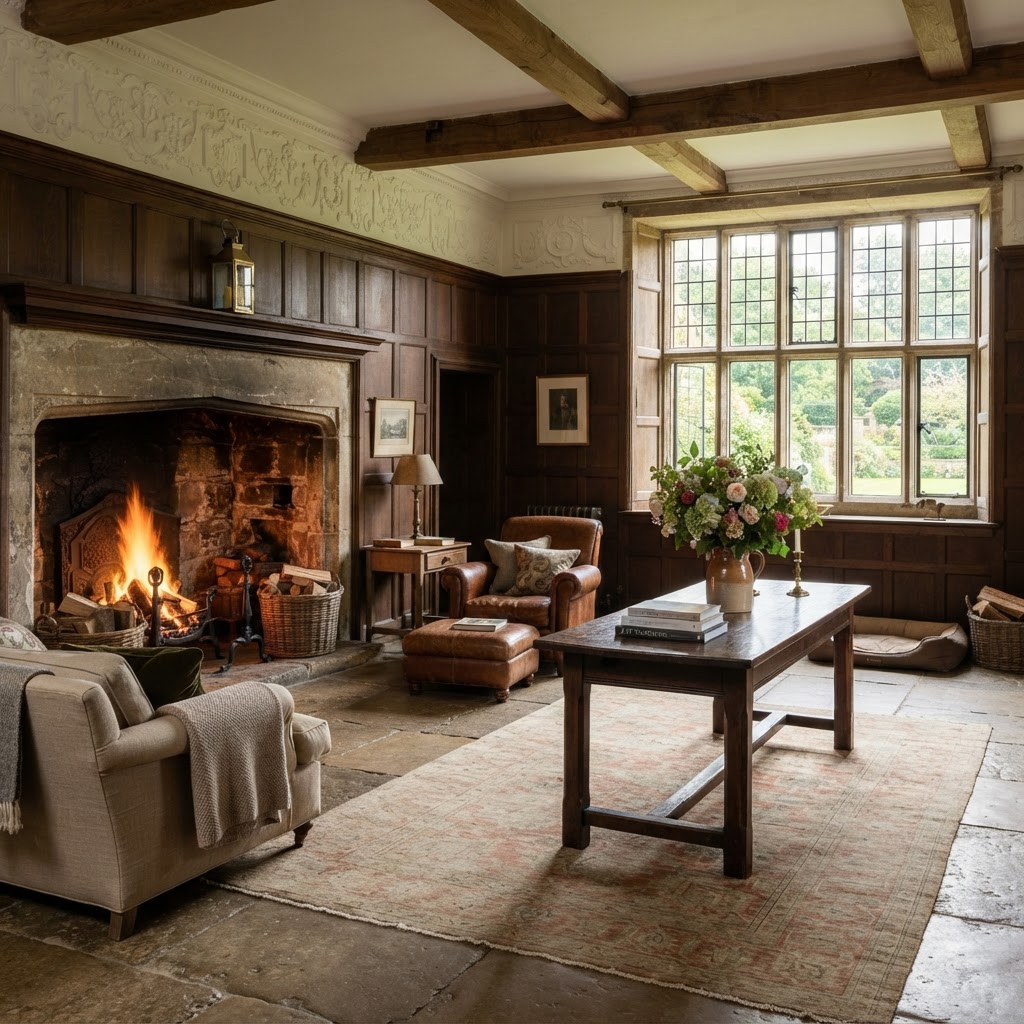
You don't need a medieval great hall to borrow the warmth and character of a manor house. These are the elements I use when clients ask for a "manor house feel", even in a new build or a terraced house.
- Panelling. Oak or painted panelling, full height or to dado level, instantly adds age and gravitas. In a smaller room, paint it in a soft heritage green or stone colour; the deep heritage greens are especially good on panelling.
- Beams and stone. Exposed beams, flagstone or reclaimed stone floors and a big stone fireplace are the bones of the look. A wood burner in a generous surround gives the same focal point.
- A great hall moment. Even a modest hallway can feel grand with a flagstone floor, a long oak table or bench, a large mirror or oil painting and a jug of garden flowers. Many of the principles from Georgian hallway ideas, such as symmetry and generous scale, work in a manor style hall.
- Layered antique rugs. Faded Persian and Turkish rugs on stone or timber floors soften the hard surfaces. Choose them large, following the same sizing rules as any living room rug.
- Old and new furniture together. An oak refectory table, a carved chest or an antique writing desk alongside a comfortable modern sofa feels lived in rather than museum-like.
- Art and portraits. Oil paintings, botanical prints and still lifes, hung in clusters or on picture rails, add instant history. Old master flower paintings are a lovely fit.
- Leather and textiles. Worn leather armchairs, tapestry cushions, velvet curtains and wool throws build warmth and comfort.
- Flowers from the garden. As a florist, I think no manor house room is complete without flowers: loose armfuls of garden roses, foxgloves, delphiniums or branches of blossom in old jugs. Decorating with fresh flowers is the quickest way to make the look feel alive rather than stiff.
Looking after old furniture
Antique oak and leather are the soul of a manor house interior, but they need care in older, cooler houses. Old chests and cupboards often pick up a musty smell, and removing a musty smell from wood furniture usually starts with airing and gentle cleaning. Leather armchairs in damp rooms can also develop spots, so it's worth knowing how to deal with mould on a leather sofa before it spreads.
Frequently Asked Questions
What makes a house a manor house?
Historically, a manor house was the house of the lord of the manor and the administrative centre of a manorial estate. Today, the term is also used loosely for old English country houses, especially smaller ones built before the 18th century.
What is the difference between a manor house and a castle?
A castle was built primarily for military defence and to withstand a siege. A manor house was a home and the centre of an estate; some were lightly fortified with moats and gatehouses, but they weren't designed for siege warfare.
Is a manor house the same as a stately home?
No. Stately homes are grand country houses, often very large and now open to the public. Manor houses are usually much smaller and older, and their original purpose was running a manor.
Who lived in a manor house?
The lord of the manor and his family and household, or, when the lord lived elsewhere, a steward or bailiff who managed the estate on his behalf.
Can you still buy a lord of the manor title?
Yes. Lordship of the manor titles are still bought and sold in England and Wales, often at auction. They're usually separate from the manor house and don't make you a peer.
What is inside a manor house?
Traditionally a great hall, a solar or private chamber, service rooms such as the buttery, pantry and kitchen, and often a chapel. Later manor houses added parlours, long galleries and more bedrooms.
Can I call my house a manor?
Many houses use "Manor" in their name, including Victorian, Edwardian and modern homes. If you want to rename your house, check with your local council, which usually manages house names and addresses.
The Lasting Charm of the Manor House
A manor house is part home, part history book: the place where medieval estates were run, villages were governed and, over the centuries, the English country house was born. Whether you visit one or simply borrow its panelling, stone, old oak and garden flowers, the manor house look is one of the warmest and most enduring styles in British design.
For more period home inspiration, explore the interior design section, and if you'd like help bringing a little manor house character to your own home, you can book a one-hour online interior design consultation with me.
About the author
Magda Callery is a UK interior designer and florist with more than 15 years' experience designing homes, pubs, restaurants and bars, and her expert commentary has featured in Homes & Gardens, The Mirror and The Spruce. Explore more of the interior design articles.
Continue reading


Spanish Bedroom Ideas: 25 Ways to Get the Look
25 Spanish bedroom ideas from a UK interior designer: limewashed walls, arches and niches, terracotta floors, iron beds, linen, lanterns and ceramics, plus the five Spanish styles, the colour palette and how to adapt the look to a UK home.


Edwardian Interior Design: Colours, Features and Ideas
A designer's guide to Edwardian interior design: what makes it different from Victorian style, the key features to keep, the Edwardian colour palette, furniture, lighting and room by room ideas for modern living.

Scandi Console Table: Styling Ideas, Sizes and Tips
How to choose and style a Scandi console table, with standard sizes, where to use one, a simple styling formula, 20 ideas for hallways and living rooms, and what to check before you buy.