
Famous Flower Paintings: 20 Masterpieces to Know
The most famous flower paintings in history, from Dutch Golden Age still lifes to Van Gogh's Sunflowers, Monet's Water Lilies and Georgia O'Keeffe, with the story behind each, where to see it and how to bring flower art into your home.
By Magda Callery, interior designer
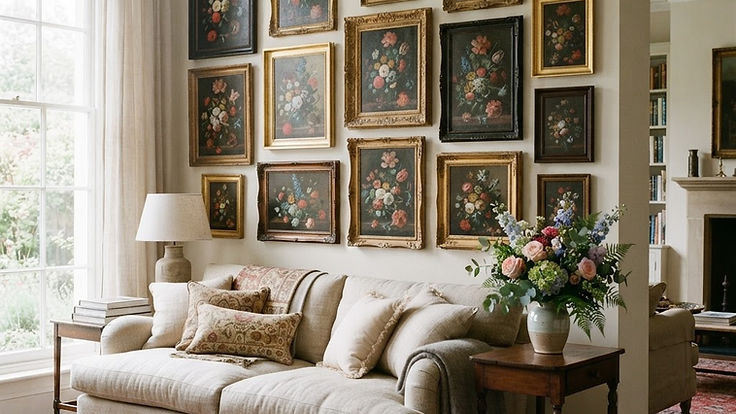
Flowers have fascinated artists for centuries. They've been painted as symbols of love, faith and the shortness of life, as scientific studies, as status symbols during the Dutch tulip craze, and as pure explosions of colour and light. Some of the most famous paintings in the world are, quite simply, pictures of flowers.
As an interior designer, I'm often asked how to choose art for a home, and floral paintings are among the most popular choices of all. In this guide I'll take you through the most famous flower paintings in history, from Dutch Golden Age masterpieces to Van Gogh's sunflowers and Georgia O'Keeffe's close-ups, with the story behind each one, what to look for and where you can see it. At the end, I'll share how to bring flower art into your own home.
Famous Flower Paintings at a Glance
| Painting | Artist | Date | Where to see it |
|---|---|---|---|
| Great Piece of Turf | Albrecht Dürer | 1503 | Albertina, Vienna |
| Primavera | Sandro Botticelli | c. 1480 | Uffizi Gallery, Florence |
| Flowers in a Wooden Vessel | Jan Brueghel the Elder | c. 1606 | Kunsthistorisches Museum, Vienna |
| Vase of Flowers in a Window | Ambrosius Bosschaert the Elder | c. 1618 | Mauritshuis, The Hague |
| Flowers in a Vase | Rachel Ruysch | c. 1685 | National Gallery, London |
| Flowers in a Terracotta Vase | Jan van Huysum | 1736 to 1737 | National Gallery, London |
| Poppies (Wild Poppies near Argenteuil) | Claude Monet | 1873 | Musée d'Orsay, Paris |
| Carnation, Lily, Lily, Rose | John Singer Sargent | 1885 to 1886 | Tate Britain, London |
| Sunflowers | Vincent van Gogh | 1888 | National Gallery, London, and other museums |
| Irises | Vincent van Gogh | 1889 | J. Paul Getty Museum, Los Angeles |
| Almond Blossom | Vincent van Gogh | 1890 | Van Gogh Museum, Amsterdam |
| Pinks and Clematis in a Crystal Vase | Édouard Manet | c. 1882 | Musée d'Orsay, Paris |
| Rose still lifes | Henri Fantin-Latour | 1860s to 1890s | National Gallery, London, and Musée d'Orsay, Paris |
| Water Lilies | Claude Monet | c. 1897 to 1926 | Musée de l'Orangerie, Paris, and museums worldwide |
| Farm Garden with Sunflowers | Gustav Klimt | c. 1906 | Belvedere, Vienna |
| Black Iris | Georgia O'Keeffe | 1926 | The Metropolitan Museum of Art, New York |
| Jimson Weed/White Flower No. 1 | Georgia O'Keeffe | 1932 | Crystal Bridges Museum of American Art, Arkansas |
| The Flower Carrier | Diego Rivera | 1935 | San Francisco Museum of Modern Art |
| Flowers | Andy Warhol | 1964 | Many versions in museums and collections |
Paintings travel for exhibitions and are sometimes off display, so check the museum's website before you visit.
The Most Famous Flower Paintings in History
1. Primavera by Sandro Botticelli (c. 1480)
Botticelli's Primavera is not a still life, but it may be the most flower-filled masterpiece of the Renaissance. Venus stands in an orange grove while Flora, the goddess of spring, scatters blossoms across a meadow. Botanists who have studied the painting have identified hundreds of plant species, including around 190 different flowers, painted with remarkable accuracy.
Look for: the flowers tumbling from Flora's dress and the carpet of blooms beneath the figures' feet. Where to see it: Uffizi Gallery, Florence.
2. Great Piece of Turf by Albrecht Dürer (1503)
This small watercolour shows nothing more than a clump of wild meadow plants, including dandelions, grasses and plantain, yet it's considered one of the first great nature studies in Western art. Dürer painted it from life with almost scientific precision, centuries before botanical illustration became common.
Look for: the low viewpoint, which makes you feel as if you're lying in the grass. Where to see it: Albertina, Vienna. As a fragile work on paper, it's only shown occasionally.
3. Flowers in a Wooden Vessel by Jan Brueghel the Elder (c. 1606)
Jan Brueghel the Elder, son of Pieter Bruegel the Elder, was one of the pioneers of the flower still life. His lavish bouquets contain dozens of different flowers, from tulips and irises to roses and fritillaries, painted with jewel-like detail. Brueghel is often nicknamed "Flower Brueghel" for his skill.
Look for: the sheer number of species, and the insects hidden among the petals. Where to see it: Kunsthistorisches Museum, Vienna.
4. Vase of Flowers in a Window by Ambrosius Bosschaert the Elder (c. 1618)
Bosschaert's arrangement sits in a window niche against a distant landscape. Like many Dutch flower paintings, it brings together flowers, including prized tulips and roses, that would never have bloomed at the same time. Artists painted each flower from life over months, then combined them into an idealised bouquet.
Look for: the perfect symmetry of the bouquet and the precious striped tulips at the top. Where to see it: Mauritshuis, The Hague.
5. Flowers in a Vase by Rachel Ruysch (c. 1685)
Rachel Ruysch was one of the most successful artists of the Dutch Golden Age, man or woman, and her flower paintings sold for more than works by many of her male contemporaries. Her bouquets are dynamic and asymmetrical, with stems curving out into space and a dark background that makes the colours glow.
Look for: the sweeping S-shaped composition, which gives the bouquet a sense of movement. Where to see it: National Gallery, London.
6. Flowers in a Terracotta Vase by Jan van Huysum (1736 to 1737)
Jan van Huysum was the most celebrated flower painter of the 18th century. His bouquets are light, airy and incredibly detailed, with dew drops, insects and a bird's nest with eggs. This painting is a brilliant example of the colour terracotta in art, the warm clay vase anchoring the pale, delicate flowers. If you love that pairing, my guide to terracotta colour shows how to bring it into your home.
Look for: the bird's nest on the ledge and the tiny insects crawling over the leaves. Where to see it: National Gallery, London.
7. Poppies by Claude Monet (1873)
Also known as Wild Poppies near Argenteuil, this is one of the best-loved paintings of Impressionism. A woman and child walk through a hillside of red poppies, with a second pair in the distance. Monet painted the poppies as loose dabs of colour rather than individual flowers, capturing the feeling of a summer's day rather than botanical detail.
Look for: the oversized poppies in the foreground, which create depth and movement. Where to see it: Musée d'Orsay, Paris.
8. Pinks and Clematis in a Crystal Vase by Édouard Manet (c. 1882)
In the last years of his life, when illness kept him from painting larger works, Manet painted a series of small, exquisite flower still lifes. This one shows pinks and clematis in a simple glass vase, painted with quick, confident brushstrokes.
Look for: the way Manet captures the stems through the clear water and glass. Where to see it: Musée d'Orsay, Paris.
9. Carnation, Lily, Lily, Rose by John Singer Sargent (1885 to 1886)
Two young girls light paper lanterns in a garden at dusk, surrounded by lilies, roses and carnations. Sargent painted it outdoors in the Cotswolds over two summers, working only for a few minutes each evening to capture the exact quality of fading light. The title comes from a popular song of the time.
Look for: the soft, violet evening light and the glowing lanterns. Where to see it: Tate Britain, London.
10. Sunflowers by Vincent van Gogh (1888)
Van Gogh's Sunflowers are probably the most famous flower paintings ever made. He painted them in Arles in the south of France to decorate the room of his friend, the artist Paul Gauguin. Van Gogh painted several versions of sunflowers in a vase, and they now hang in museums around the world. The version in London's National Gallery, painted in August 1888, is one of the most popular paintings in the collection.
The sunflowers are shown at every stage of life, from fresh blooms to wilting seed heads, painted in thick, textured layers of yellow. For Van Gogh, yellow symbolised happiness and the southern sun.
Look for: the thick impasto paint and the signature "Vincent" on the vase. Where to see it: National Gallery, London. Other versions are held in Amsterdam, Munich, Philadelphia and Tokyo.
11. Irises by Vincent van Gogh (1889)
Van Gogh painted Irises in the garden of the asylum at Saint-Rémy-de-Provence, where he had admitted himself after a breakdown. He called painting "the lightning conductor for my illness", and the work is full of energy and life, with blue-violet irises set against orange earth and a single white iris standing out from the crowd.
In 1987, Irises sold at auction for $53.9 million, which at the time was a record for any painting.
Look for: the lone white iris on the left, often read as a symbol of individuality. Where to see it: J. Paul Getty Museum, Los Angeles.
12. Almond Blossom by Vincent van Gogh (1890)
Van Gogh painted Almond Blossom to celebrate the birth of his nephew, also named Vincent, the son of his brother Theo. White blossoms on gnarled branches stand out against a brilliant turquoise sky, a symbol of new life and hope. The flattened composition shows the influence of Japanese woodblock prints, which Van Gogh collected.
Look for: the strong outlines and flat blue background, inspired by Japanese art. Where to see it: Van Gogh Museum, Amsterdam.
13. Henri Fantin-Latour's roses (1860s to 1890s)
Henri Fantin-Latour painted hundreds of flower still lifes and is best known for his roses. His paintings are quiet, intimate and beautifully observed, with soft petals against plain, muted backgrounds. They were especially popular with collectors in England. There's even a rose variety named after him, 'Fantin-Latour'.
Look for: the soft, velvety texture of the petals and the restrained, earthy backgrounds. Where to see it: National Gallery, London, the Musée d'Orsay, Paris, and many other museums.
14. Water Lilies by Claude Monet (c. 1897 to 1926)
Monet painted around 250 versions of the water lily pond in his garden at Giverny, which he designed himself, including the famous Japanese footbridge. In his later years, failing eyesight made the paintings increasingly abstract, with swirling brushwork and rich blues, greens and pinks.
The most immersive way to see them is the Musée de l'Orangerie in Paris, where eight enormous panels, the Grandes Décorations, wrap around two oval rooms. Monet donated them to France after the First World War as a symbol of peace.
Look for: the reflections of sky and clouds on the water, which make the surface feel endless. Where to see them: Musée de l'Orangerie, Paris, plus major museums including the National Gallery, London, MoMA in New York and the Art Institute of Chicago.
15. Farm Garden with Sunflowers by Gustav Klimt (c. 1906)
Better known for The Kiss, Klimt also painted landscapes during summers on the Attersee lake in Austria. This square canvas is a dense tapestry of flowers, with sunflowers rising above a mass of blooms in a cottage garden. It's like looking at a garden through a window, with no sky at all.
Look for: the square format and the mosaic-like brushwork that echoes his gold paintings. Where to see it: Belvedere, Vienna.
16. Black Iris by Georgia O'Keeffe (1926)
Georgia O'Keeffe transformed flower painting in the 20th century by zooming in so closely that a single bloom fills the entire canvas. "Nobody sees a flower really," she said, so she painted them big enough that people would have to look. Black Iris is one of her most famous close-ups, with velvety dark petals in shades of purple, grey and black.
Look for: the soft gradations of tone and the way the flower becomes almost abstract. Where to see it: The Metropolitan Museum of Art, New York.
17. Jimson Weed/White Flower No. 1 by Georgia O'Keeffe (1932)
This large painting of a white jimson weed flower set a record for a work by a woman artist at auction when it fetched $44.4 million in 2014. It shows O'Keeffe's love of the plants of the American Southwest, painted with clean lines and luminous whites.
Look for: the spiralling petals and the subtle greens and blues in the white. Where to see it: Crystal Bridges Museum of American Art, Bentonville, Arkansas.
18. The Flower Carrier by Diego Rivera (1935)
Rivera's painting shows a man bent double under an enormous basket of bright yellow flowers, helped by a woman behind him. It's both beautiful and a powerful comment on the hard labour of working people.
Look for: the contrast between the joyful flowers and the weight of the load. Where to see it: San Francisco Museum of Modern Art.
19. Flowers by Andy Warhol (1964)
Warhol's Flowers series turned a photograph of hibiscus blossoms from a magazine into bold, flat screen prints in bright, artificial colours. Repeated in many sizes and colourways, they're Pop Art's take on the flower still life, and remain some of his most recognisable images.
Look for: the flat, saturated colour against grassy, photographic backgrounds. Where to see it: versions are held by museums and collections around the world.
20. Mary Delany's paper flowers (1772 to 1782)
Although not paintings, Mary Delany's paper "mosaicks" deserve a place on any list of great flower art. Starting at the age of 72, she created nearly a thousand astonishingly accurate botanical collages from tiny pieces of coloured paper on black backgrounds.
Look for: the botanical accuracy, achieved entirely with cut paper. Where to see them: British Museum, London, where they're shown occasionally to protect them from light.
Why Are There So Many Dutch Flower Paintings?
In the 17th century, the Dutch Republic was one of the richest places in the world, and its merchants were passionate about rare plants brought back by traders and explorers. Tulips became a luxury status symbol, and during the famous "tulip mania" of the 1630s, single bulbs changed hands for extraordinary sums.
Flower paintings let wealthy collectors own a bouquet that would never wilt, filled with rare blooms from different seasons that could never have been arranged together in real life. Many also carried a message: insects, fallen petals and fading flowers were reminders that life and beauty are fleeting, a theme known as vanitas.
Women Artists Who Painted Flowers
Flower painting was one of the few genres where women artists could build successful careers before the modern era. Alongside Rachel Ruysch and Mary Delany, look out for:
- Clara Peeters (active early 17th century), one of the earliest Flemish still life painters.
- Maria van Oosterwijck (1630 to 1693), whose flower paintings were collected by European royalty.
- Mary Cassatt (1844 to 1926), the American Impressionist whose work includes Lilacs in a Window.
- Georgia O'Keeffe (1887 to 1986), who reinvented the flower painting for the modern age.
What Flowers Mean in Art
Artists often used flowers to carry hidden messages. These are some of the most common meanings:
| Flower | Traditional meaning in art |
|---|---|
| Rose | Love, beauty and, in religious art, the Virgin Mary |
| Lily | Purity and innocence, often shown with the Virgin Mary |
| Tulip | Wealth and status, especially in Dutch paintings |
| Sunflower | Devotion and loyalty, as the flower turns towards the sun |
| Poppy | Sleep and death, and since the First World War, remembrance |
| Iris | Hope, faith and, in Christian art, the sorrow of the Virgin Mary |
| Almond blossom | New life and hope, as it blooms early in the year |
| Carnation | Love and marriage, and in religious art, the Passion of Christ |
| Wilting flowers and insects | The passing of time and the fragility of life |
How to Bring Flower Art Into Your Home
As an interior designer, I love using floral art to bring warmth and personality into a room. These are my favourite tips:
- Choose good quality prints of public domain works. Many museums, including the Rijksmuseum, the Metropolitan Museum of Art and the National Gallery of Art in Washington, share high resolution images of out of copyright paintings for free through their open access collections. Print them professionally on fine art paper for a museum look.
- Frame it properly. A simple oak or gilt frame with a generous mount (mat) makes even a modest print look expensive. Dutch Golden Age florals look beautiful in black or dark wood frames.
- Hang it at the right height. As a guide, the centre of a picture should sit at roughly eye level, around 145cm to 150cm (57 to 60 inches) from the floor, or 20cm to 25cm above a sofa or sideboard.
- Go bigger than you think. One large floral painting has more impact than lots of small ones, especially above a fireplace or bed. My small living room ideas explain why bigger art often makes a small room feel larger.
- Create a floral gallery wall. Mix botanical prints, small oil paintings and pressed flowers in coordinating frames, keeping the gaps between them even.
- Match the mood to the room. Dark, moody Dutch still lifes suit dining rooms, studies and hallways. Light Impressionist florals suit bedrooms and living rooms. Bold O'Keeffe-style close-ups work beautifully in modern spaces.
- Pick up colours from the painting. Use the colours in your art to choose cushions, throws and paint. A sage wall, for example, looks stunning with pink and white florals. See my guides to the best green paint colours and choosing the perfect colour palette.
- Pair painted flowers with real ones. A vase of seasonal flowers beneath a floral painting is a lovely, gallery-like touch. My guide to decorating with fresh flowers has ideas for every season.
- Display one piece with intention. In the Japanese tradition, a single artwork or flower arrangement is displayed in a tokonoma alcove and changed with the seasons, an idea I explore in my guide to Japanese house design.
- Use art to shape how a space feels. Floral art can lift a home office or calm a bedroom. My article on why office artwork matters explains how art affects mood and focus.
Frequently Asked Questions
What is the most famous flower painting?
Vincent van Gogh's Sunflowers is widely considered the most famous flower painting in the world, closely followed by his Irises and Claude Monet's Water Lilies.
Who is the most famous flower painter?
Vincent van Gogh and Claude Monet are the most famous painters of flowers. Among still life specialists, Jan van Huysum, Rachel Ruysch and Henri Fantin-Latour are especially celebrated, and Georgia O'Keeffe is the best-known flower painter of the 20th century.
How many sunflower paintings did Van Gogh paint?
Van Gogh painted sunflowers many times. Alongside an earlier series of cut sunflowers lying on a table, painted in Paris in 1887, he painted several versions of sunflowers in a vase in Arles in 1888 and 1889. These are now held in museums in London, Amsterdam, Munich, Philadelphia and Tokyo and in a private collection, and one was destroyed during the Second World War.
Where can I see Monet's Water Lilies?
The most famous display is at the Musée de l'Orangerie in Paris. Other Water Lilies paintings hang in museums worldwide, including the National Gallery in London, MoMA in New York and the Art Institute of Chicago.
What is the most expensive flower painting ever sold?
Van Gogh's Irises set a world record for any painting when it sold for $53.9 million in 1987. Several of Monet's Water Lilies have since sold for even more, and Georgia O'Keeffe's Jimson Weed/White Flower No. 1 sold for $44.4 million in 2014, a record for a woman artist at the time.
Why did Dutch artists paint so many flowers?
Wealthy Dutch collectors in the 17th century prized rare flowers such as tulips. Paintings let them own bouquets of rare blooms that never faded, often with hidden messages about the shortness of life.
Can I hang prints of famous flower paintings at home?
Yes. Paintings by artists who died more than 70 years ago are generally out of copyright, and many museums offer free high resolution images through open access programmes. Always check the museum's terms of use.
Bring Beauty Home
From Dürer's humble meadow to Van Gogh's blazing sunflowers, flower paintings show us how differently artists have seen the same subject over five centuries. Whether you visit them in a gallery or hang a beautiful print at home, they bring colour, warmth and a little of nature's beauty into everyday life.
If you'd like help choosing and placing art in your home, you can book a one-hour online interior design consultation with me. For more ideas, browse my decorating articles.
About the author
Magda Callery is a UK interior designer with more than 15 years' experience designing homes, pubs, restaurants and bars, and her expert commentary has featured in Homes & Gardens, The Mirror and The Spruce. Explore more of the decorating articles.
Continue reading

Dulux Ink Well: Review, Colour Pairings and Room Ideas
An interior designer's review of Dulux Ink Well: what colour it is, how it looks in different light, the colours that go with it, how it compares to Hague Blue, and the best rooms to use it in.


Cosy Autumn Bedroom Ideas for a Warm Fall Aesthetic
How to create a cosy autumn bedroom with a warm fall aesthetic: earthy colour palettes, layered bedding, warm lighting, texture, scent and five complete bedroom looks to copy.


Best Green Paint Colours: A Designer's Guide by Room
The best green paint colours for every room, from sage and olive to forest and emerald, with how to choose the right green for your light and the colours that go with it.