
Sofa Table Behind Couch: Sizes, Styling and Ideas
How to choose a sofa table to go behind your couch: the right height, length and depth, how much space you need, which style suits your room, 20 ideas for lamps, storage, desks and open plan layouts, and the mistakes to avoid.
By Magda Callery, interior designer and florist
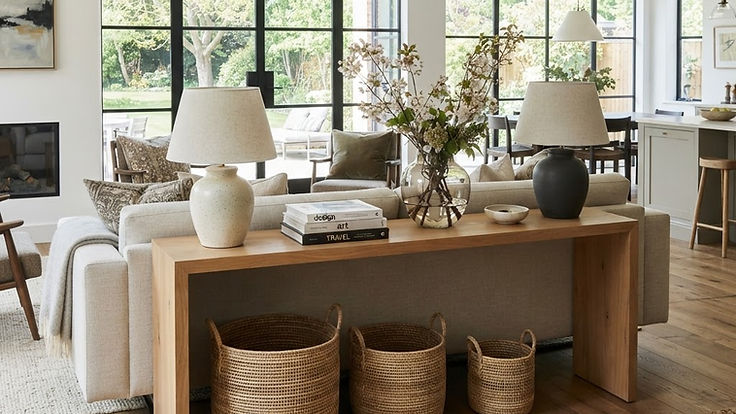
A table behind the sofa is one of the most useful pieces of furniture you can add to a living room, and one of the most underrated. It gives a floating sofa a finished back, puts lamps exactly where you need them, adds storage, divides an open plan space and can even become a compact desk or breakfast bar. Get the size wrong, though, and it looks awkward, blocks the walkway or sits higher than the sofa.
In this guide I'll explain exactly how to choose a sofa table to go behind your couch, with the right height, length and depth, how much space you need, which style suits your room, 20 ideas for using and styling one, the best options for sofas against a wall, and the mistakes I see most often.
What Is a Sofa Table?
A sofa table is a long, narrow table designed to sit behind a sofa, usually tight against its back. It's also called a couch table, a behind the couch table or a console table behind the sofa. Console tables and sofa tables are very similar; the difference is mostly where they go. A console table usually sits against a wall in a hallway or living room, while a sofa table is sized to sit behind a sofa, so its height and length are chosen to match it.
| Question | Quick answer |
|---|---|
| Where does it go? | Directly behind the sofa, usually touching or within a few centimetres of it |
| How tall? | Level with the back of the sofa, or up to about 5cm (2in) lower |
| How long? | Shorter than the sofa, usually about two thirds to three quarters of its length |
| How deep? | Usually 25 to 45cm (10 to 18in); 15 to 25cm for tight spaces |
| What is it for? | Lamps, storage, display, a desk, a drinks station or dividing an open plan room |
Why Put a Table Behind Your Sofa?
- It finishes a floating sofa. When a sofa sits in the middle of a room, the back can look unfinished. A table gives it a purposeful, furnished look from every angle.
- It brings light to the seating. Lamps on a sofa table light the seating area without trailing cables across the floor from a wall.
- It divides open plan spaces. In a kitchen diner or open plan living room, a sofa with a table behind it creates a soft boundary between zones without blocking light.
- It adds storage. Shelves, drawers or baskets underneath hold books, blankets, toys and chargers.
- It's a landing spot. Drinks, books, remote controls and phones have somewhere to go when there's no space for side tables.
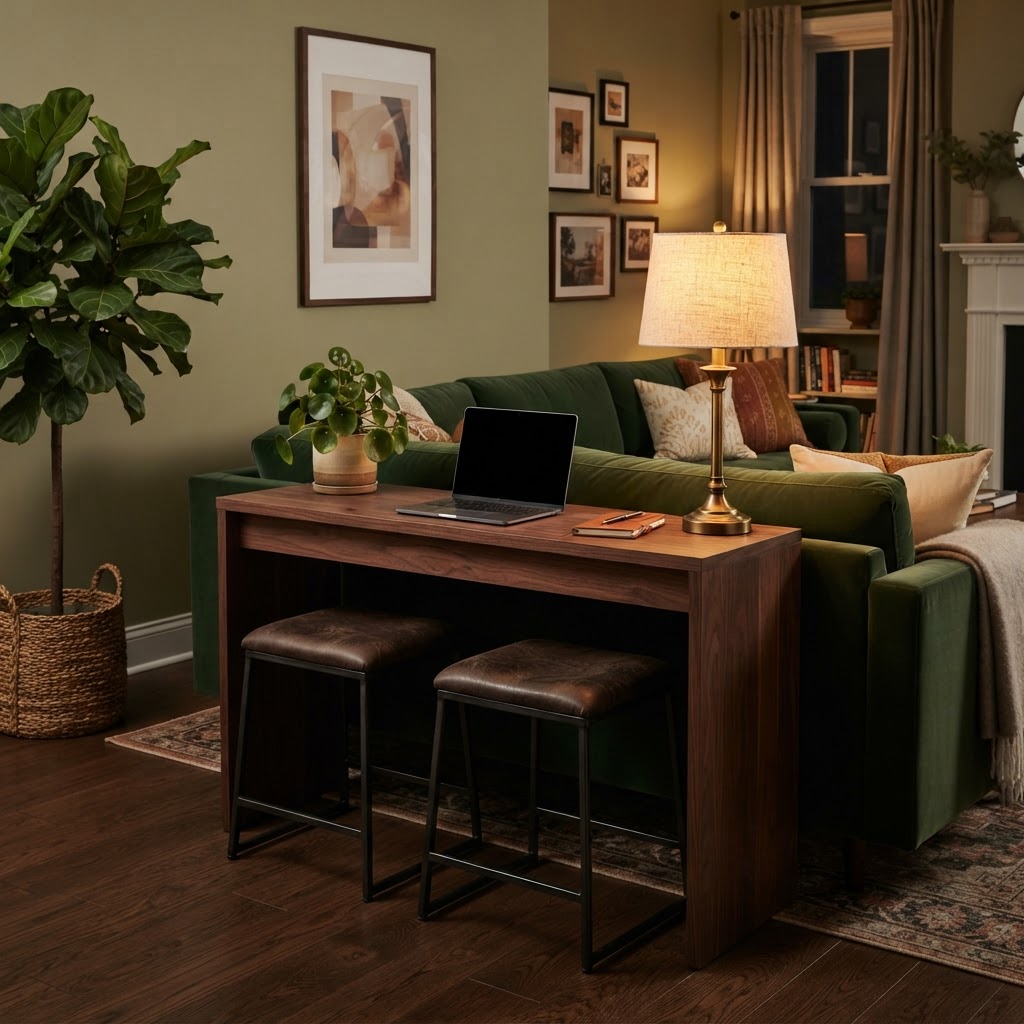
- It can work as a desk. Add a pair of stools and you have a compact workspace or breakfast bar facing the room.
Sofa Table Size Guide
Size is where most people go wrong. These are the measurements I use when planning a room.
| Measurement | The rule | Typical range |
|---|---|---|
| Height | Level with the top of the sofa back, or up to about 5cm (2in) lower | 66 to 81cm (26 to 32in) |
| Length | Shorter than the sofa; about two thirds to three quarters of its length, or around 15cm (6in) shorter at each end | 120 to 180cm (47 to 71in) for most sofas |
| Depth | Deep enough for a lamp base, narrow enough to keep the walkway clear | 25 to 45cm (10 to 18in) |
| Walkway behind | Leave a clear path behind the table | At least 75cm (30in), ideally 90cm (36in) |
| Gap to sofa | Tight to the sofa back, so nothing falls down the gap | 0 to 5cm (0 to 2in) |
How to measure: measure the height of your sofa at the back, not the cushion height, as many sofas have a higher back at the centre than at the ends. Then subtract up to 5cm for your table height. A table that's taller than the sofa back looks top heavy from the seating side and makes lamps feel close to your head; a table that's much lower disappears and lets things slide down the gap.
For low modern sofas, which can have backs as low as 65cm, look for low console tables or have one made to measure. A standard 76cm console table will stand well above a low sofa and look wrong.
How Much Space Do You Need?
Before you buy, check you have room for the table and a comfortable walkway behind it. A sofa table that's 35cm deep, plus 90cm of walkway, needs about 1.25m between the back of the sofa and the nearest wall, kitchen island or furniture. If that's too tight, choose a narrower table, about 20 to 25cm deep, or a slim ledge instead.
In smaller rooms, a narrow table can actually help a layout, because it lets you pull the sofa away from the wall and create a cosier, more defined seating area. There are more space-saving layouts among these small living room ideas.
Choosing the Right Style
| Interior style | Sofa table to look for |
|---|---|
| Scandinavian | Pale oak or ash, simple legs, a lower shelf for baskets |
| Japandi | Low, solid timber with clean lines and rounded edges |
| Industrial | Reclaimed wood top with black steel legs or frame |
| Mid-century modern | Walnut or teak with tapered legs and slim drawers |
| Farmhouse and rustic | Chunky reclaimed pine or oak, trestle or turned legs |
| Contemporary | Marble, travertine, glass or lacquer with a sculptural base |
| Traditional and period | Mahogany or oak with drawers and turned or tapered legs |
| Small spaces | Glass, acrylic or slim metal frames that let light through |
If your living room leans Scandi, a pale oak Scandi console table with a lower shelf for baskets works beautifully behind a sofa. For a raw, urban look, a reclaimed wood and steel piece in true industrial furniture design style is hard wearing and suits leather and velvet sofas alike.
20 Sofa Table Ideas for Behind the Couch
Lighting and display
1. A pair of matching lamps. The classic: one lamp at each end of the table gives symmetry and lights both ends of the sofa. Choose shades that sit above head height when you're seated.
2. One lamp and a tall vase. For a more relaxed look, balance a single lamp at one end with a tall vase of branches or a stack of books at the other.
3. Fresh flowers and branches. A long, low arrangement or a big jug of seasonal branches softens the back of the sofa. As a florist, I love foliage here: eucalyptus, olive or beech last for weeks, and decorating with fresh flowers behind a sofa means you see them from the whole room.
4. A curated book display. Stack books horizontally, top them with a small object, and add bookends at each end for a library feel.
5. Art leaning on the table. If the sofa backs onto a wall, lean a large framed print or mirror on the table rather than hanging it.
Storage
6. Baskets underneath. Woven baskets on a lower shelf hide throws, toys and magazines.
7. Drawers for clutter. A table with slim drawers keeps remote controls, chargers and coasters out of sight.
8. Stools or ottomans tucked under. Two upholstered stools or poufs under the table give extra seating for guests.
9. A charging station. A table with a built-in power strip or a discreet charging tray keeps phones topped up without cables across the sofa.
10. Open shelves for books. A bookcase-style sofa table with two or three shelves doubles as a room divider in open plan spaces.
Function
11. A behind-the-sofa desk. A deeper table at desk height with two stools becomes a small workspace facing the room. Keep the surface clear at the end of the day so it reads as a table again. A table around 74 to 76cm tall matches a standard writing desk, so ordinary stools or chairs fit underneath.
12. A breakfast bar. In a kitchen diner, a counter-height table behind the sofa with bar stools creates a casual eating spot facing the kitchen.
13. A drinks station. A tray with glasses, a decanter and a small ice bucket turns the table into a bar for evenings and parties.
14. A games and puzzle table. Families can use a deeper sofa table for puzzles, homework or board games, with storage underneath.
15. A plant shelf. A sunny spot behind the sofa near a window is perfect for trailing plants and herbs.
Layout
16. Divide an open plan room. Use the sofa and table together to define the living area. Lamps on the table make the zone feel cosy in the evening.
17. A curved table for a curved sofa. Curved sofas need a curved or crescent-shaped table that follows their line.
18. An L-shaped sectional. Run the table along the longest side only, or use a matching corner table behind the junction.
19. Two small tables instead of one. Two slim consoles, one behind each end of a long sofa, can be easier to fit and move than one very long table.
20. A built-in half wall or ledge. In a new build or renovation, a low partition wall with a timber top behind the sofa gives the same function as a table, with sockets built in.
What If Your Sofa Is Against a Wall?
You can still use a table behind a sofa against a wall, as long as you have room to pull the sofa forward.
- Choose a slim ledge. A shelf-style table just 15 to 20cm deep holds a lamp base, a few books and a drink.
- Use a wall-mounted shelf at sofa height instead, which saves floor space completely.
- Keep it shorter than the sofa, so it doesn't stick out at the ends.
- Check the walkway in front, because pulling the sofa forward reduces the space for your coffee table.
The Other "Table on Couch": Sofa Arm and C-Shaped Tables
When people search for a table on a couch, they often mean a different kind of table: one that sits on or over the sofa itself.
| Type | What it is | Best for |
|---|---|---|
| Sofa arm tray | A flat tray or wooden clip-on table that sits on the sofa arm | Drinks and remote controls on wide, flat arms |
| C-shaped table | A side table whose base slides under the sofa so the top hovers over the seat | Laptops and eating on the sofa |
| Sofa shelf | A narrow shelf that slots behind or over the sofa back | Sofas with no room for side tables |
These are great for small flats, studios and rooms without space for side tables, and many of the small studio apartment ideas use them to make one room work harder.
How to Style a Sofa Table
- Anchor both ends. Put the tallest pieces, such as lamps, vases or branches, at the ends.
- Add a middle layer. Books, a tray or a bowl in the centre at a lower height.
- Use odd numbers. Groups of three look more natural than pairs, except for matching lamps.
- Mix textures. Ceramic, glass, wood, metal and something living, like flowers or a plant.
- Leave space. A sofa table should look curated, not crowded; leave at least a third of the surface clear.
- Hide the cables. Run lamp cables down a table leg and under the rug to a floor socket, or use a cable cover.
A practical tip: if you're renovating and plan to float the sofa, ask your electrician to fit a floor socket where the sofa table will go. It's far tidier than running cables under rugs, and much easier to do before the floor goes down.
Rugs and Sofa Tables
The table should sit either fully on the rug or fully off it, not with two legs on and two off, which makes it wobble and look unplanned. In most floating layouts, a rug large enough for the front legs of the sofa to sit on it, with the sofa table just behind on the floor, is the neatest solution. These living room rug ideas include a sizing guide.
Common Mistakes to Avoid
| Mistake | Why it's a problem | What to do instead |
|---|---|---|
| Table taller than the sofa back | Looks top heavy from the seating side | Match the sofa height or go up to 5cm lower |
| Table longer than the sofa | Sticks out and blocks the walkway | Keep it shorter, about two thirds to three quarters of the sofa length |
| Leaving a gap behind the sofa | Things fall down the back | Push the table tight to the sofa |
| Too deep for the space | Narrows the walkway | Choose a 20 to 30cm deep table in tight rooms |
| Cluttered surface | Looks messy from across the room | Edit to a few larger pieces |
| Trailing lamp cables | Trip hazard and untidy | Floor socket, cable covers or cordless lamps |
Frequently Asked Questions
How tall should a sofa table be?
A sofa table should be the same height as the back of your sofa, or up to about 5cm (2in) lower. Most sofa tables are between 66 and 81cm (26 to 32in) tall.
How long should a table behind a couch be?
Shorter than the sofa, usually about two thirds to three quarters of its length, or around 15cm (6in) shorter at each end.
How deep should a sofa table be?
Most are 25 to 45cm (10 to 18in) deep. In narrow rooms or behind a sofa against a wall, choose a slim table or ledge 15 to 25cm deep.
What is the difference between a sofa table and a console table?
They're very similar long, narrow tables. A sofa table is sized and placed to sit behind a sofa, while a console table is usually placed against a wall, often in a hallway.
Should a sofa table touch the sofa?
Yes, ideally. Pushing it tight against the sofa back, or within a few centimetres, stops things falling down the gap and looks more intentional.
Can you put a sofa table behind a sofa against a wall?
Yes. Choose a slim ledge or narrow table 15 to 20cm deep and pull the sofa forward, as long as you still have enough space in front of it.
What do you put on a sofa table?
Lamps, books, a vase of flowers or branches, a tray, a plant and a few personal objects. Keep it simple and leave some surface clear.
Can a sofa table be used as a desk?
Yes. Choose a slightly deeper table at around desk height and add stools that tuck underneath, so it works as a compact workspace facing the room.
Finish Your Sofa With Purpose
A well chosen sofa table makes a floating sofa look finished, brings light and storage exactly where you need them, and can quietly double as a desk or bar. Measure carefully, keep it at or just below the sofa back, and style it simply.
For more living room inspiration, explore the interior design section, and if you'd like help planning your living room layout, you can book a one-hour online interior design consultation with me.
About the author
Magda Callery is a UK interior designer and florist with more than 15 years' experience designing homes, pubs, restaurants and bars, and her expert commentary has featured in Homes & Gardens, The Mirror and The Spruce. Explore more of the interior design articles.
Continue reading

Sage Green Kitchen Cabinets: Paint Colours and Ideas
A designer's guide to sage green kitchen cabinets: the best sage paint colours, what worktops, handles, walls and floors to pair them with, 10 kitchen ideas, how to paint your cabinets properly, rough costs and mistakes to avoid.

Tongue and Groove Ceiling: Ideas and How to Install
Everything you need to know about tongue and groove ceilings: how they differ from shiplap and beadboard, materials and profiles, 15 ideas, rough UK costs, the fire safety rules many guides miss, and a step by step installation guide.

What Is a Manor House? History, Features and Style
What is a manor house? A UK interior designer explains the history of the manor house, its key features, how it differs from castles, country houses and stately homes, famous examples to visit, lordship titles today and how to get the manor house look at home.