
Handleless Kitchen Ideas: Types, Pros and Cons
An interior designer's guide to handleless kitchens: true handleless vs J-pull vs push-to-open, handleless doors and cabinets, handleless shaker kitchens, costs, pros and cons, and 21 ideas.
By Magda Callery, interior designer and florist
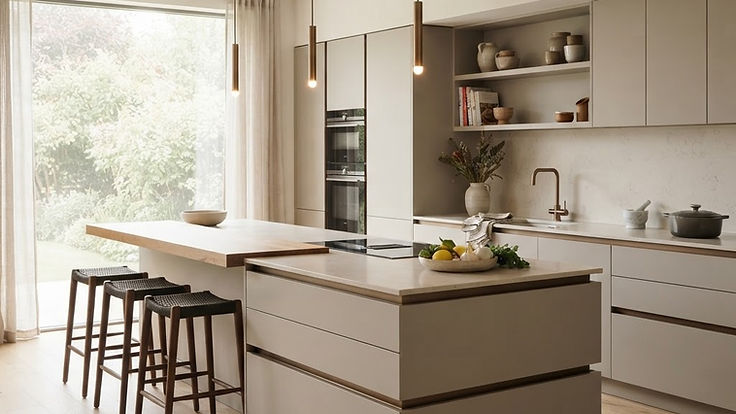
A handleless kitchen is one of the simplest ways to make a kitchen look calm, modern and expensive. Without rows of handles breaking up the cabinetry, the doors read as clean, continuous planes, and the room feels bigger and quieter. But "handleless" can mean several quite different things, and the choice you make affects cost, cleaning and everyday use as much as looks.
As an interior designer, it's one of the questions clients ask me most when planning a new kitchen. In this guide I'll explain what a handleless kitchen is, the difference between true handleless, J-pull and push-to-open, what to know about handleless doors and cabinets, the honest pros and cons, 21 handleless kitchen ideas, including handleless shaker kitchens, and whether the look is going out of fashion.
What Is a Handleless Kitchen?
A handleless kitchen is a kitchen with no visible handles or knobs on the cabinet doors and drawers. Instead, you open them using a recessed channel, a groove shaped into the door, or a push-to-open mechanism hidden inside the cabinet. The result is a sleek, uninterrupted run of cabinetry.
Handleless kitchens became popular with the rise of minimalist, Scandinavian and German-style kitchens, but they're no longer only for ultra-modern homes. Today you'll find handleless shaker kitchens, handleless kitchens in warm wood veneers and handleless designs in soft, earthy colours.
Types of Handleless Kitchen
| Type | How it works | Look | Cost | Best for |
|---|---|---|---|---|
| True handleless (rail or channel system) | A continuous recessed metal channel built into the cabinet frame, between doors and drawers | Very sleek, with crisp horizontal and vertical lines | Usually the most expensive | Contemporary kitchens, islands, long runs |
| J-pull | A J-shaped groove routed into the top or side edge of each door | Clean, with a slim shadow line along each door | Usually more affordable | Budget-friendly modern kitchens, small kitchens |
| Push-to-open | A mechanism inside the cabinet pops the door or drawer open when you press it | Completely flat, no grooves at all | Mid to high, depending on the mechanism | Tall larders, wall cabinets, utility rooms |
| Integrated finger pull or cut-out | A small cut-out or finger grip shaped into the edge of the door | Subtle, often with a contrasting edge | Varies | Plywood, shaker and Scandi-style kitchens |
| Electric opening | A small motor opens drawers or doors at a light touch | Completely flat | The most expensive | Heavy pan drawers, bins and lift-up wall cabinets |
True handleless
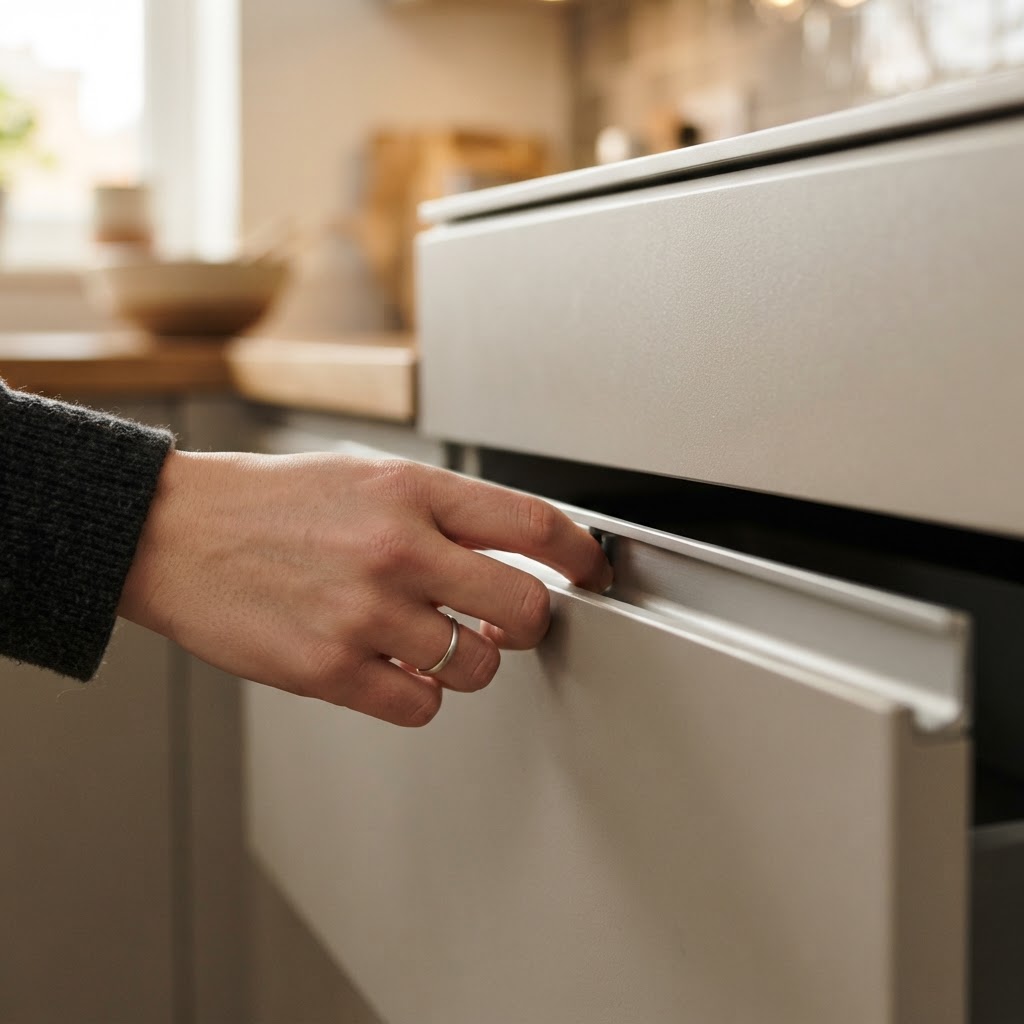
A true handleless kitchen has an aluminium channel, or rail, fitted into the carcass itself, usually just below the worktop and between rows of drawers. You slip your fingers into the channel to open the door or drawer below. Because the channel runs the full length of the cabinets, it creates strong, continuous lines that look beautiful on an island or a long run of units. The channel is often finished to match the doors, or in a contrasting metal such as black, bronze or stainless steel.
J-pull
A J-pull kitchen has a groove shaped into the door itself, usually along the top edge of base units and the bottom edge of wall units. From a distance it looks handleless; up close you'll see a slim shadow line on each door rather than a continuous rail. J-pull kitchens are usually cheaper than true handleless, because the cabinets themselves don't need special channels.
Push-to-open
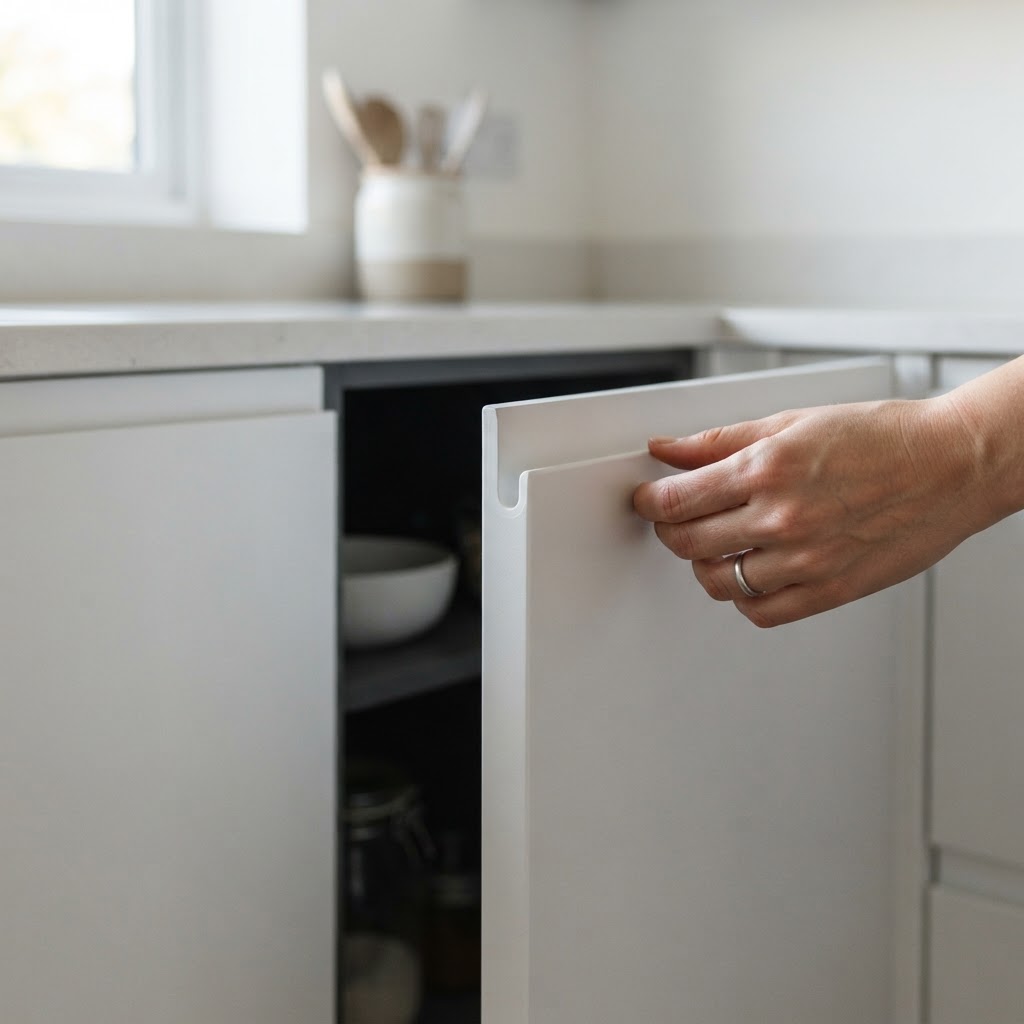
Push-to-open doors and drawers have no grooves at all. A hidden mechanism inside the cabinet springs the door open when you press the front. Hardware maker Blum, whose handleless furniture systems are widely used in kitchens, offers both a mechanical option and an electrical one: "The TIP-ON mechanical opening system allows you to implement handle-less furniture throughout the home", while with its SERVO-DRIVE system, "Handle-less furniture opens at a single touch."
Push-to-open is ideal for tall larder doors and wall cabinets. Many designers prefer a channel or J-pull for base drawers, which can be nudged open accidentally by a knee or a hip if they're push-to-open.
Handleless Kitchen Doors and Cabinets: What to Know
- Door finishes. Matt lacquer, supermatt laminate, painted timber and wood veneers are all popular. Supermatt finishes with anti-fingerprint coatings are easiest to live with.
- Gaps and alignment. Handleless kitchens rely on crisp, even gaps between doors, so good fitting matters even more than with a handled kitchen.
- Integrated appliances. Check that your dishwasher, fridge and freezer can be opened without a handle. Some integrated dishwashers have a push-to-open or knock-to-open function, while others need a channel or a J-pull door.
- Tall units. On floor-to-ceiling cabinets, think about how you'll reach the opening. A vertical channel, a recess at a comfortable height or push-to-open usually works best.
- Corners. Corner units and blind corners need careful planning so doors can open without catching.
- Soft close. Make sure push-to-open mechanisms are paired with soft-close hardware, so doors and drawers close gently.
Pros and Cons of a Handleless Kitchen
| Pros | Cons |
|---|---|
| Clean, calm, uncluttered look | Doors and edges get fingerprints and need more wiping |
| Makes small kitchens feel bigger | Usually costs more than a kitchen with handles, especially true handleless |
| No handles to catch clothes or bump hips | Can be harder to open for people with limited grip or mobility |
| Easy to wipe flat fronts, with no handles to clean around | Push-to-open drawers can open accidentally |
| Works with modern, Scandi, Japandi and even shaker styles | Mechanisms can need adjusting or replacing over time |
| Timeless, architectural lines | Fitting has to be precise, or uneven gaps show |
Are Handleless Kitchens a Good Idea?
For most people, yes, as long as you choose the right type for how you use your kitchen. They're a great choice if you love a calm, minimal look, have a small or open-plan space, or want your kitchen to blend into a living area.
They're less ideal if anyone in the household has arthritis or a weak grip, as a handle can be easier to use than a narrow channel. Busy family kitchens with lots of sticky fingers may also prefer a supermatt anti-fingerprint finish, or a J-pull or channel design rather than push-to-open, which means touching the door fronts every time.
Are Handleless Kitchens Going Out of Fashion?
Not really. Handleless kitchens have become a classic of modern design rather than a passing trend. What has changed is the style around them: the cold, glossy white handleless kitchens of the 2010s have given way to warmer, softer versions in supermatt finishes, wood veneers and earthy colours such as greige, sage, olive and deep green.
The other big shift is that handles are back as a design feature in many kitchens, especially shaker and heritage styles, where beautiful brass or leather pulls are part of the look. So rather than going out of fashion, handleless has become one of two equally good choices. If you want a kitchen that will still feel current in ten years, choose a warm, matt finish and a simple design rather than high gloss.
21 Handleless Kitchen Ideas
Colours and finishes
1. Warm greige. Soft cashmere and greige handleless doors are calm and timeless, and they suit both period and modern homes. A warm neutral like Edgecomb Gray on the walls finishes the look.
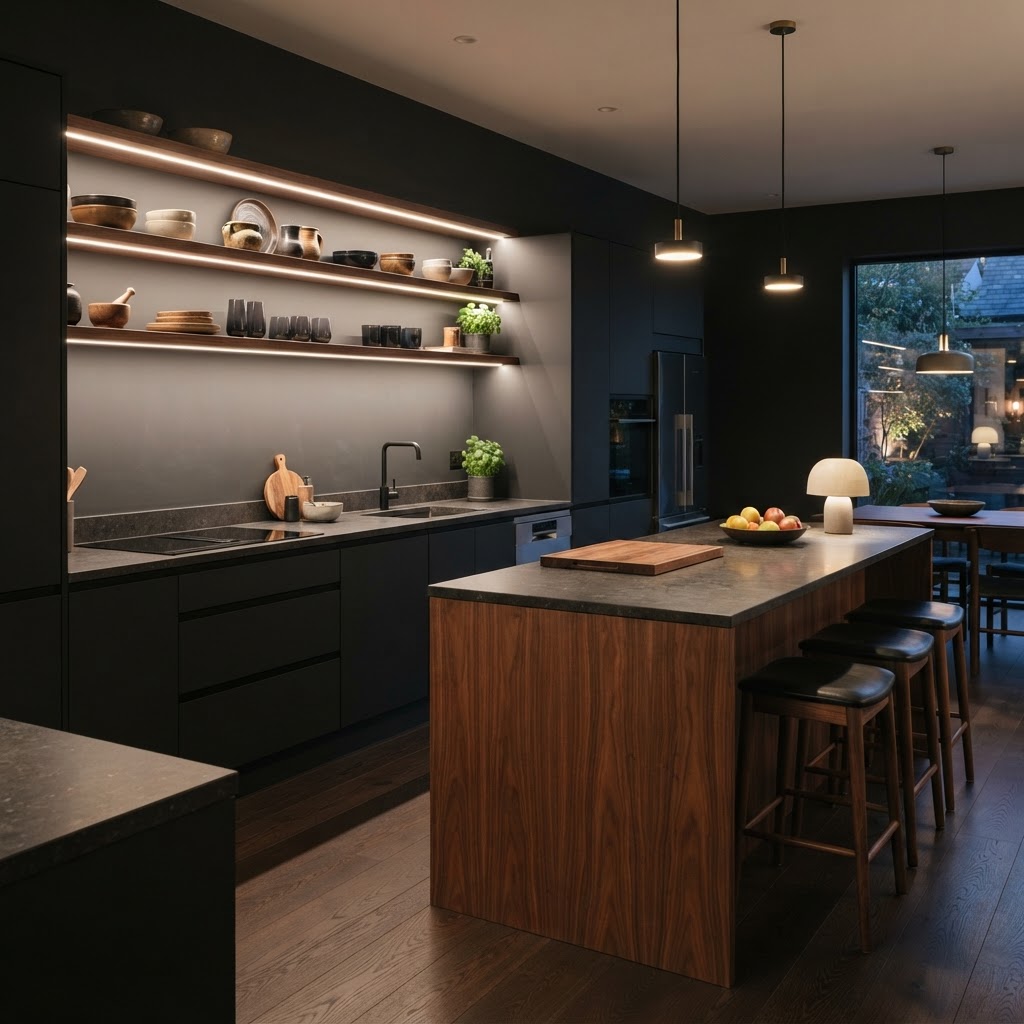
2. Black matt. A true handleless black matt kitchen is dramatic and sophisticated. Balance it with warm wood, such as a walnut island or open shelves, and soft lighting so it doesn't feel cold.
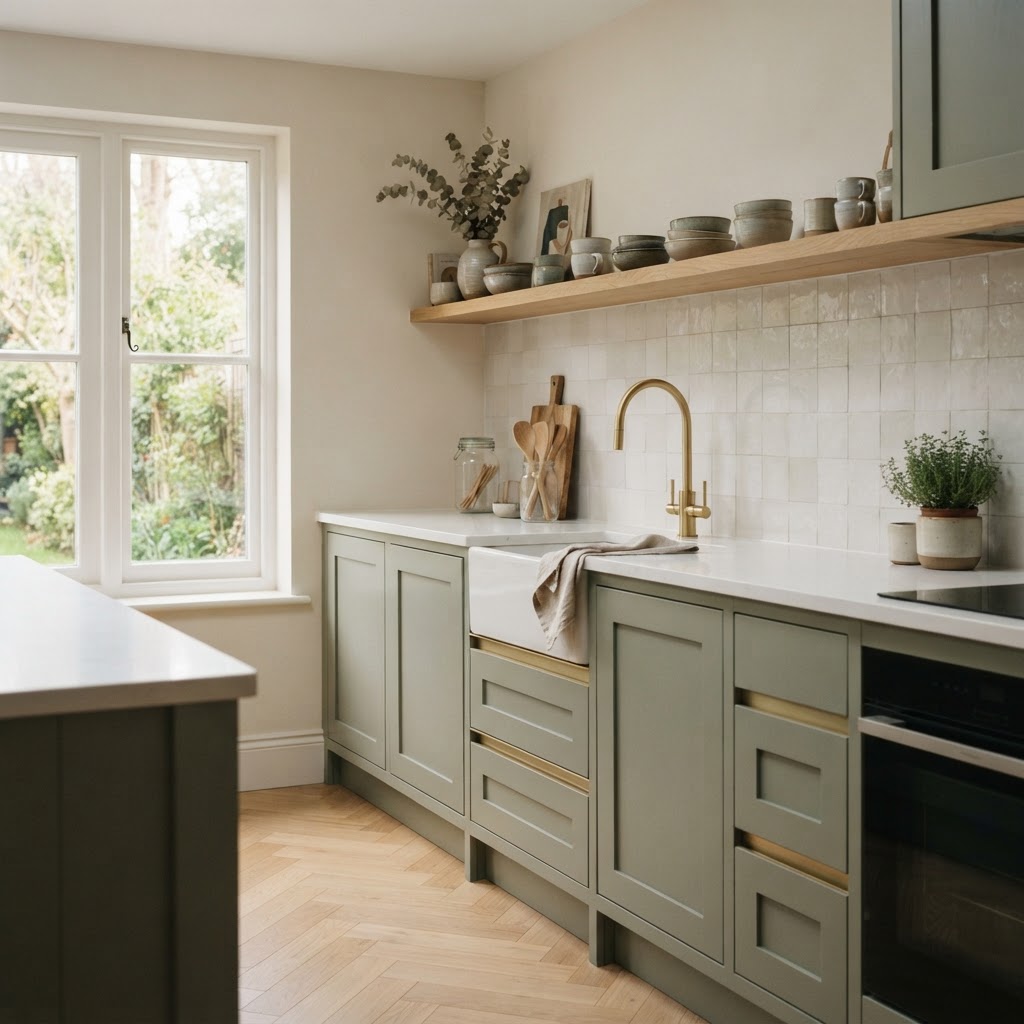
3. Sage and soft green. Green handleless doors feel fresh and natural. Soft sage green kitchen cabinets look lovely with brass channels and pale stone.
4. Deep olive or forest green. Richer greens such as olive green feel cosy and grown up, especially with oak worktops.
5. Inky blue. Navy or ink blue handleless cabinets look elegant with white worktops and brass details. A shade like Dulux Ink Well is a good reference if you're matching paint to the doors.
6. Wood veneer. Oak, walnut or ash veneer doors make a handleless kitchen feel warm and natural rather than clinical.
7. Soft white. If you love white, choose a warm, soft white in a matt finish rather than brilliant gloss white. The undertones that work on walls apply to cabinets too, so it's worth comparing these white paint colours first.
8. Two-tone. Combine dark base units with lighter wall units, or a coloured island with neutral perimeter cabinets.
Handleless shaker kitchens
9. Shaker doors with a channel. A handleless shaker kitchen combines the framed doors of a classic shaker kitchen with a slim integrated rail or channel. It's the perfect balance of traditional and modern.
10. Shaker with J-pull. Some shaker doors have a J-pull shaped into the top rail of the frame, so the classic look stays intact.
11. Painted shaker in a heritage colour. Sage, olive, stone or navy shaker doors with a brass channel feel classic and fresh.
Layouts and details
12. A handleless island. Long, uninterrupted channels look especially striking on an island. Add a contrasting worktop, such as oak on a painted island.
13. Contrasting channels. Choose a channel finish that contrasts with the doors, such as bronze on greige or black on oak, to turn the lines into a design feature.
14. Colour-matched channels. For the most seamless look, match the channel to the door colour so it almost disappears.
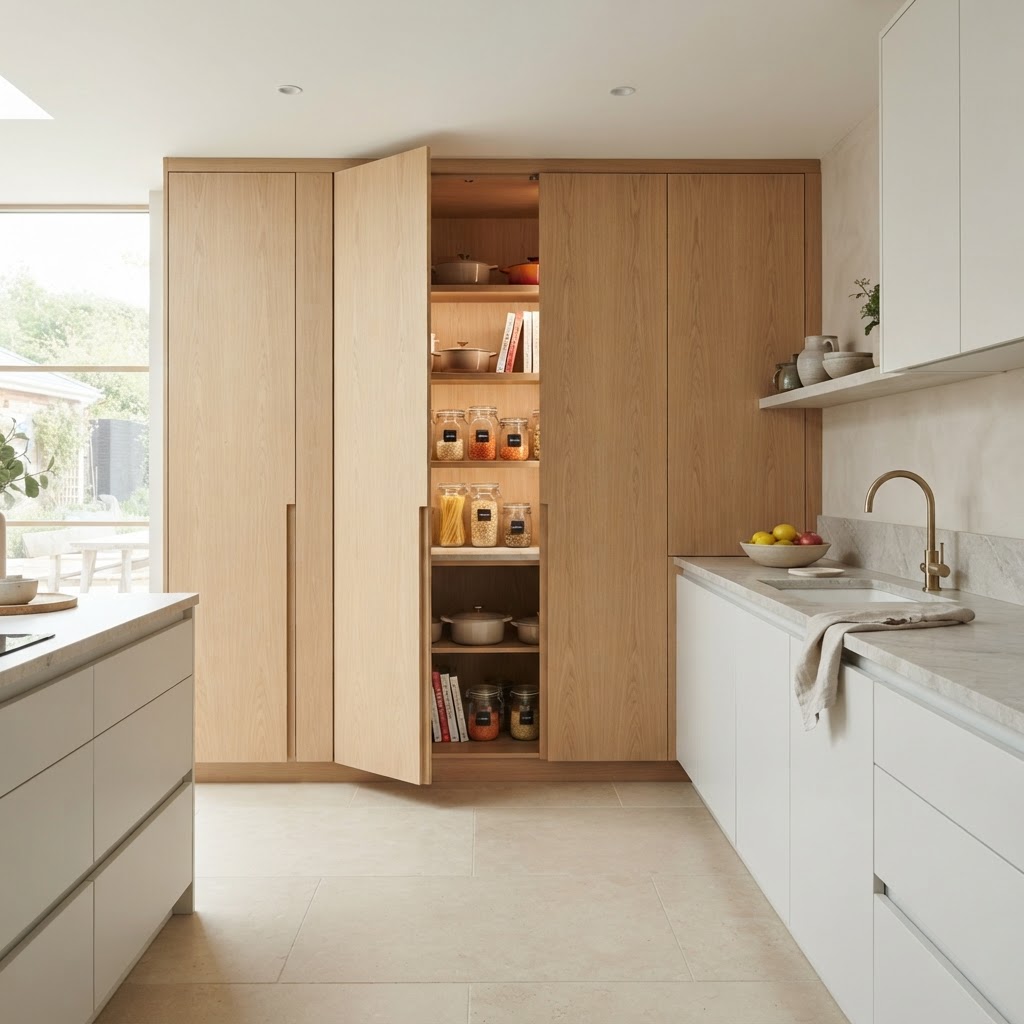
15. Floor-to-ceiling tall units. A wall of handleless tall cabinets, with a hidden larder, fridge and oven housing, looks like a piece of architecture rather than a kitchen.
16. A hidden pantry. Push-to-open doors on a tall larder keep everything tucked away. Organise the inside with pull-out drawers and baskets, using the same zones as when you organise kitchen drawers.
17. Open shelving for contrast. A few open oak shelves break up a long run of flat doors and give you somewhere to display pretty ceramics, such as hand-stamped Boleslawiec pottery.
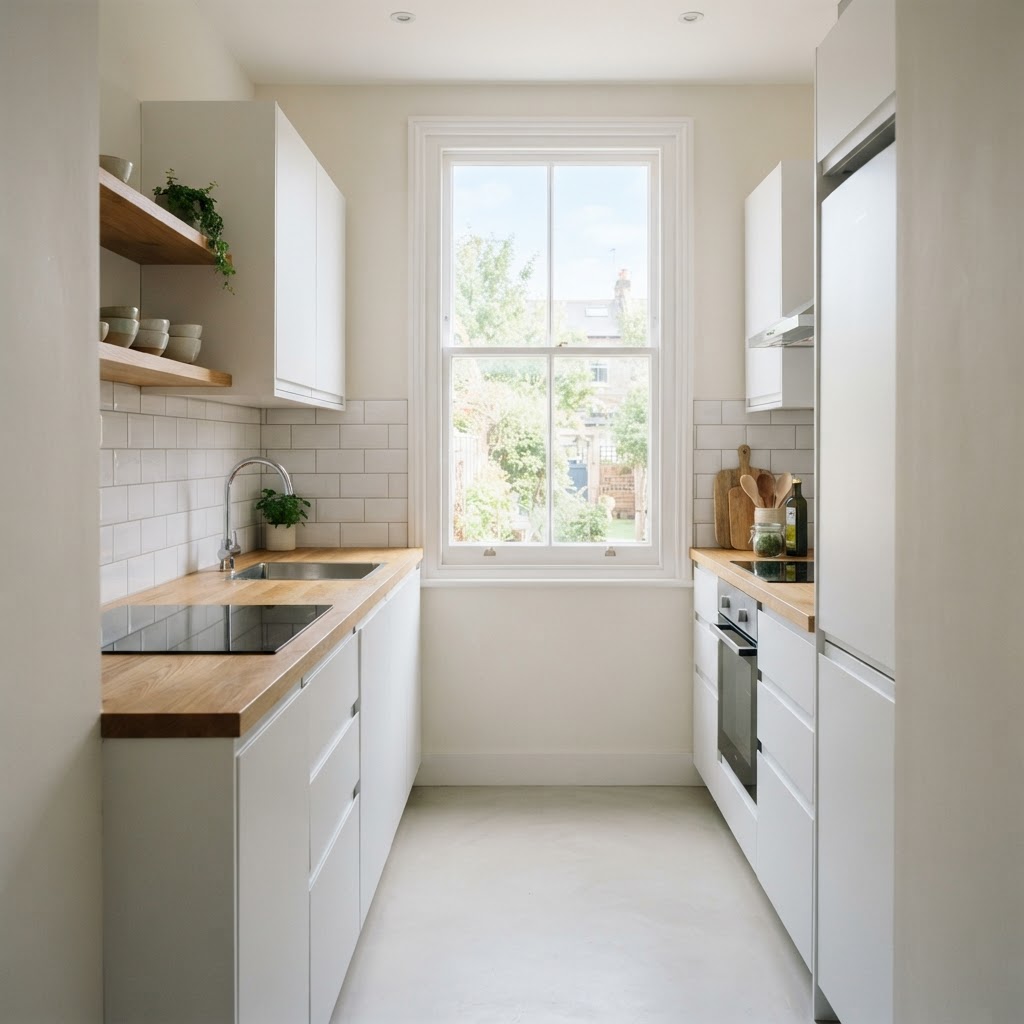
18. A handleless small kitchen. In a galley or a small studio apartment, handleless doors stop the space feeling cluttered and avoid bruised hips in narrow walkways.
19. Japandi minimalism. Pale oak, warm white and a low, simple island create a calm Japandi-style handleless kitchen, echoing the natural materials of Japanese house design.
20. Handleless utility room. Carry the same handleless doors into a utility room or boot room so the whole ground floor flows.
21. Under-cabinet and channel lighting. LED strips under wall cabinets or inside the channels themselves add a soft glow and highlight the clean lines in the evening.
How Much Does a Handleless Kitchen Cost?
Prices vary enormously with size, door finish, worktops and appliances, so get several quotes. As a rough guide:
- J-pull is usually the most affordable way to get the handleless look.
- True handleless usually costs more, because the cabinets need integrated channels and precise fitting.
- Push-to-open adds the cost of mechanisms for each door and drawer.
- Electric opening is the most expensive option and is often used only for a few heavy drawers or lift-up wall units.
How to Keep a Handleless Kitchen Clean
- Choose a supermatt or anti-fingerprint finish if you're worried about marks.
- Wipe doors with a soft microfibre cloth and warm water with a drop of washing-up liquid, then dry them.
- Avoid abrasive cleaners and scourers, which can polish or scratch matt finishes.
- Clean the channels regularly, as crumbs and dust can collect in the rails.
- Use the channel or groove, not the door face, wherever possible, to keep fingerprints to a minimum.
Common Mistakes to Avoid
| Mistake | Why it's a problem | What to do instead |
|---|---|---|
| Push-to-open on every drawer | Drawers open when you lean on them | Use a channel or J-pull for base drawers |
| Forgetting the dishwasher | Some integrated dishwashers can't open without a handle | Check the appliance before ordering doors |
| High gloss in a busy family kitchen | Shows every fingerprint and smear | Choose a supermatt anti-fingerprint finish |
| Ignoring tall units | Hard to reach the opening on tall doors | Plan vertical channels, recesses or push-to-open |
| Cold, all-white design | Can feel clinical | Add wood, texture and warm lighting |
| Rushed fitting | Uneven gaps are very noticeable | Use an experienced fitter and check alignment |
Frequently Asked Questions
What is a handleless kitchen?
A handleless kitchen has no visible handles on its doors and drawers. Instead, they open using a recessed channel, a groove shaped into the door (J-pull) or a push-to-open mechanism.
What is the difference between true handleless and J-pull?
True handleless kitchens have a continuous metal channel built into the cabinets between the doors and drawers. J-pull kitchens have a groove shaped into the edge of each door. True handleless gives crisper lines but usually costs more.
Are handleless kitchens a good idea?
Yes, for most homes. They look clean and modern and suit small spaces. Choose a supermatt finish to reduce fingerprints, and consider handles if anyone in the household finds narrow grips difficult.
Are handleless kitchens going out of fashion?
No. They've become a modern classic. The trend has moved from glossy white to warmer matt finishes, wood veneers and earthy colours, which keeps handleless kitchens looking current.
Are handleless kitchens more expensive?
Usually, yes. J-pull is the most affordable handleless option, while true handleless rail systems and push-to-open or electric mechanisms cost more.
Can you have a handleless shaker kitchen?
Yes. Handleless shaker kitchens combine framed shaker doors with a slim channel or a J-pull shaped into the frame, giving a classic look with modern, clean lines.
Do handleless kitchens show fingerprints?
They can, especially with push-to-open doors and dark or glossy finishes. Supermatt anti-fingerprint finishes, wood veneers and lighter colours show marks far less.
A Calm, Clean Kitchen
A handleless kitchen is about more than the absence of handles: it's about creating calm, continuous lines that let the room breathe. Choose the type that suits how you cook and live, pick a warm, matt finish, and balance the sleek lines with wood, texture and good lighting.
For more kitchen ideas, explore the interior design section, and if you're planning a new kitchen and would like help with the layout, colours and finishes, you can book a one-hour online interior design consultation with me.
About the author
Magda Callery is a UK interior designer and florist with more than 15 years' experience designing homes, pubs, restaurants and bars, and her expert commentary has featured in Homes & Gardens, The Mirror and The Spruce. Explore more of the interior design articles.
Continue reading

Polish Architecture: Poland's Most Famous Buildings
From red brick Gothic castles to Zakopane carving, a Polish designer's tour of Polish architecture, its styles, its most famous buildings and how to bring a little of it home.

Pink and Green Room Ideas: 21 Fresh Ways to Style It
21 pink and green room ideas for living rooms, bedrooms, nurseries, kitchens and bathrooms, plus which pinks go with which greens, paint colours to try and how to keep a pink and green room looking grown up.

How to Organize Kitchen Drawers: 19 Clever Ideas
How to organize kitchen drawers in 7 simple steps, which drawer should hold what, the best drawer organizers, and 19 clever ideas for shallow, deep and IKEA kitchen drawers, plus how to keep them tidy for good.